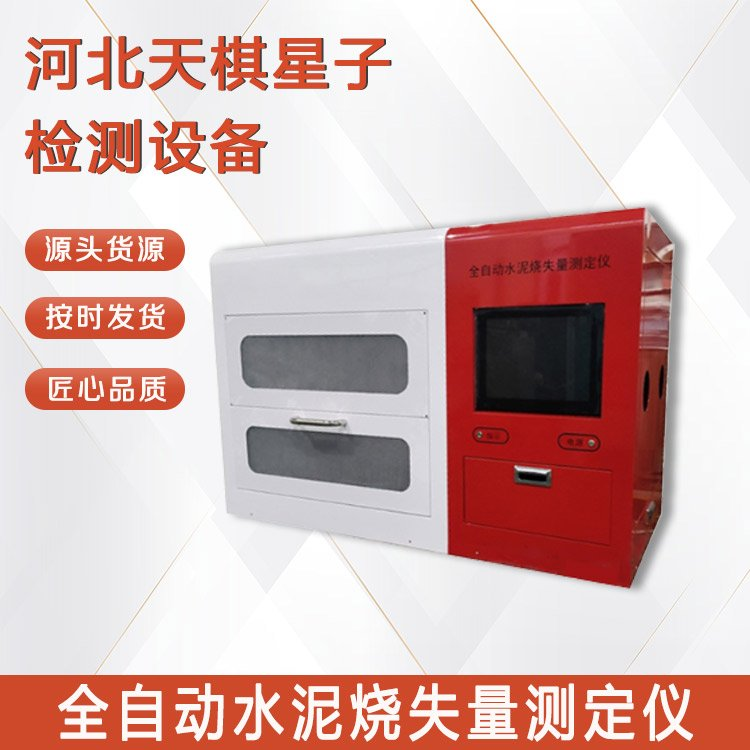
New Product Release: Fully Automatic Cement Loss on Ignition Tester
Recently, our company has launched a fully automatic cement loss on ignition tester. Below is a detailed introduction to this product
1、 Product Introduction
The fully automatic cement loss on ignition measuring instrument is a fully automatic and D-function measuring instrument developed and produced by our company according to the national standard "GB/T176-2017 Methods for Chemical Analysis of Cement". It can measure the loss on ignition of cement, carbon dioxide of cement, ash content of coal, volatile matter of coal, moisture content of coal, and high-temperature burning of substances. Mainly used for fully automatic measurement of loss on ignition of cement raw materials, clinker, and finished products.
2、 Working principle
The fully automatic cement loss on ignition tester shows that the loss on ignition is an important indicator of cement and has a significant impact on its performance; At present, the main method used on the market is muffle furnace heating, with manual measurement by laboratory technicians. The measurement process requires full operation by laboratory technicians: the fully automatic cement loss on ignition measurement system, with automatic heating, rapid cooling, automatic weighing, automatic calculation of results, and automatic completion of the entire measurement process.
3、 Main technical parameters
1. Test quantity: Cement loss on ignition 1-16 pieces, testing time: Classic method 2.5 hours/Rapid method 2 hours.
2. Test quantity: 1-16 pieces of cement carbon dioxide, with a testing time of 4 hours.
3. Test quantity: 1-8 pieces of coal ash content, testing time of 3 hours.
4. Test quantity: 1-16 coal volatiles, testing time of 1 hour.
5. Z high temperature: 1550 ℃.
6. Constant temperature: 960 ℃ or 1200 ℃ (adjustable).
7. Constant temperature accuracy: ± 10 ℃.
4、 Experimental operation steps
1. Sample weighing and loading
1.1 Weigh approximately 1g (J to 0.0001g) of pre treated cement sample using an electronic balance, pour it into a clean sample tray, gently shake it to make the sample evenly spread (to avoid sample accumulation and incomplete burning). 1.2 Place the sample trays loaded with samples in the automatic sample rack of the instrument in order, and record the sample number and corresponding position.
2. Parameter settings
2.1 Open the instrument operation software and enter the sample information (number, quality, etc.). 2.2 Setting burning parameters: heating rate (recommended 5~10 ℃/min), target burning temperature (cement loss on ignition measurement is usually 950~1000 ℃), holding time (usually 30~60 minutes to ensure the complete release of volatile components W), cooling method (natural cooling or programmed cooling, weighing after cooling to room temperature).
3. Start the experiment
After confirming that the parameter settings are correct, click the "Start" button, and the instrument will automatically execute the following process:
3.1 Automatically feed the sample tray into the furnace; 3.2 Heat up to the target temperature at the set rate and maintain the set time; After the burning is completed, automatically remove the sample tray to the cooling zone and cool it to room temperature according to the program; After cooling is completed, automatically weigh the residual sample mass and record the data.
4. Result calculation and recording
4.1 The instrument automatically calculates the loss on ignition based on the formula: Loss on ignition (%)=(mass of sample before ignition - mass of sample after ignition)/mass of sample before ignition × 100. 4.2 Print or export test data, record sample number, weighing data, loss on ignition results, and test date.
5、 Maintenance and upkeep
1. Cleaning treatment
1.1 Use a soft bristled brush to clean the residual sample powder in the furnace, avoiding the accumulation of impurities that may affect temperature control accuracy or contaminate subsequent samples; If there are stubborn stains, they can be wiped with anhydrous ethanol and dried. 1.2 Cleaning the sample tray: Immediately rinse with deionized water after use. If there are burn residue attachments, soak in dilute nitric acid for 30 minutes, then wash and dry (avoid scratching with hard objects to prevent damage to the sample tray). 1.3 Wipe the surface and operation panel of the instrument to remove dust and stains; Clean the sample rack track to ensure smooth transmission.
2. Component inspection
2.1 Check if there are any foreign objects blocking the sample transfer mechanism (such as guide rails and motors), and clean them up in a timely manner if necessary; Observe whether the drive belt or chain is loose, and adjust the tension if necessary. 2.2 Check if the cooling fan is running properly to ensure good heat dissipation; Confirm that the power and data cable interfaces are not loose or oxidized, and wipe them with a dry cloth if necessary.
VI. Summary
To learn more about product details, please feel free to contact the staff of Hebei Tianqi Xingzi Testing Equipment Co., Ltd. at any time.