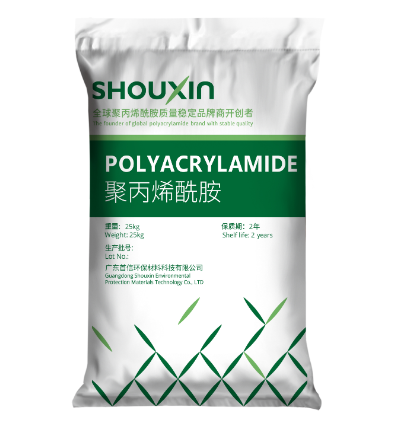
Which polyacrylamide brands from china are reputable ?
Overview of major polyacrylamide manufacturers in China: 10 brands worth paying attention to09,21,2026 8 views


On August 22, 2025, the 4th Hyperspectral Imaging Application Seminar (Northern Station) hosted by Jiangsu Shuangli Hepu Technology Co., Ltd. came to a successful conclusion.The core theme of this forum is "Innovation and Application of Hyperspectral Imaging Technology", focusing on the innovative application of hyperspectral imaging technology in agriculture, environmental monitoring, smart forestry and other fields, promoting the technology from laboratory to industrialization. The atmosphere on site was lively, with participants colliding ideas and discussing together how to empower development with technology. Now, let's review the exciting moments of the meeting together!
Experts gather to explore the forefront of technology together
Professor Yu Fenghua from Shenyang Agricultural University brings a report on the construction of a radiation transfer model for rice leaves based on optical property layering and real structure. The report focuses on the fact that most radiation transfer models currently dominated by the PROSPECT model are based on the assumption that the interior of the leaf is turbid and homogeneous, ignoring the influence of the true structure inside the leaf on the leaf spectrum. Additionally, there exists a structural parameter (N) that cannot be measured, which limits the explanatory power of radiation transfer models for the interaction mechanism between light and vegetation. This study proposes the hypothesis of heterogeneous distribution inside the leaves and constructs a PIOSL model containing two layers of optical properties. By simulating the spectra of plant leaves from a publicly available dataset, the superiority of the PIOSL model in simulating reflectance is verified, and it further demonstrates the layered structure inside the leaves. In order to explore the relationship between N and the true anatomical structure of rice leaves, this study established the relationship between leaf anatomical features and spectral features through the eLeaf model. The RSPECT model was developed by replacing N in the PROSPECT model with measurable leaf anatomical parameters. The proposal of the RSPECT model provides a new framework for improving radiative transfer models for other vegetation types.
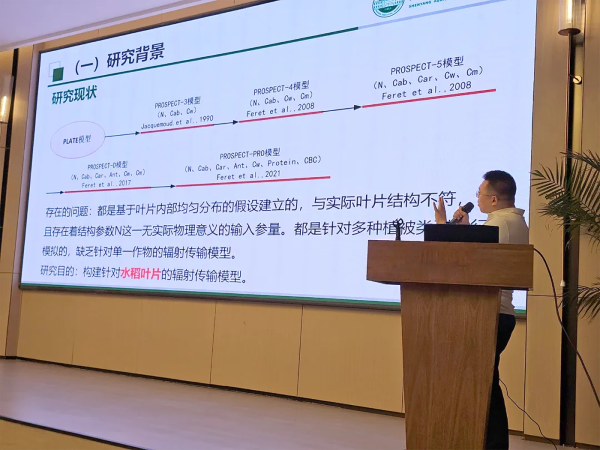
▲Professor Yu Fenghua from Shenyang Agricultural University
Professor Li Zhaokui from Shenyang University of Aeronautics and Astronautics brings a report on the research of open domain adaptive classification methods for hyperspectral images. The report mainly explains that hyperspectral image classification is widely used in fields such as environmental monitoring and precision agriculture, but the problems of spectral shift and unknown target domain categories faced when applied across different scenarios seriously restrict the model's generalization ability. The traditional domain adaptation method assumes that the source domain and the target domain share the same category. Directly aligning domains will result in negative transfer and cannot effectively handle unknown categories in the target domain. This study proposes two open set domain adaptation methods to address this challenge: the WGDT method constructs a metric space through a class anchor strategy, implements weighted domain adversarial learning using reliability weights, and uses dynamic thresholding to separate known and unknown classes; The PWDA method dynamically adjusts neighborhood weights through pixel aware weight learning to reduce feature bias, and adopts a decoupling dual alignment strategy to process known and unknown class features separately. The experimental results of multiple cross scene hyperspectral datasets show that the proposed method significantly outperforms existing open set domain adaptation algorithms in both known class discrimination and unknown class recognition performance, providing an effective technical solution for solving practical cross scene hyperspectral image classification problems.
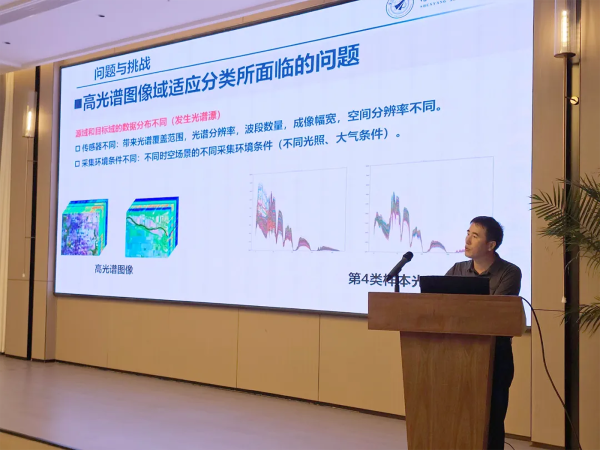
▲Professor Li Zhaokui from Shenyang University of Aeronautics and Astronautics
Professor Jiang Hong from People's Public Security University of China brings a report on the application of hyperspectral imaging technology in forensic science. The report mainly introduces that hyperspectral imaging technology integrates image and spectral information (spectrum integration), which can obtain both one-dimensional spectral information and two-dimensional spatial information of the tested sample. Enriched the information dimension and improved the detection and recognition ability. Hyperspectral imaging technology has a wide range of applications in the field of forensic science. This article mainly introduces the application of hyperspectral imaging technology in forensic science from the following three aspects: firstly, using hyperspectral imaging technology to examine trace evidence; 2、 Using hyperspectral imaging technology to inspect traditional Chinese medicinal materials; 3、 Using hyperspectral imaging technology to detect foodborne pathogens.

▲Professor Jiang Hong from People's Public Security University of China
Associate Professor Yu Haoyang from Dalian Maritime University brings a report on the research of underwater target spectral restoration method based on Gaiafield imaging system. This report mainly introduces the important application value of underwater spectral detection in marine resource exploration, ecological monitoring and other fields. However, due to the scattering and absorption effects of water bodies, the target reflectance signal has serious distortion. The traditional method of converting the apparent reflectance of reference plates has many limitations in underwater scenarios. This report conducts in-depth analysis based on the underwater imaging process and establishes a correction method for the underwater radiative transfer equation to achieve accurate restoration of target spectral features. The experiment is based on the push scan imaging and nanometer level spectral resolution advantages of the Gaiafield hyperspectral imaging system from Shuangli He Spectral Company. An underwater target spectral restoration system is constructed, and multiple sets of materials are used for testing and verification. The results show that compared with traditional conversion methods, the correction method based on the underwater radiative transfer equation has significant advantages in reflectance restoration tasks, and significantly improves the spectral fidelity of the visible near infrared band. This provides reliable technical support for target recognition and material composition inversion in underwater scenes.
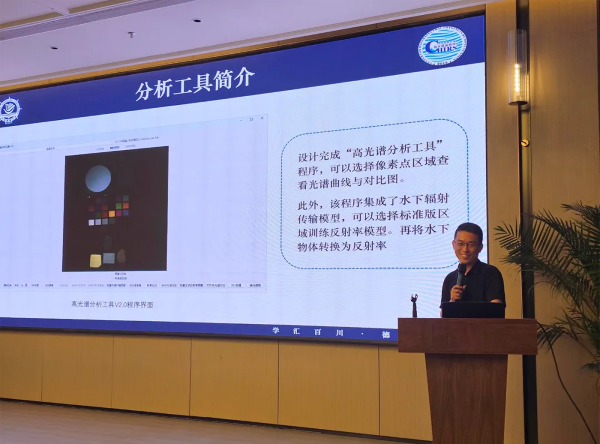
▲Associate Professor Yu Haoyang from Dalian Maritime University
Gong Xuewei, associate researcher of Shenyang Institute of Applied Ecology, Chinese Academy of Sciences, brings the report "Research on Inversion of Water Status of Tree Leaves Based on Hyperspectral Technology". The report describesThe analysis of leaf moisture status is of crucial significance for assessing the degree of drought stress in trees and predicting the risk of forest decline. However, traditional measurement methods require destructive sampling and rely on bulky measuring instruments. It is urgent to develop a non-destructive inversion model for leaf moisture status based on hyperspectral technology to improve the efficiency of measuring tree leaf moisture status. This article introduces the preliminary research results of hyperspectral technology in the inversion of tree leaf moisture status (leaf moisture content and water potential), which has important reference value for smart forestry management under the background of climate warming and drying.

▲Gong Xuewei, Associate Researcher of Shenyang Institute of Applied Ecology, Chinese Academy of Sciences
Zhou Zixiang, an application expert from Wuxi Pu Shi Shi Technology Co., Ltd., brings a report titled "Exploration of the Application of Sky Earth Integration Technology in Smart Agriculture". The report describes that ground sensing, unmanned aerial vehicle remote sensing, and satellite remote sensing are all important components of agricultural information perception technology, each with its own advantages and disadvantages. Through the organic integration of the three technologies, mutual verification and complementarity, a more comprehensive and accurate perception network is formed to better support agricultural information monitoring and change research. The significance of the integration of "sky ground" is mainly reflected in the following aspects: improving data quality, expanding monitoring range, and real-time updating of data. This report focuses on the integration of "sky ground" and conducts in-depth discussions.
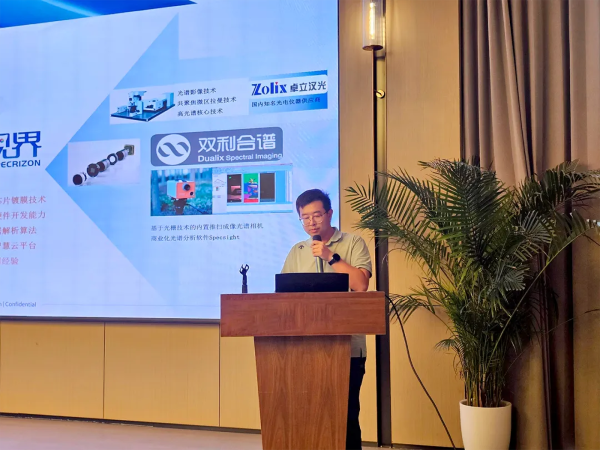
▲Zhou Zixiang, Application Expert at Wuxi Pu Shi Shi Technology Co., Ltd
Instrument training to assist in the implementation of technology
After the expert report in the morning, a special instrument operation training session was held in the afternoon, attracting many users who have purchased instruments and interested teachers and students to participate.
On site, professional after-sales engineers provided meticulous operation training and Q&A guidance. For different models of hyperspectral imaging instruments, engineers have provided detailed explanations and demonstrations on equipment startup, parameter settings, data acquisition, and later data processing and analysis software usage. The attendees actively asked questions and had in-depth exchanges with engineers. Through practical operation, they effectively mastered the skills of instrument use, laying a solid foundation for better application of hyperspectral imaging technology in scientific research and production in the future.
This instrument training is not only about imparting technology, but also a crucial step in promoting hyperspectral imaging technology from theory to practice and from the laboratory to the front line of industry. It enables more people to use advanced instruments and equipment to tap into the enormous potential of hyperspectral imaging technology.

The successful hosting of the 4th Hyperspectral Imaging Application Seminar (Northern Station) in Shenyang has brought cutting-edge technological concepts, practical solutions, and valuable opportunities for communication and cooperation to the industry. I believe that with the joint efforts of numerous experts, scholars, and industry practitioners, hyperspectral imaging technology will achieve breakthroughs and innovations in more fields, providing stronger technological support for the development of many industries such as agriculture, environment, and industry, and promoting related industries to move towards higher levels.
About Shuangli Hepu
Shuangli Hepu is deeply rooted in the field of hyperspectral technology and has created a hyperspectral product matrix covering multiple scenarios with independent research and development capabilities. From unmanned aerial vehicle hyperspectral imaging systems and airborne hyperspectral cameras adapted for aerial operations, to portable hyperspectral spectrometers and analyzers for on-site inspection, to ground observation focused hyperspectral imaging systems, as well as hyperspectral cameras, near-infrared hyperspectral cameras, shortwave infrared hyperspectral, and microscopic hyperspectral imaging systems for specific bands and scenes, it fully meets the precise spectral detection needs of different fields.
These hyperspectral products are widely used in agricultural remote sensing, environmental monitoring, geological exploration, biomedicine, industrial quality inspection and other scenarios. With their core performance of high resolution and sensitivity, they help users efficiently obtain spectral data and mine material composition information. Continuously follow Shuangli Hepu to obtain more updates on hyperspectral products, technological progress, and industry application cases, empowering your scientific research and industrial upgrading with our independently developed hyperspectral technology!
Previous111

Which polyacrylamide brands from china are reputable ?
Overview of major polyacrylamide manufacturers in China: 10 brands worth paying attention to
How to Source Reliable Polyacrylamide from Top Manufacturers and Suppliers
Shouxin Advanced Polymer Sciences provides high-performance polyacrylamide (PAM) solutions for water treatment, mining, pulp and paper, and industrial applications.
Polyacrylamide Manufacturer in China | Shouxin Advanced Polymer Sciences Co., Ltd.
Shouxin Advanced Polymer Sciences Co., Ltd. is a leading polyacrylamide (PAM) brand and global supplier based in China.