-
E-mail
Nov9923@163.com
-
Phone
15965537807
-
Address
South Crossing, 3rd Floor, Area A, Building 14, Instrument and Meter Industrial Park, No. 9009 Qinglongshan Road, High tech Zone, Zibo City, Shandong Province
Zibo Gaimi Measurement and Control System Co., Ltd
The application prospects of near-infrared moisture detection in industrial production
Date: 2025-04-28Read: 2
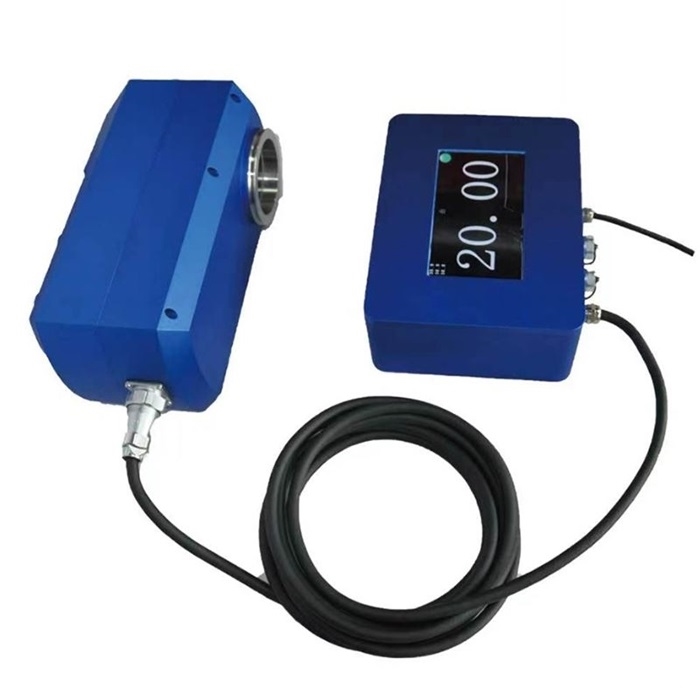
Near infrared moisture detectionTechnology, as a non-destructive analytical method, has been widely applied in multiple fields, especially in industrial production, demonstrating enormous potential. With the continuous development of industrial automation and intelligent manufacturing, how to monitor product quality in real time and accurately has become the key for enterprises to improve production efficiency and product quality. Near infrared spectroscopy technology, with its fast, accurate, and non-destructive characteristics, has become an ideal tool for moisture detection.
1. The principle of near-infrared moisture detection
Near infrared spectroscopy analyzes the composition of materials by measuring their absorption characteristics in the near-infrared region (typically between 700-2500 nanometers). Moisture molecules have specific absorption wavelengths, and near-infrared spectrometers can detect changes in moisture content at these wavelengths. Compared with traditional moisture detection methods, near-infrared moisture detection has the advantages of no sample pretreatment, rapid response, real-time online monitoring, and improved production efficiency.
2. Application areas in industrial production
Near infrared moisture detection technology has been applied in multiple industrial fields, especially in industries such as food, pharmaceuticals, chemicals, and textiles.
-Food industry:Moisture is one of the key factors affecting food quality, and excessive or insufficient moisture content can affect the taste, shelf life, and safety of products. Near infrared moisture detection can monitor the moisture content of food in real-time on the production line, ensuring product consistency and quality. For moisture detection of bread, meat products, dairy products, etc., near-infrared technology has become a routine method.
-Pharmaceutical industry:The precise control of moisture content in the production process of drugs directly affects the stability and bioavailability of the drugs. Traditional moisture detection methods often require longer reaction times and sample pretreatment, while near-infrared spectroscopy technology can quickly and non destructively complete moisture determination, meeting the quality control requirements in large-scale production.
-Chemical industry:The efficiency and product quality of many chemical reactions are closely related to moisture content. In the production process of chemical raw materials such as polymers, coatings, rubber, etc., near-infrared moisture detection can monitor moisture levels in real time, avoiding unstable product quality.
-Textile industry:In the production of textiles, the moisture content of fibers determines the softness, durability, and moisture absorption properties of the product. Near infrared moisture detection can quickly analyze fiber materials and provide data support for quality control in the production process.
3. Future Development Prospects
With the advancement of industrial intelligence, the application of moisture detection technology will become more widespread. On the one hand, with the gradual reduction of equipment costs and the continuous maturity of technology, more and more small and medium-sized enterprises can afford this advanced technology; On the other hand, by combining big data and artificial intelligence analysis methods, near-infrared moisture detection will be able to provide more accurate prediction and control, achieving lean production.
In addition, with the development of miniaturization and convenience of spectroscopic instruments, near-infrared moisture detection is not limited to laboratories or production lines, but can also be applied to rapid on-site detection. For example, some portable near-infrared spectrometers are capable of real-time analysis of raw materials on the production site, providing immediate feedback for industrial production.
Near infrared moisture detection technology, as an efficient, non-destructive, and real-time monitoring tool, has broad application prospects in industrial production. With the continuous advancement of technology and the expansion of application scenarios, it will play an increasingly important role in improving production efficiency, ensuring product quality, and reducing resource waste, providing strong technical support for modern industrial production.