-
E-mail
service@zkray.cn
-
Phone
15922273117
-
Address
3rd Floor, Building 4, Building F, No. 6 Huafeng Road, Huaming High tech Industrial Zone, Dongli District, Tianjin City
Zhongkeruijie (Tianjin) Technology Co., Ltd
Infrared light source
Date: 2025-10-11Read: 5
Infrared(IR radiation sources play a crucial role in spectroscopy, industrial heating, and various scientific applications. Among commonly used infrared light sources, Nernst lamps, Globars, and nickel chromium coils exhibit different characteristics, making them suitable for different application scenarios. This article provides an in-depth analysis of these three types of light sources, discussing their structures, working principles, spectral characteristics, advantages, and limitations, and comparing and evaluating them. It can help everyone choose the appropriate infrared light source for specific applications.
Infrared light sources are key components in infrared spectroscopy, thermal imaging, and heating applications. How to choose a suitable infrared light source mainly depends on factors such as spectral range, efficiency, stability, and durability. Nernst lampGlobar and nickel chromium coils are three widely used light sources, each with unique properties that give them an advantage in specific scenarios. This article aims to analyze the performance of these light sources and provide reference for the selection of light sources in practical applications.
Nernst lamp
Structure and Working Principle
Nernst lamps are made of rare earth oxides such as zirconia Composed of ceramic rods made of ZrO ₂ and yttrium oxide Y ₂ O ∝. At room temperature, the material is non-conductive and requires external preheating
use.Once heated, it will become a conductor and emit infrared radiation. Its working temperature is between 1500 and 2000K, the effective spectral range is within 15um, and the average emissivity between 2 and 15um is 0.66.
advantage
Has high radiation efficiency in the mid infrared region.
At high temperatures(Stable operation at 1500-2000 K.
The aging effect is relatively small after long-term use.
局限性
External preheating is required to start.
Ceramic structures have high brittleness and low mechanical strength.
Easily affected by atmospheric oxidation at high temperatures.
Globar (silicon carbide light source)
Structure and Working Principle
Globar is a rod-shaped resistive heating element made of silicon carbide (SiC). Unlike Nernst lamps, it is conductive at room temperature and does not require preheating. Its working temperature ranges from 1200K to 1400K,
The working temperature can reach 1500k,The radiation is between 8-9 µ m, and the average emissivity in the range of 2-15 µ m is 0.8.
advantage
Start immediately without preheating.
The spectral coverage is wide, extending to the far-infrared region.
Excellent thermal stability and durability.
Strong resistance to chemical corrosion
局限性
because SiC material is brittle and easily broken.
Accurate temperature control is required to maintain spectral consistency.
In near-infrared applications, the efficiency is lower than that of Nernst lamps.
Nickel chromium coil
Structure and Working Principle
Nickel chromium coils are made of nickel chromium(Made of Ni Cr alloy wire, it works as a resistance heating element. When current passes through, it produces infrared radiation with a spectral range of 1 µ m to about 20 µ m, depending on temperature.
advantage
Simple structure and low cost.
High mechanical flexibility and durability.
Excellent antioxidant properties and long service life.
Suitable for applications that require moderate infrared radiation.
局限性
The emissivity of ceramic light sources is lower.
At high temperatures, the efficiency may decrease due to material degradation.
May pose health risks due to nickel exposure.
comparative analysis
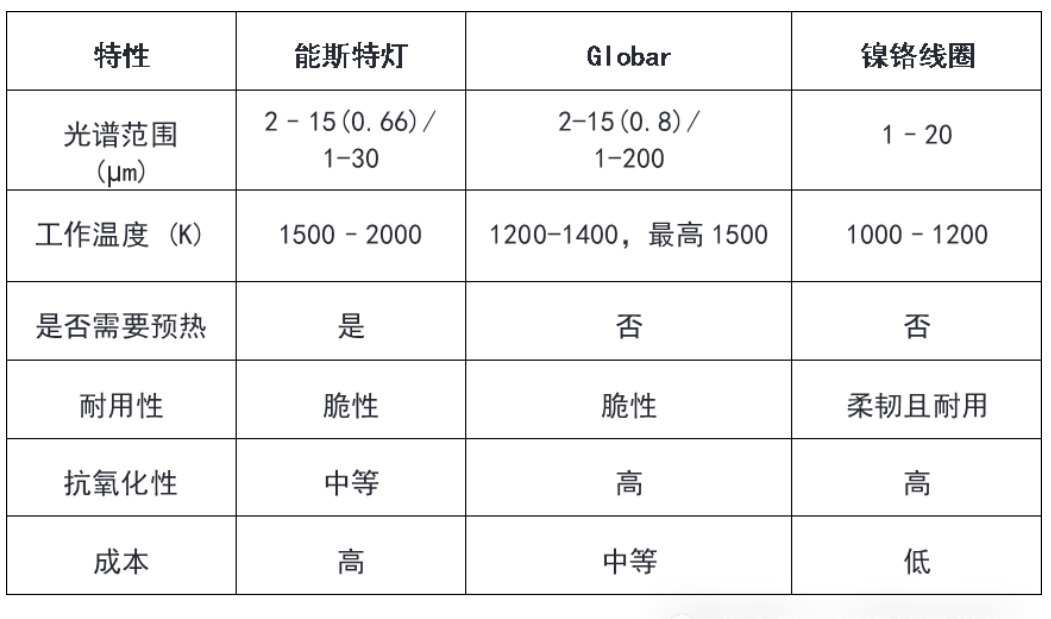
How to choose a suitable infrared light source depends on specific application requirements. Nernst lamps are suitable for applications that require high-intensity mid infrared radiation, but require preheating;Globar provides a wider spectral range, does not require preheating, has excellent chemical corrosion resistance, but has lower mechanical strength; Nickel chromium coils are an affordable and durable choice for general heating applications, but their spectral efficiency is relatively limited. By delving into the characteristics of these three types of light sources, more suitable infrared light sources can be selected for scientific and industrial applications.