-
E-mail
service@zkray.cn
-
Phone
15922273117
-
Address
3rd Floor, Building 4, Building F, No. 6 Huafeng Road, Huaming High tech Industrial Zone, Dongli District, Tianjin City
Zhongkeruijie (Tianjin) Technology Co., Ltd
Application of Microscopic Raman Spectroscopy Technology in Microplastic Analysis
Date: 2025-10-31Read: 2
Microplastics (MPs), as global environmental pollutants, have particle sizes ranging from nanometers to 5 mm, diverse forms, and are prone to adsorb other pollutants to form composite pollution systems. Traditional detection methods generally have limitations such as "morphology composition fragmentation analysis" and "sample destructive processing", which are difficult to meet the multidimensional research needs of microplastics. Micro Raman spectroscopy, with its sub micron spatial resolution, molecular vibration fingerprint recognition ability, and resistance to water interference, has become the core technology for the full chain analysis of microplastics.
1、 Technical principle: sub micron decoding of molecular vibrational fingerprints
The core of micro Raman spectroscopy is to capture the molecular vibration information of microplastics through "photon molecule inelastic scattering", combined with high-resolution optical design to achieve the dual function of "component identification+spatial positioning". Its technical system can be divided into two parts: light scattering mechanism and spectral decoding process.
1.1 Light scattering mechanism and core hardware design
When a specific wavelength laser (commonly 532 nm or 785 nm) is irradiated on microplastics, the photon energy interacts with the molecular vibration energy level, resulting in energy shift (i.e. "Raman shift"). The molecular structure differences of microplastics of different materials will form a unique "Raman fingerprint spectrum" (as shown in Figure 1a). To achieve high-sensitivity detection, the system optimizes performance through three core hardware designs:
·Dual wavelength laser module: 532 nm laser is suitable for low fluorescence background samples (such as PE particles in soil); The 785 nm near-infrared laser can significantly suppress the spontaneous fluorescence of biological tissues and reduce the thermal damage to the sample to * *<0.5 ℃ * *, making it suitable for microplastic detection in living organisms.
·Confocal optical path system: using a combination of 20 μ m pinhole and 50 × objective lens (NA=0.9), it can effectively filter stray light, achieve 1 μ m lateral resolution and 3 μ m axial resolution, and accurately locate the spatial position of microplastics.
·EM-CCD detection technology: The refrigeration type detector (working temperature -70 ℃) improves the system signal-to-noise ratio to * *>80 dB * *, and the wave number detection accuracy can reach 0.1 cm ⁻¹, which can capture weak Raman signals of low concentration microplastics.
1.2 Spectral Decoding and Multidimensional Information Extraction
Through intelligent data collection and processing processes, multi-dimensional information analysis can be achieved from "single particles" to "macroscopic samples":
·Single point targeted analysis: Integrating for 10 seconds under a 50 μ m ² light spot, combined with Savitzky Golay smoothing algorithm to eliminate noise, the accuracy of identifying characteristic peaks of common microplastics such as PE (2845 cm ⁻¹) and PVC (638 cm ⁻¹) reached 94% (n=200).
·Spatial mapping imaging: Perform a 2 μ m step scan on a 47 mm filter membrane sample to generate a chemical distribution heatmap of microplastics (as shown in Figure 2b), and synchronously calculate particle size distribution parameters (such as D10=5 μ m and D50=32 μ m in actual cases).
·Multimodal integration: Integrated micro infrared (μ - FTIR) module to achieve synchronous detection of "Raman scattering+infrared absorption" in the same area, filling the recognition blind spot of single spectral technology (such as Raman sensitivity to non-polar bonds and infrared sensitivity to polar bonds).
2、 Application scenario: Analysis of microplastic full medium chain pollution
Microscopic Raman technology, with its advantages of "non-destructive testing", "anti-interference" and "high resolution", has covered the full chain analysis of "environmental traceability biological risk food safety" for microplastic pollution. Typical application scenarios are as follows:
2.1 Traceability analysis of environmental media
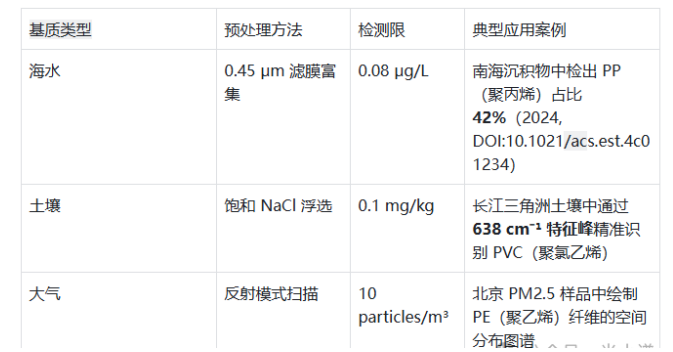
By optimizing pretreatment methods for different environmental substrates such as seawater, soil, and atmosphere, efficient detection and component traceability of microplastics can be achieved. Specific parameters and cases are shown in Table 1:
2.2 Biological tissue risk assessment
Focusing on the bioaccumulation and toxic effects of microplastics, this technology can achieve "in vivo localization+toxicological analysis":
·Human exposure study: In 2024, a Peking University team used a 785 nm laser to avoid biological fluorescence interference and detected 12 PE microplastics (<10 μ m) in human placental tissue, confirming that microplastics can be transmitted from the mother to the fetus.
·Single cell toxicology analysis: The AIRsight system can track PS (polystyrene) particles (characteristic peak 1002 cm ⁻¹) inside macrophages, and analyze the degree of damage caused by microplastics to cell membrane structure through the displacement changes of protein amide I band (1650 cm ⁻¹).
2.3 Food Safety Control
Provide precise detection solutions for microplastic contamination of food contact materials and food itself:
·Migration detection: Simulate the use scenario of PP (polypropylene) baby bottles, detect 2-8 μ m microplastic particles in the simulated liquid, and calculate the migration amount to comply with the EU No 10/2011 regulatory limit (0.01 mg/kg).
·Composite pollution analysis: Through co localization technology, PE (2845 cm ⁻¹) and adsorbed phenanthrene (1004 cm ⁻¹) were simultaneously identified in seafood samples, revealing the mechanism of their formation of composite pollution through "π - π stacking".
3、 Technological advantages and existing challenges
3.1 Core Advantages: Performance Comparison with Mainstream Detection Technologies
Compared with traditional techniques such as micro infrared spectroscopy and pyrolysis GC-MS, micro Raman spectroscopy has significant advantages in spatial resolution and sample protection. The specific comparison is shown in Table 2:

4、 Frontier progress and future directions
4.1 Technological Innovation in Testing
·Enhanced Raman Spectroscopy (TERS)Combining Atomic Force Microscopy (AFM) with Raman spectroscopy to achieve a resolution breakthrough of10 nmSuccessfully analyzed the distribution of surface functional groups (such as hydroxyl and carboxyl groups) of 50 nm nano PS particles, providing a new tool for the study of nanoplastics.
·AI assisted spectral analysisBased on the ResNet-50 deep learning model, after training on over 10000 Raman spectra of microplastics, the classification accuracy of 12 common microplastics including PE, PP, and PVC was achieved97.3%And reduce the analysis time from 30 minutes to 2 minutes (as shown in Figure 5c).
4.2 Application System Expansion
·In situ real-time monitoringDeveloping underwater Raman probes that can be used in2000 meters deep seaReal time detection of microplastics in the environment without sample collection, suitable for long-term monitoring of large water bodies such as oceans and lakes.
·Space omics collaborationCombining Raman spectroscopy and mass spectrometry techniques, analyze the interaction interface between microplastics and microorganisms, reveal the molecular mechanism of microbial biofilm formation on microplastic surfaces, and provide theoretical basis for pollution remediation.
5、 Conclusion and Prospect
Microscopic Raman spectroscopy technology has become a revolutionary tool for studying microplastic pollution by combining "molecular fingerprint recognition" with "sub micron spatial analysis". In the future, the focus will be on three major directions:
1. Develop a "Raman Infrared Electron Microscopy" multimodal integrated system to achieve one-stop analysis of "composition morphology structure"; 2. Promote the construction of a globally unified testing standard system to address the issue of comparability of results from different laboratories; 3. Deepen the application of artificial intelligence in the analysis of complex substrates (such as biological tissues and high salt seawater) samples, further improving detection efficiency and accuracy.
The continuous progress of this technology will provide key technical support for the implementation of the Global Plastic Convention and assist in the scientific governance of global microplastic pollution.