-
E-mail
wjb@cykeyi.com
-
Phone
13837189935
-
Address
201, 2nd Floor, Building 5, Zhengzhou Yida Technology New City, Jinzhan Street, High tech Zone, Zhengzhou City
About Us
Zhengzhou Chengyue Scientific Instrument Co., Ltd
Research and simulation of uniform coating on the surface of micro particles by magnetron sputtering
Date: 2025-08-14Read: 1
Magnetron sputtering technology for achieving uniform coating on micro particle surfaces is currently a research hotspot in the field of surface engineering, especially in catalyst carriers3DPrinting powders, drug sustained-release granules, and other applications have significant value. However, due to the complexity of the geometric characteristics (curvature, size distribution) and motion states (agglomeration, fluidization) of particles, traditional planar coating processes face enormous challenges. The following is a systematic summary of the research progress and simulation methods in this field:1. The core difficulty of micro particle coating(1)Geometric effects
Shadow effect: The mutual obstruction between particles leads to uneven coating (especially for particles with high aspect ratios).
Curvature dependence: The film thickness distribution during spherical deposition follows the cosine law, and the edge region is prone to thinning.
Size dispersion: differences in particle size (such as10μm vs. 100μm)Resulting in differences in sedimentation rates.(2)Particle aggregation in dynamic problems: electrostatic force/Van der Waals forces cause particle adhesion, forming'dead zone'Uneven fluidization: Bubbles or channeling may occur in gas-solid fluidized beds, disrupting uniformity.
2. The key technical solution for uniform coating
(1)Particle motion control technology
method |
principle |
Applicable particle size range |
Mechanical vibration assistance |
High frequency vibration breaks agglomeration and promotes particle rolling (frequency)50-200Hz, amplitude1-5mm) |
1μm-1mm |
fluidized bed |
Suspend particles through airflow (the critical flow rate is determined by particle density, such as...)Al?O?need0.1-0.5m/s) |
20μm-500μm |
Rotating drum sputtering |
Tilt angle of drum5-15°, rotational speed5-20rpmRealize three-dimensional motion |
50μm-5mm |
(2)Plasma optimization technology
Multi target collaborative sputtering: symmetrically arranged target materials (such as4The target is arranged in a tetrahedral pattern to reduce shadow effects.
Pulse bias technology: Applying negative bias voltage to particles(-50Vto-200V)Attract ions to improve edge coverage.
Plasma sheath control: By designing a magnetic field to expand the plasma region and enhance the surface coverage of particles.
3. Numerical simulation method
(1)Multi physics field coupling modeling framework
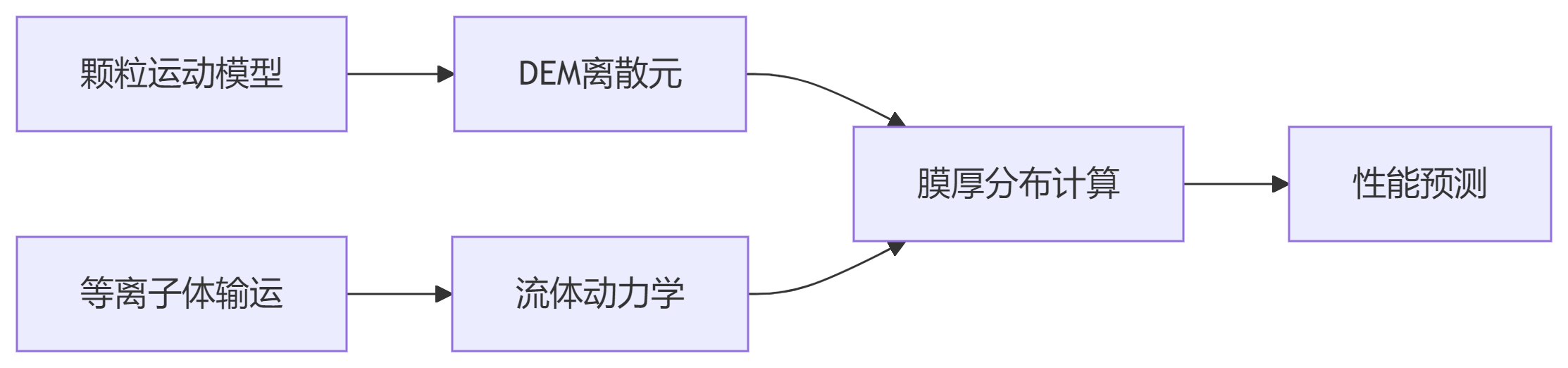
(2)Typical simulation tools and cases
DEM(Discrete Element Method):
Software:EDEMTheLIGGGHTS
Case: Simulating a vibrating screenAl?O?Particle motion trajectory, optimizing vibration frequency to increase rolling frequency>10time/min.
CFD-PIC(Fluid)-Particle coupling):
Software:COMSOL MultiphysicsTheANSYS Fluent
Case: In a fluidized bedArPlasma andTiParticle interactions predict the angular distribution of sputtered atoms.
Monte Carlo film thickness model:
Method: Track the motion of sputtered atoms (considering scattering and adsorption probabilities), such asSRIM/TRIMSoftware extensions.
Output: spherical facial mask thickness distribution formula\\frac{d(\\theta)}{d_0} = \\cos^n\\thetad0d(θ)=cosnθ(nRelated to air pressure.
(3)Data driven optimization
Machine learning agent model:
Input: Sputtering power, gas pressure, particle rotation speed, etc20+parameter
Output: Film thickness uniformity index (such as\\frac{\\sigma}{\\mu} \\leq 5\\%μσ≤5%)
Case: Based onGA-BPNeural network reduces experimental data90%.
4. Examples of Industrial Applications
(1)Catalyst carrier coating
Requirement: Inγ-Al? O?Particles (diameter)200μm)Surface plating2nm Ptfilm.
Solution: Fluidized bed magnetron sputtering+Pulse bias voltage,CV(Coefficient of variation of membrane thickness)<8%.
(2) 3DPrinting powder modification
Titanium alloy powder(Ti-6Al-4V): SputteringAl?O?Insulation layer, controlling laser absorption rate.
Key parameter: drum speed12rpmSubstrate bias voltage-150VDeviation in film thickness±3nm.
5. Frontier research direction
(1)Submicron particle coating
Challenge: Particle size<1μmBrownian motion dominates, traditional fluidization fails.
Solution:
Electric Suspension Technology (Applied)10-100kV/mElectric field)
Sound wave gathering(MHzUltrasonic waves)
(2)Intelligent coating system
Real time feedback control:
passCCDMonitor particle motion status
利用PIDAlgorithm dynamically adjusts air pressure/power
(3)New simulation dimension
Quantum computing assistance:
Simulate atomic level adsorption processes (such asDFTCalculate the binding energy between sputtered atoms and particle surfaces
Optimize the composition of the target material (such as the influence of doping elements on adhesion)
6. Technical and Economic Analysis
technical route |
Uniformity(CV) |
Capacity(kg/h) |
Cost($/kg) |
Traditional fluidized bed |
15-20% |
5-10 |
50-80 |
Vibration assisted sputtering |
8-12% |
2-5 |
120-150 |
Intelligent drum system |
<5% |
1-3 |
200-300 |
Conclusion:
The uniformity control of magnetron sputtering micro particle coating requires the coordinated optimization of kinematic control and plasma engineering. Numerical simulation (especiallyDEM-CFD-PICCoupling has become a core tool in process development, and machine learning will further accelerate the process of parameter optimization. In the future, with the increasing demand for nanoparticle coating, developing low damage, high-precision deposition systems will be a key breakthrough direction.