-
E-mail
yuanyuan.liu@insaoptics.com
-
Phone
15000590832
-
Address
Building 6, Huaxin Zhongjiao Digital Intelligent Manufacturing Port, No. 1388 Huazhi Road, Qingpu District, Shanghai
Yingsa Optical Instrument (Shanghai) Co., Ltd
Why can we see red light - User's question answered
Date: 2025-08-20Read: 1
User A: "Is this red light spot used for measuring samples? ”
User B: "The sample has been placed on the sample holder, but the red spot seems to be slightly off center and not shining exactly at the center of the sample. Is there something wrong? ”
User C: "I noticed that the intensity of red light changes during testing. Is there a problem with our light source? ”
User D: "Why does your instrument have a red light spot? I didn't use infrared before, did I? ”
User E, F, G...: "This red spot XXX, XXX"
Many users of Fourier transform infrared spectrometers may have such doubts. Fourier transform infrared technicians must have also received such questions from users. In this issue, we will answer everyone's questions one by one:
Let's start with the light used in conventional Fourier transform infrared spectrometers! Firstly, we used spectral infrared light to test the samples. Near infrared light is generally tested in the range of 800-2500nm, while mid infrared light is generally tested in the range of 2500-25000nm. However, based on the wavelength range of visible light that the human eye can see -380-750nm, it can be seen that the infrared light used for infrared spectral testing cannot be observed by the human eye. So, what is the red light we see?
The light we also use in Fourier transform infrared is laser, which is used to control the movement of the interferometer moving mirror. Generally, 633nm laser is used, which is the short wave red light in the visible light region of red, green, and blue (RGB). And it will also enter the sample chamber along with long wave spectral infrared light, so we see that the red light is short wave red light (as shown in Figure 1 below). Please remember that it is not used to test samples, and our long wave infrared detector will not have any response to it, so there is no need to worry about it interfering with our testing.
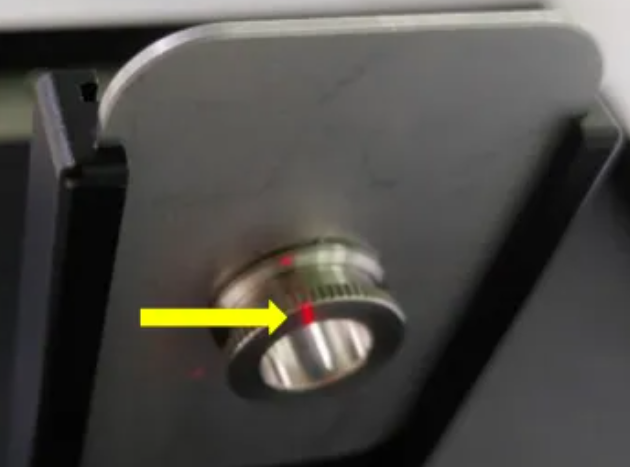
Figure 1
Since it enters the sample chamber together with the spectral infrared light we use for testing, can we use it to determine whether the sample has received the testing light? The answer is incorrect. Although sometimes we see this laser shining on the sample, it is not the basis for our judgment. The optical path of the infrared spectrometer is carefully tuned to ensure that users can obtain information about the sample using the accompanying accessories. Moreover, the infrared spot used for testing is affected by the size of the aperture and the size of the laser spot, so the red spot (i.e. laser spot) cannot be used to determine the position of the testing infrared light. What should some users do if they need to design their own attachments for testing? It is recommended to contact the manufacturer's engineer to understand the infrared light path, and then use an infrared photosensitive card to check the position of the light spot, whether the light path adjustment is good, and whether the tested signal is appropriate and stable during the adjustment process. Signal inspection can also be performed in the software to check the signal strength and stability of the light received by the detector.
The last question is, why do some users' infrared spectrometers not see red light? That's because infrared spectrometers sometimes use semiconductor lasers with wavelengths greater than 750nm, which belong to invisible light, so we can't see red light! (As shown in Figure 2 below)

Figure 2
Follow "IR Infrared Cloud School" to learn more about infrared knowledge. Welcome to learn and discuss together, and use infrared to solve more problems.