-
E-mail
1504129505@qq.com
-
Phone
18512111473
-
Address
Room 1571E, Building 1, No. 196 Yangtai Road, Baoshan District, Shanghai
Xibiao (Shanghai) Technology Co., Ltd
[New Product Recommendation] GB 31658.26-2025 Screening for 127 Drug Residues in Animal based Foods
Date: 2025-11-17Read: 1
Interpretation of National Standard Documents
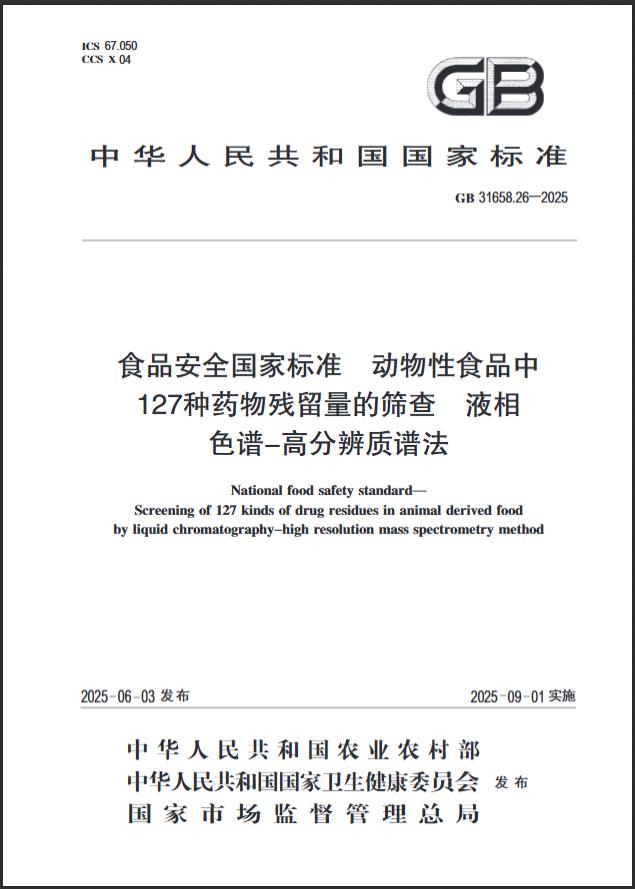
GB 31658.26-2025 National Food Safety Standard - Screening of 127 Drug Residues in Animal based Foods - Liquid Chromatography High Resolution Mass Spectrometry Methodis caused byHenan Agricultural, Livestock and Aquatic Products Inspection Technology Research InstituteDrafted and formulated by the former Henan Provincial Veterinary Drug and Feed Supervision InstituteMinistry of Agriculture and Rural Affairs, National Health Commission, and State Administration for Market RegulationYuJointly released on June 3, 2025And inFormally implemented from September 1, 2025.
1、 Scope of application
(1) Applicable sample types
The standard applies to edible tissues of livestock and poultry (such as muscles, liver, etc.), poultry eggs (such as eggs, duck eggs, etc.), sheep's milk, and cow's milk, which cover most common animal derived foods and provide a unified method basis for comprehensive monitoring of animal food safety;
(2) Scope of drug testing
The standard covers the screening of 127 types of drug residues, which are divided into 16 different categories, including sulfonamides, quinolones, nitroimidazoles, antiviral drugs, lincolamines, amide alcohols, beta lactams, quinoxalines, antipyretic and analgesic drugs, psychotropic drugs, antihistamines, macrolides, deworming drugs, pesticides, truncated ear mushrooms, and other types of drugs.
2、 Method principle
(1) Sample pre-treatment
The target substance in the sample was extracted using a 0.1mol/L McIlvaine Na ₂ EDTA buffer solution and acetonitrile. Salt precipitation was performed using sodium chloride and anhydrous sodium sulfate, followed by purification using a solid-phase extraction column to achieve effective purification and concentration of the sample;-
(2) Instrument analysis
The purified sample is detected and analyzed using liquid chromatography high-resolution mass spectrometry (LC-HRMS) technology, which utilizes the efficient separation capability of liquid chromatography and the precise mass determination of high-resolution mass spectrometry to achieve accurate screening and qualitative analysis of target compounds.
IIISample pretreatment and testing process
(1) Sample preparation and preservation
1.sample preparation:Take an appropriate amount of fresh or thawed blank or test tissue, crush and homogenize it; Take an appropriate amount of fresh or thawed blank or test milk samples and mix them evenly; Take an appropriate amount of fresh or refrigerated blank or test eggs, remove the shell and mix evenly;
2. Sample classification:a) Take homogenized test samples as test specimens; b) Take the homogenized blank sample as the blank sample. This distinction is crucial for reducing background interference and ensuring accuracy of results.
(II)Sample pretreatment process
1. Extraction process:Using 0.1mol/L McIlvaine Na ₂ EDTA buffer solution and acetonitrile as extraction solvents, the target drug is fully dissolved in the solvent through vortex mixing and oscillation. McIlvaine Na ₂ EDTA buffer solution can effectively integrate metal ions, prevent target degradation, and improve extraction efficiency;
2. Salt precipitation stratification:Add sodium chloride and anhydrous sodium sulfate for salt precipitation, to clearly separate the aqueous and organic phases, promote the transfer of target substances to the organic phase, and improve extraction efficiency;-
3. Purification treatment:Use solid-phase extraction columns (such as HyperSep Retain PEP solid-phase extraction columns) to purify the extract and remove matrix interferences such as oil and protein. The standard specifies that listing this model of solid-phase extraction column is for reference only and does not involve commercial purposes. Standard users are encouraged to try using solid-phase extraction columns from different manufacturers or models;-
4. Concentration and reconstitution:Concentrate the purified extract to near dryness using a nitrogen blower, and then dissolve it in an appropriate solvent for instrumental analysis.
(3)Instrument testing conditions
1. Instrument performance requirements:The liquid chromatography-high-resolution mass spectrometer used needs to be equipped with an electric spray ion source (ESI), and the analytical balance sensitivity needs to reach 0.00001g and 0.01g. At the same time, it needs tissue homogenizer, vortex mixer, centrifuge, solid phase extraction device, nitrogen blowing instrument and other auxiliary equipment;
2. Key parameters of high-resolution mass spectrometry:The standard requires mass spectrometers to have high resolution (primary resolution of 70000, secondary resolution of 17500) and high-quality accuracy (≤ 5ppm), which helps distinguish compounds with very close mass numbers and reduce the probability of false positives;-
3. Chromatographic separation conditions:Although the standard does not specify a specific chromatographic column model, it provides the composition of the mobile phase and gradient elution procedure. The mobile phase typically includes 0.1% formic acid solution and acetonitrile, or 0.03% ammonia solution and acetonitrile, selected based on the ionization characteristics of the target substance.
4、 Summary
If these 127 drugs exceed the residue limit in animal food and are ingested by the human body for a long time or in excess, their hazards mainly include:
(1)Toxic reactions and carcinogenic risks
Some drugs, such as amide alcohols and quinolones, may have genetic toxicity, teratogenicity, or carcinogenicity; Heavy metal insecticides may accumulate in the internal organs, leading to chronic poisoning.
(2) Enhanced bacterial resistance
Long term low-dose exposure to antibiotic residues (such as sulfonamides and beta lactams) can accelerate the development of drug resistance in pathogenic bacteria in the human body, leading to a decrease or even ineffectiveness of commonly used antibiotic treatments when a person is truly infected.
(3) Allergies and Allergic Reactions
Some drugs, such as β - lactam antibiotics like penicillin, may cause severe allergic reactions such as rash and anaphylactic shock in sensitive individuals even with trace residues.
(4) Imbalance of gut microbiota and potential health risks
Antibiotic residues can disrupt the normal gut microbiota balance of the human body and may lead to digestive dysfunction.
As a standard material manufacturer, Xibiao helps GB31658.26-2025Welcome all major customers to come and purchase!
New standard materials
