-
E-mail
he.zhenzhen@yoseenir.com
-
Phone
18771127656
-
Address
Building 19, MCC Continuous Casting Industrial Park, No. 51 Guanggu Avenue
Wuhan Gewu Youxin Technology Co., Ltd
Application of Gewu Youxin Microscopic Thermal Imager in Temperature Monitoring of Chip Welding
Date: 2025-11-07Read: 3
Temperature Monitoring of Gewu Youxin Microscopic Thermal Imager in Chip Weldingapplication
In the field of modern electronic manufacturing, quality control of chip soldering processes has always been a focus of industry attention. The temperature control during the welding process directly affects the performance and long-term reliability of the chip. With the continuous improvement of chip integration and the continuous reduction of component size, traditional temperature measurement methods such as thermocouples or infrared thermometers are no longer able to meet the precise temperature measurement needs at the microscale. It is in this technological context that the Gewu Youxin microscopic thermal imager demonstrates itsexcellentThe technological value.
In the field of electronic manufacturing, the reflow soldering process has extremely strict requirements for temperature curves. Just like an experienced chef needs to precisely control the heat, engineers must ensure that the welding temperature is just right. Even if the temperature exceeds the standard slightly, it may cause irreversible damage to the fragile internal structure of the chip; When the temperature is insufficient, the solder cannot fully wet the substrate, ultimately leading to quality defects such as virtual soldering or cold soldering.
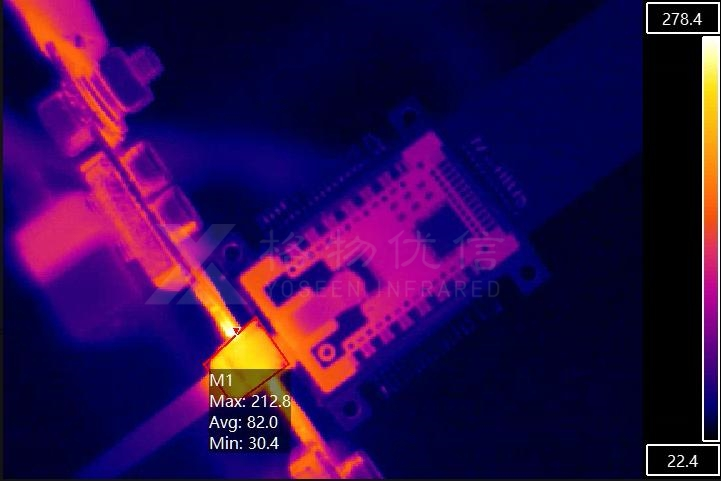
Traditional temperature measurement methods, such as using thermocouples or infrared thermometers, often only provide temperature data for a single point. It's like observing a room through a keyhole, it's difficult to get a full view. In the actual welding process, due to differences in material heat capacity and uneven heat dissipation conditions, there may be significant differences in temperature distribution at various points in the welding area. This limitation often traps process engineers in“Blind men and an elephant”The dilemma.
The emergence of micro thermal imagers has changed this situation. It's like fitting an engineer with a pair“Thermal vision glasses”It can simultaneously capture the thermal distribution of the entire observation area. Even more astonishing is that it can detect temperature anomalies in individual solder joints. This panoramic monitoring capability allows us to truly achieve it for the first time“see”Understand the complex thermal behavior characteristics of the heat flow trajectory during the welding process. This innovative device cleverly combines infrared thermal imaging technology with microscopic optical systems to achieve non-contact temperature monitoring of small targets. Its working principle is based on the infrared energy emitted spontaneously by an object, which is converted into a visualized temperature distribution map through a precise optical system and high-sensitivity infrared detector. During the chip soldering process, this technology can real-time display the temperature field changes of the solder joints and their surrounding areas, providing reliable basis for process optimization.
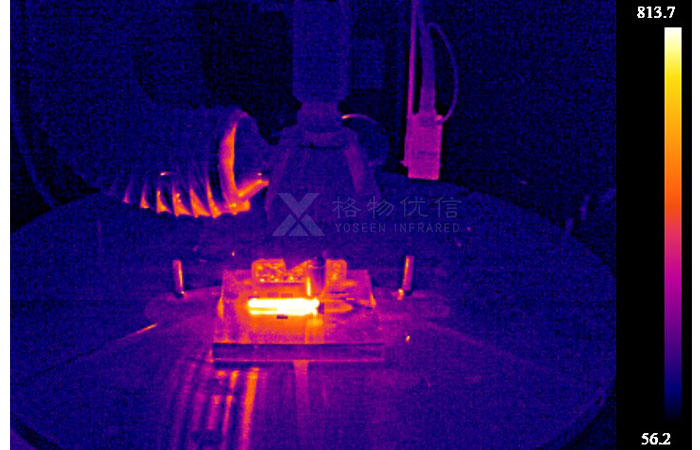
From a broader perspective, the application of micro thermal imagers is not limited to the field of chip soldering. This technology has demonstrated unique value in various aspects of the electronic manufacturing industry, such as circuit board testing, component aging testing, and heat dissipation design verification. It helps engineers“see”Temperature, understanding heatCheng, in order to manufacture more reliable and efficient electronic products.
Overall, the Gewu Youxin micro thermal imager has brought a new observation dimension to the chip soldering process. By providing accurate and real-time temperature field information, it not only improves the control level of production processes, but also provides strong support for product quality assurance. With the development of manufacturing processes towards greater precision and intelligence, this detection technology will play an increasingly important role.