-
E-mail
rliu_1@sypi.com.cn
- Phone
-
Address
Building 1, Huadian Intelligent Network Industrial Park, No. 28 Siwei Road, Dongli Development Zone, Tianjin
Solution
Tianjin Sanying Precision Instrument Co., Ltd
an introduction to
With the development of bamboo weaving technology, various complex shaped bamboo weaving crafts have put forward higher requirements for the flexibility and strength of bamboo strips. In folk culture, relying on the wisdom of the Chinese people, methods such as natural air drying, roasting over fire for more than ten seconds, and boiling in 10% salt water for 10 minutes can all improve the flexibility and strength of bamboo strips. In recent years, numerous scholars have conducted various experiments in the laboratory to study effective methods for improving the flexibility and strength of bamboo strips, and have achieved significant results.
Research Methods
Chen Hong and others from Nanjing Forestry University conducted experimental research on improving the flexibility and strength of bamboo strips using the three inch precision micro CT nanoVoxel-3000 series equipment. By using various concentrations of NaOH solution pretreatment, natural bamboo strips were processed into ultra flexible bamboo strips with higher tensile strength. High resolution scanning tests were conducted on bamboo strips using micro CT technology to obtain the fiber distribution inside the samples, indicating the structural changes inside the bamboo strips and further elucidating the mechanism of strength and toughness enhancement of bamboo strips after alkali treatment.
Main achievements
The scanning results of micro CT can be processed by software to obtain the following effect image, which can clearly observe the shape, orientation, size, and spatial distribution of cracks. The results indicate that untreated bamboo strips exhibit surface cracks under mild bending, which propagate with increasing bending force and ultimately lead to bamboo strip fracture. The cracks are easily propagated in the direction perpendicular to the fiber axis. For processed bamboo strips, although larger cracks appeared on the surface under severe bending, the cracks propagated along the fiber axis rather than perpendicular to the axis. Under bending, the treated bamboo strips have many shear bands near the cracks (indicated by green arrows), while only one or two large cracks were found in the untreated bamboo strips (indicated by yellow arrows).
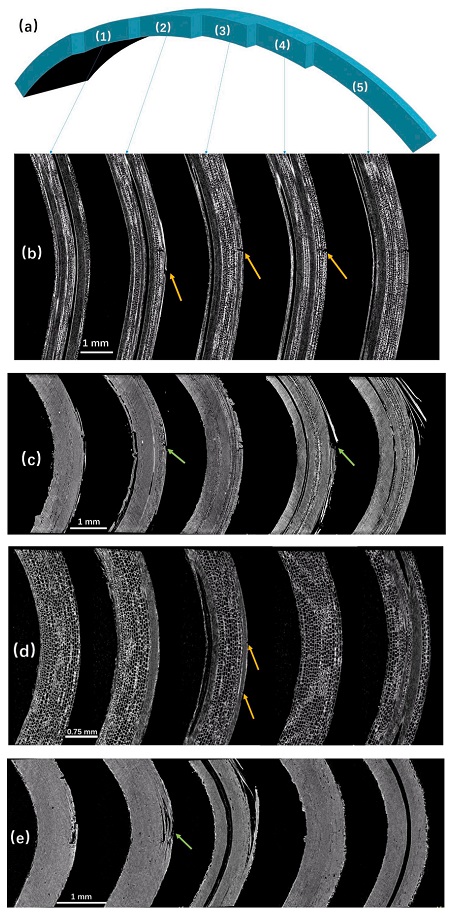
Microscopic CT imaging results of radial sections at different positions of bamboo strips bending
(a) The position of bent bamboo strips, (b) untreated outer bamboo, (c) outer bamboo treated with 15% NaOH,
(d) Untreated inner bamboo, (e) 15% NaOH treated inner bamboo
Meanwhile, the pore structure of processed and untreated bamboo strips is also not entirely the same. As shown in the figure below, the degree of thin-walled tissue cells in the outer periphery of the processed bamboo strips is higher than that in the middle part, forming a density gradient, and the outer periphery has the highest density and stress. Compared with the relatively uniform structure in the processed inner bamboo strips, this hierarchical structure greatly enhances the bending stiffness of the processed outer bamboo strips. Under the same treatment, the outer bamboo strip is more difficult to break when bent than the inner bamboo strip.
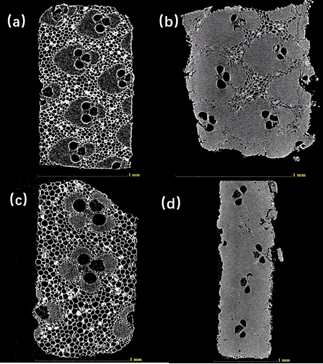
Microscopic CT imaging results of the cross-section of bent bamboo strips
(a) Untreated outer bamboo, (b) 15% NaOH treated outer bamboo, (c) untreated inner bamboo, (d) 15% NaOH treated inner bamboo
Conclusion
High resolution micro CT scanning has achieved three-dimensional visualization of the internal fiber state of the sample, revealing the flexibility and tensile properties of bamboo strips treated with different alkali concentrations. It is an effective method for studying the microstructure of plant fiber materials under different alkali concentrations, and high-resolution CT imaging technology can be applied to similar scientific research.