-
E-mail
ping.shen2@thermofisher.com
-
Phone
13386161207
-
Address
China Chip Experience Center, Building A, No. 2517 Jinke Road, Pudong New Area
Thermo Fisher Scientific Chromatography and Mass Spectrometry
Thermo Fisher RoHS comprehensive solution helps you easily cope with the new national standard GB 26572-2025
Date: 2025-10-27Read: 97
The first mandatory national standard in the field of hazardous substance control for electrical and electronic products in China, "Requirements for the Restriction of Hazardous Substances in Electrical and Electronic Products" (GB 26572-2025), has been approved and released by the National Standardization Management Committee and will be officially implemented on August 1, 2027.
Currently, China's RoHS control is mainly based on GB/T 26572-2011 "Requirements for Limiting Substances in Electronic and Electrical Products" and SJ/T 11364-2024 "Requirements for Identification of Hazardous Substances in Electrical and Electronic Products", both of which are recommended standards. The release of mandatory new national standards will effectively solve the problem of insufficient supervision of recommended standards, which is of great significance for promoting industry green upgrading, protecting consumer health and ecological environment.
The new national standard will come into effect on August 1, 2027, with a transition period of 2 years and an additional 1 year for inventory product consumption.
1、 Changes in the new national standard
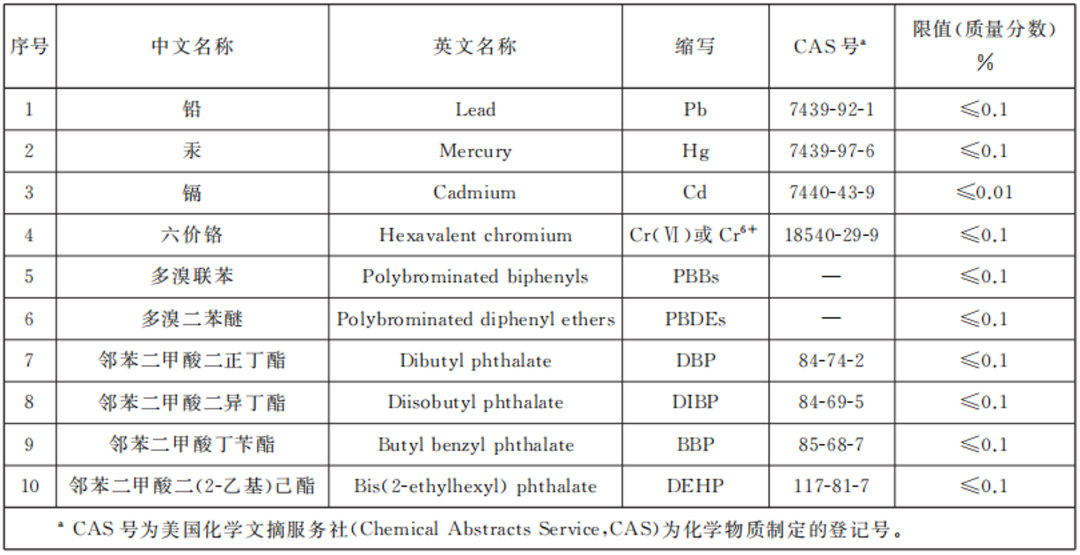
The new national standard has increased the types of hazardous substances controlled in electrical and electronic products from six categories to ten categories, and added four categories of phthalates, which are consistent with the EU RoHS requirements. The types of restricted substances and their limit values are shown in the table below[1].
(Click to view large image)
The testing method adopts the GB/T 39560 series standard, which is equivalent to the IEC62321 series international standard, to maintain the synchronization of China's RoHS hazardous substance detection technology and testing results with international standards, and to enhance recognition.
2、 Thermo Fisher Solutions
1. Py GCMS rapid screening protocol for pyrolysis gas chromatography-mass spectrometry
The Thermo Fisher Py GCMS rapid screening protocol refers to IEC 62321-8:2017 "Determination of certain substances in electronic and electrical products - Part 8: Gas chromatography-mass spectrometry (GC-MS) and gas chromatography-mass spectrometry with pyrolysis/desorption (Py/TD-GC-MS) for the determination of phthalates in polymers" and IEC 62321-3-3:2021 "Determination of certain substances in electronic and electrical products - Part 3-3: Screening of polybrominated biphenyls, polybrominated diphenyl ethers, and specific phthalates in polymers using Py/TD-GC-MS".
This solution is easy to operate, does not require pre-treatment, does not require organic solvents, and can be directly sampled and tested on the machine. It is particularly suitable for users who need to quickly screen whether products comply with the new national standards and EU RoHS standards
In addition, we also provide rapid screening solutions for red phosphorus flame retardants, SCCPs (short chain chlorinated paraffins), MCCPs (medium chain chlorinated paraffins), and TBBPA (tetrabromobisphenol A) to meet more testing needs

Figure 1 Thermal cracking gas chromatography-mass spectrometer

Figure 2. Simultaneous determination of 7 phthalate esters by thermal cracking gas chromatography-mass spectrometry (TIC image) (click to view larger image)

Figure 3 TIC diagram of brominated flame retardants determined by pyrolysis gas chromatography-mass spectrometry
(Click to view large image)
Swipe to view more
2. Accurate quantitative plan
The ISQ7610 gas chromatography-mass spectrometry (GC-MS) equipped with a liquid automatic sampler by Thermo Fisher Scientific, as well as the iCAP PRO series plasma emission spectrometer, can accurately quantify the top 10 hazardous substances controlled by GB 26572-2025.
① For 4 phthalates and 2 brominated flame retardants
When the ISQ7610 gas chromatography-mass spectrometer is equipped with both a liquid sampler and a thermal cracking analyzer, the rapid screening scheme can be integrated with the precise quantification scheme. The same set of equipment can perform rapid screening or precise quantification, making it flexible and versatile to meet different usage needs.
The switch between rapid screening and precise quantification schemes does not require moving the thermal cracking instrument and liquid automatic sampler, making the operation simple and time-saving.
ISQ7610 has a vacuum locking function (VPI), which enables non-stop and non emptying ion source maintenance and column replacement, maximizing productivity. Combined with the compatibility of RoHS rapid screening and precise quantification with the same GCMS, it truly achieves non-stop and real-time online operation.

Figure 4 ISQ7610 gas chromatography-mass spectrometer equipped with liquid automatic sampler

Figure 5: The ISQ7610 gas chromatography-mass spectrometer is equipped with both a liquid automatic sampler and a thermal cracking analyzer, as shown in the actual machine photo
Swipe to view more
② For the four heavy metal elements
For the determination of Pb, Cd, Hg, and Cr, multiple analysis schemes can be used, including AA, ICP-OES, and ICP-MS. The difference is that the latter two have higher efficiency and higher plasma temperature without chemical interference. ICP-OES is the preferred instrument for measuring total elements due to its stronger tolerance to substrates and wide linear range. Cr6+can meet RoHS testing requirements by using UV (ultraviolet spectrophotometer).
The biggest challenge in ICP-OES testing is spectral interference, which is related to wavelength, luminous flux, and resolution. Low wavelength excitation requires more energy and relatively lower intensity, which is why it receives less interference than high wavelength excitation. For example, in the determination of Pb in high nickel samples, ultraviolet wavelengths of 168.218nm and 182.205nm are significantly better, as shown in Figure 6-8. The lighting cone diameter of Thermo Fisher iCAP PRO series ICP-OES is 10mm, which is 3-5 times the diameter of ordinary metal cold cones, ensuring a high degree of luminous flux. At the same time, the 4 million pixel detector reduces the width of each small grid in the spectrogram to only 0.002nm, maximizing the ability to adjust the background.
The Thermo Fisher ICAP PRO series ICP-OES has high luminous flux and resolution, making trace element wavelengths more stable and easily handling the testing of impurity elements in high matrices. It eliminates falsehoods and preserves truth, making spectral interference nowhere to hide!

Figure 6: iCAP PRO Element Analysis Tool for Four Million Pixel, 10mm Light Cone

Figure 7 Determination of Lead in High Nickel Samples at 168.215nm
(Click to view large image)

Figure 8 Determination of Lead in High Nickel Sample at 182.205nm
(Click to view large image)
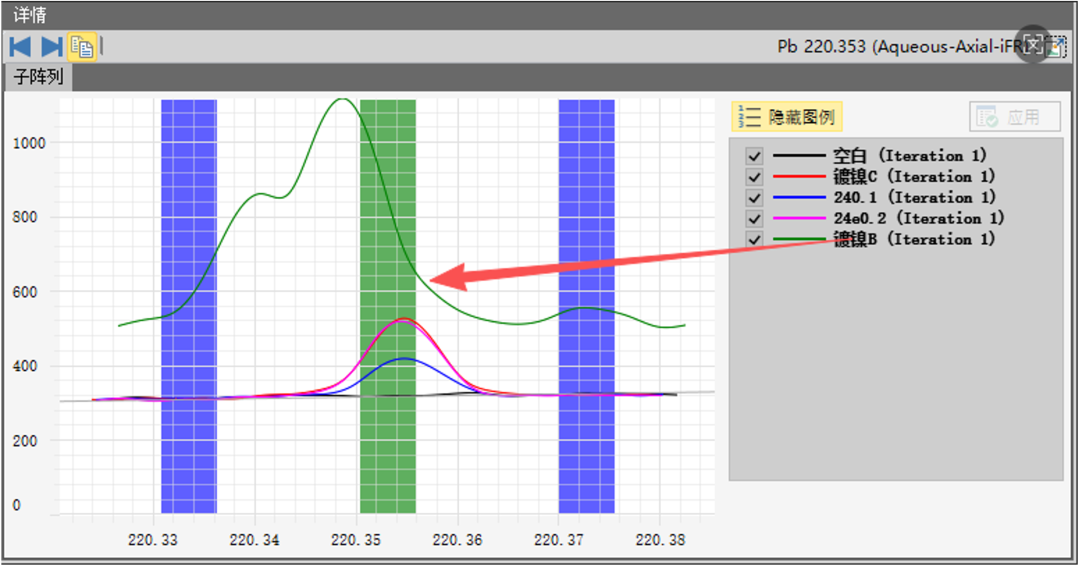
Figure 9 Determination of Lead in High Nickel Samples at 220.353nm
(Click to view large image)
Swipe to view more
reference material:
[1] GB 26572-2025 "Requirements for the Restriction of Hazardous Substances in Electrical and Electronic Products"
If you need to collaborate in reprinting this article, please leave a message at the end of the article.