-
E-mail
ping.shen2@thermofisher.com
-
Phone
13386161207
-
Address
China Chip Experience Center, Building A, No. 2517 Jinke Road, Pudong New Area
Thermo Fisher Scientific Chromatography and Mass Spectrometry
The new seventh generation CAD is approaching, and old users say: there is a unique 'tacit understanding' between me and it!
Date: 2025-09-15Read: 94
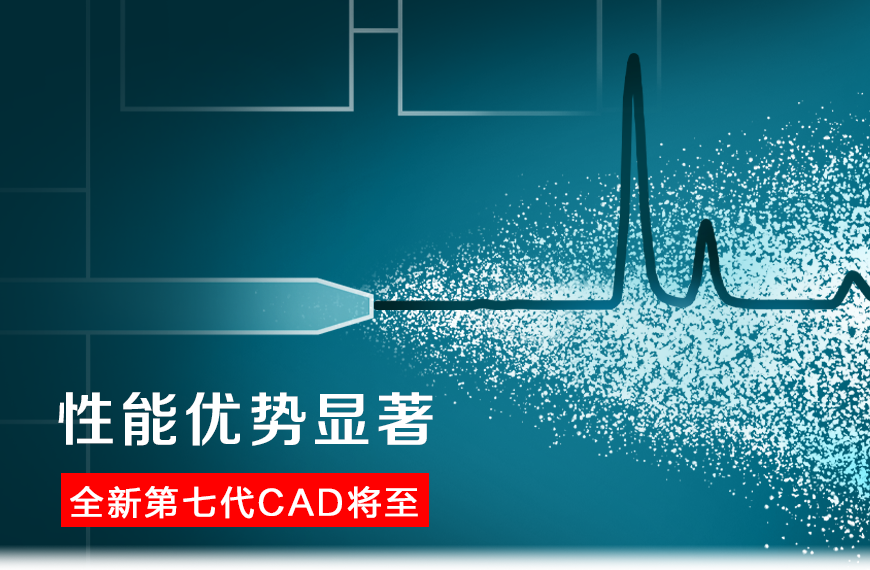
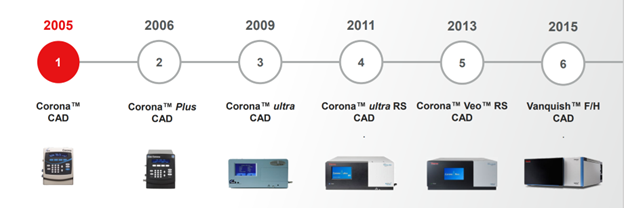
After 20 years of research and development, the CAD electric fog detector has gained a large number of fans on the road of continuous innovation and change. Recently, Feifei received usage experience from laboratory teachers, taking everyone to experience the unique charm of CAD firsthand~

The cold light in the laboratory refracts a faint blue halo on the surface of the CAD detector (electric fog detector). I stare closely at the faint peak on the chromatogram, and my fingertips almost touch the display screen: "The third time! The residual amount of Tween 80 is always stuck at the edge of the detection limit. Can this machine really work?" The story begins 10 years ago. When I first started working with CAD detectors, I requested trace detection of Tween emulsifiers used in the production process. As for quality control, I thought that relying on my experience in liquid chromatography was enough to handle it, until that CAD detector was pushed into the laboratory.
This thing claims to be able to quantify without using standard samples and detect residues at the Pic level, "the technical specialist's words while debugging the equipment made me doubt. Traditional liquid-phase detection requires precise configuration of standard curves, while CAD detectors claim to be able to directly capture compound signals through a series of complex processes such as atomization, evaporation, and charging. I secretly argued, "No matter how advanced the instruments are, they still have to rely on people to interpret the data
I hit a wall in my first actual combat. Samples processed according to conventional methods show abnormal baseline fluctuations on the CAD detector. I repeatedly checked the flow ratio, chromatographic column status, and even re distilled the solvent, but the problem still persists. Until one late night, I accidentally discovered a very thin layer of emulsified residue on the inner wall of the centrifuge tube used for sample pretreatment - it was Twain! This discovery made me start to face up to the sensitivity of CAD detectors. It's like a hunting dog with a keen sense of smell, not missing any clues. I began to systematically study its detection principle and discovered the New World in the operating manual: the original CAD detector had almost identical responses to non-volatile or semi volatile compounds, which means that even without ready-made Tween standards, quantification can still be achieved through theoretical correction factors.
During the days of integration with CAD detectors, we gradually formed a unique 'tacit understanding'. In order to eliminate the interference of matrix effects, I have developed a pretreatment scheme of "gradient elution+online dilution"; In response to the difficulty in separating Tween isomers, we repeatedly optimized the chromatographic conditions and successfully distinguished the residual signals of Tween 20 and Tween 80 with the high sensitivity of the CAD detector.
The most thrilling experience was when the CAD detector detected 0.0003% residual Tween signal in a batch of raw materials about to be shipped. This value is lower than the detection limit required by the customer, but the stable repeatability signal of the instrument makes me insist on retesting. Finally, the presence of this' ghost residue 'was confirmed under a sample size magnification of 10 times. It was this timely interception that prevented orders worth millions from being returned due to quality issues!
Nowadays, watching the smooth running data stream of CAD detectors always reminds me of the embarrassment I experienced during our first encounter. This precision instrument not only taught me new detection techniques, but also made me understand that in the battlefield of quality control, there is no absolute empiricism. Only by maintaining a sense of awe and collaborating deeply with technology can we safeguard the last line of defense for product safety. And my story with the CAD detector is still writing a new chapter.

Real time pictures of instruments at the customer's location

In the development of analytical methods for acyl chloride compounds, we often use derivatization with aniline or other reagents and combine it with ultraviolet (UV) detection for quantitative detection. The potential challenge of this method is that the derivatization reaction system is usually complex and may produce multiple by-products. There may be significant differences in UV absorption characteristics among these derivatives, which can interfere with the identification or accurate quantification of target acyl chloride derivatives due to the strong UV response of coexisting compounds.
During a certain method development, it involved monitoring the synthesis reaction of a specific acyl chloride compound. The acyl chloride is converted from a certain acid with weak UV absorption. When attempting to monitor the reaction process using the aniline derivative UV detection method, it was found that the UV spectrum of the derivative product had complex peak shapes, making it difficult to identify the target derivative peak. Direct detection of residual raw material acid is also ineffective due to the weak UV response of the prototype acid and significant interference from derivative products.
So, considering the advantages of CAD, such as small differences in response to different compounds, high sensitivity, and less interference from the matrix, we attempted to use CAD instead of UV detectors. The results indicate that under the same analysis conditions, CAD can effectively avoid the interference of unknown impurities (strong UV response) in the derivative system on the target substance (raw acid), and successfully achieve effective monitoring of the acyl chloride reaction process. Quickly solved the interference problem previously faced by UV detection.

There are more positive reviews for CAD, which greatly improved the detection efficiency during the experimental process and helped the project achieve twice the result with half the effort!
