-
E-mail
marketing@gassensor.com.cn
-
Phone
13296672587
-
Address
No. 3 Fenghuangyuan 3rd Road, Fenghuangyuan Industrial Park, Donghu New Technology Development Zone, Wuhan City, Hubei Province
Sifang Optoelectronics Co., Ltd
Understand one article! The 'technical arena' for electrolyte leakage monitoring
Date: 2025-10-30Read: 79
As is well knownElectrolyte, as the 'blood' in batteries, plays an important role in ion conduction; Meanwhile, electrolyte is also a latent source of danger. It is mainly composed of organic solvents (such as EC, DMC, etc.) and lithium salts. Once a leak occurs, it can cause multiple risks:
-
Short circuit: The leaked electrolyte forms a new conductive path inside the battery, which may cause an external short circuit;
-
Corrosion: Lithium salts (such as LiPF ₆) become "chemical killers" when they come into contact with water, producing HF gas (corrosive, highly toxic), damaging equipment and even endangering personnel health;
-
Burning: When exposed to open flames or high temperatures, the electrolyte is easily ignited and becomes a 'fuel leader' in a thermal runaway chain reaction, accelerating fire and explosion.
Therefore, real-time and accurate monitoring of electrolyte leakage is a necessary means to curb lithium battery safety accidents.

01. With the advancement of multiple monitoring technologies, who can stand out?
The essence of electrolyte leakage monitoring is to "sniff" and identify specific gas molecules, and its technical path can be divided into chemical sensing, physical analysis, and optical detection directions, with significant differences in performance, cost, and applicable scenarios.
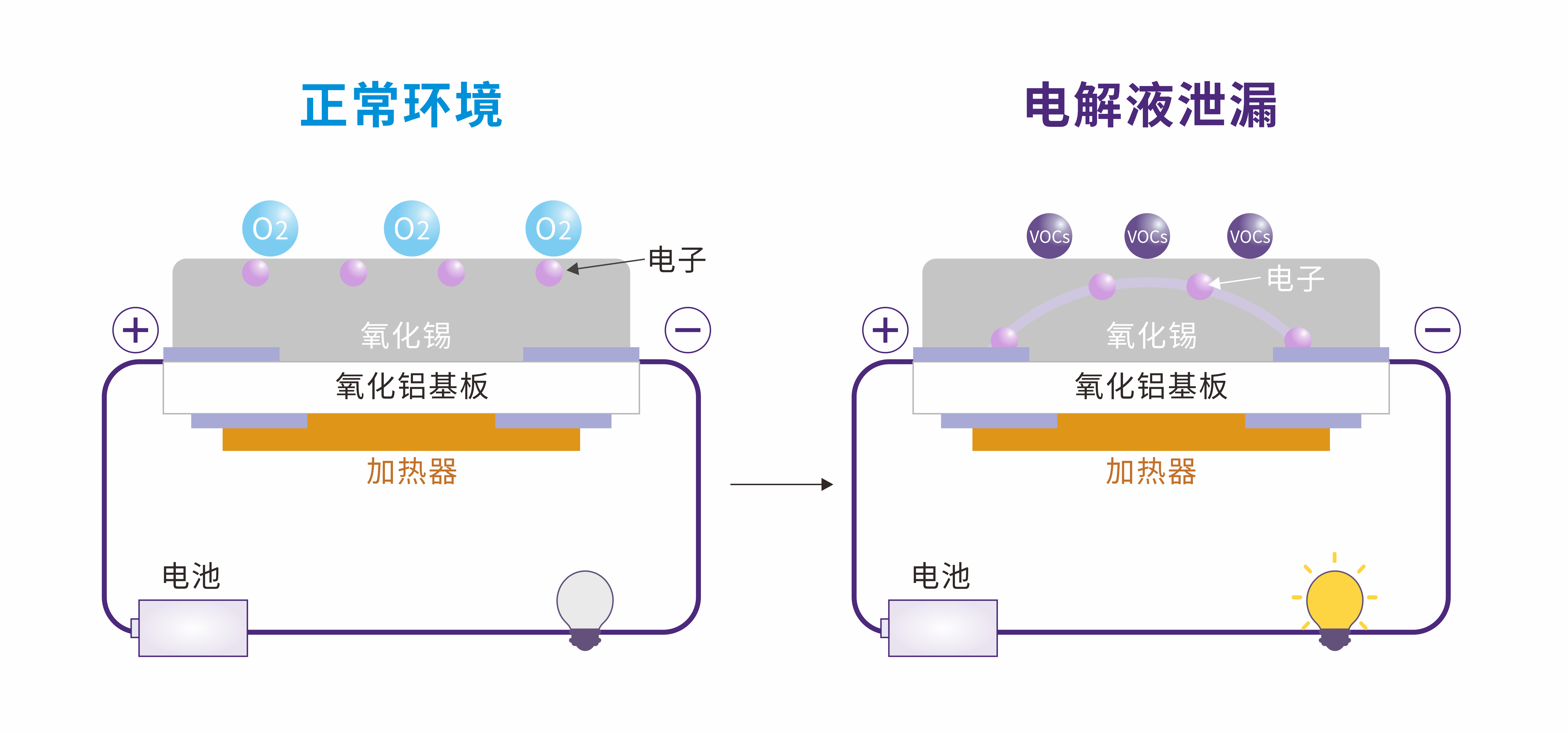
MOS (Metal Oxide Semiconductor)
-Principle: Gas sensitive materials (such as SnO ₂) change their resistance when in contact with the target gas during heating, thereby detecting gas concentration.
-Advantages: Extremely low cost, small size, and simple circuit.
-Disadvantages: Poor selectivity (susceptible to interference from alcohol, smoke, etc.), easy poisoning/drifting (electrolyte can contaminate its surface), requiring regular calibration, relatively short lifespan.
PID (photoionization detector)
-Principle: Use a UV lamp to ionize gas molecules and measure the resulting ion current to detect gas concentration.
-Advantages: extremely high sensitivity (ppb level), fast response speed.
-Disadvantage: Unable to distinguish specific types of VOC gases, UV lamps are consumables (usually with a lifespan of 1-2 years).

NDIR (Non Dispersive Infrared)
-Principle: Gas absorbs infrared light of a specific wavelength and calculates gas concentration by detecting changes in light intensity.
-Advantages: Good selectivity, extremely long lifespan, anti toxicity, high stability.
-Disadvantage: The cost is slightly higher than MOS and PID.

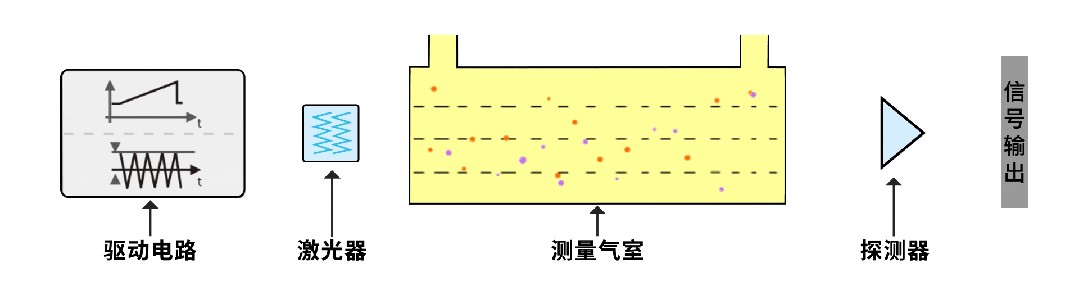
TDLAS (Tunable Diode Laser Absorption Spectroscopy)
-Principle: By adjusting the laser wavelength to align it with the absorption spectrum of a specific gas, the gas concentration is calculated by measuring the change in light intensity.
-Advantages: ultra-high selectivity and sensitivity, good stability, fast response speed.
-Disadvantages: High cost, relatively complex system, high requirements for optical path alignment.
RGA (Mass Spectrometry Analysis)
-Principle: Ionizing gas molecules and separating and identifying them based on the mass to charge ratio of different ions is the "gold standard" for analysis.
-Advantages: Able to detect multiple gases simultaneously, with good qualitative ability and high sensitivity.
-Disadvantages: Extremely expensive price, large size, complex operation and maintenance, requiring a vacuum environment. Basically not used for real-time monitoring, mainly used for offline laboratory analysis.

Why NDIR is an excellent choice for monitoring electrolyte leakage in lithium batteries?
In this' technical showdown 'of electrolyte leakage monitoring, there is no perfect solution, only suitable choices.
-
MOS and PID: Each has advantages in cost or response speed, but their selectivity and stability are average, making them suitable for scenarios with low requirements or as auxiliary monitoring tools;
-
NDIR: The performance indicators are balanced, with cost advantages and no obvious shortcomings, making it the preferred solution for industrial online measurement;
-
TDLAS and RGA: perform well in terms of performance, but have high costs, and are mostly used in industrial processes, scientific research, and laboratory research fields;

△ Comparison of Five Major Technologies and Five Dimensions
In the production, storage, and use of lithium batteries, extremely strict requirements are placed on gas detection technology: it requires high precision, rapid response, and long-term stability to warn of thermal runaway risks and ensure safety; We also need to control costs to adapt to large-scale applications.NDIR technology, with its high performance and low cost, precisely meets the above needs and has become a comprehensive solution to ensure the safety and economic benefits of lithium batteriesChampion.
03. championAbove, go further
There is no end to exploration, and champions still have potential to explore. Sifang Optoelectronics has been deeply involved in NDIR technology for 22 years, and its breakthrough lies not only in the ultimate performance, but also in the matching of different scenarios. Contact us to customize a more surprising and reliable solution for you.