-
E-mail
marketing@gassensor.com.cn
-
Phone
13296672587
-
Address
No. 3 Fenghuangyuan 3rd Road, Fenghuangyuan Industrial Park, Donghu New Technology Development Zone, Wuhan City, Hubei Province
Sifang Optoelectronics Co., Ltd
How can domestic automotive grade AQS safeguard the air quality of intelligent cabins, from MEMS chips to sensors, with full chain autonomy?
Date: 2025-12-08Read: 55
Have you noticed that your car always automatically switches to internal circulation before the exhaust hits during rush hour traffic in the morning and evening? Such precise prediction cannot be achieved without an "electronic sentinel" hidden in the intake system - the vehicle's AQS air quality sensor. It uses the power of technology to isolate health hazards, ensuring that every breath taken during every trip is healthy and reassuring.
What does AQS measure?
Air Quality Sensor (AQS) is a gas sensor installed near the air intake of a car's air conditioning system. By real-time monitoring of motor vehicle exhaust components such as carbon monoxide (CO), hydrocarbons (HC), and nitrogen oxides (NO ₓ) in the air outside the vehicle, and linking with the air conditioning control unit, the internal and external circulation is automatically switched to effectively block polluted air from entering the cabin, ensuring fresh air inside the vehicle and driving health.

01CO
CO is an incomplete combustion product of fuel under anaerobic conditions, which is a colorless, odorless, and non irritating toxic gas. Inhaled CO in the human body easily combines with hemoglobin, the carrier of oxygen in the blood, to form carboxyhemoglobin (HbCO), which affects oxygen transport in the body and causes varying degrees of hypoxia.
02 NO2
NO2 is the reaction product of nitrogen (N2) and oxygen (O2) in the high-temperature and high-pressure combustion environment of an engine. It is a reddish brown, highly irritating toxic gas. NO2 can severely irritate and corrode the respiratory tract, reduce human resistance, and exacerbate respiratory diseases such as asthma and bronchitis.
03 HC
HC compounds are escaped unburned or partially burned fuels that are inherently toxic (such as benzene being a carcinogen). Can undergo photochemical reactions with NOx, generating more irritating derived pollutants such as surface ozone (O3) and peroxyacetyl nitrate (PAN), which can irritate the eyes and respiratory tract and cause diseases such as asthma.
How to measure AQS?
The AQS sensor chip is based on a WO3 semiconductor gas sensing unit, with two functional coatings integrated on its surface: an oxidizing gas (such as NO2) sensitive coating increases its resistance, while a reducing gas (such as CO/HC) sensitive coating decreases its resistance. By simultaneously monitoring the direction and amplitude of resistance changes in these two coatings, the chip can effectively distinguish and detect these two types of gases, and ultimately output a preset pollution level signal.
AQS chip fully autonomous throughout the entire chain: Sifang Optoelectronics activates the cockpit's "air defense shield"
As the only domestic supplier with independent production and manufacturing capabilities for AQS chips, Sifang Optoelectronics has mastered core technologies such as MEMS micro thermal disk substrates, highly sensitive materials, spray precision coating, and system anti-interference. With high porosity nano self-assembled materials and precious metal modification processes, the company's products have the characteristics of high consistency, high stability, low power consumption, and long lifespan.
Based on the independently developed MEMS MOX chip, the company has launched the AQM-1020 automotive grade air quality sensor. The product can accurately identify gases such as NO ₂, CO/HC (expandable NH3/SO ₂) through material combination and intelligent differentiation algorithm, output air quality level judgment, and link with the air conditioning ECU to automatically adjust the intake valve, intelligently maintaining fresh air in the car.
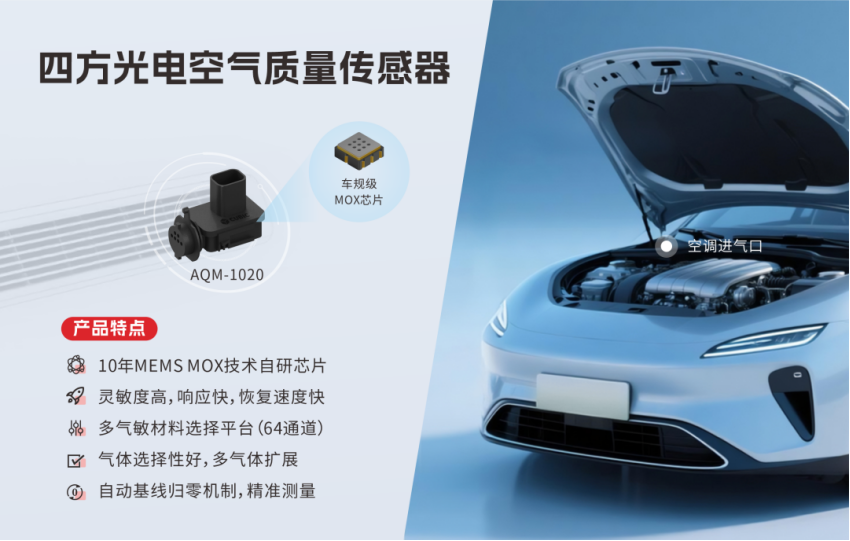
With the technical support of the National Strong Foundation Project for High Temperature Ceramic Chips, the company has achieved a complete independent industrial chain from slurry preparation, chip design, device manufacturing to sensor assembly. AQM-1020 is manufactured strictly in accordance with the IATF 16949 automotive standard, adapting to harsh onboard environments and providing reliable protection for cabin air quality.

In the current era of accelerated localization and penetration of automotive chips, Sifang Optoelectronics, with its full chain autonomous and controllable capabilities, can deeply collaborate with automotive OEMs to provide customized, highly reliable, and responsive air quality monitoring solutions, helping to enhance cabin environmental competitiveness and consolidate supply chain security and resilience.