-
E-mail
info@enboso.com
-
Phone
18676688185
-
Address
Building D, Donghua Zhiyuan Garden, No. 5003 Bao'an Avenue, Shenzhen
Shenzhen Yingbaoshuo Technology Co., Ltd
From Canary to Spectral Technology: A Century of Evolution in Gas Detection Technology
Date: 2025-08-13Read: 1
In the long river of development of gas detection technology, many interesting and profound stories interweave, outlining the wonderful trajectory of this field from germination to gradual maturity.
Going back in time to 19th century Europe, the coal industry flourished, and in dangerous mines, canaries served as early "gas detectors". Due to their smaller lungs and faster blood circulation than humans, canaries are particularly sensitive to toxic and harmful gases due to their biological characteristics. When working in a mine, if a canary experiences abnormal conditions such as raising feathers, screaming, fainting, or even death, it is like sounding an alarm. Miners must evacuate urgently to avoid possible deadly gas threats. It can be said that canaries played a crucial role in ensuring the safety of miners during that period. It is regrettable that until around 2000, a hundred years later, including in the coastal areas of Shenzhen and Guangzhou, some small contractor foremen still used this technology in some municipal engineering projects to save money. Due to the long-term exposure of birds to low concentrations of CO, H2S has developed resistance, and accidents resulting in casualties due to failure to report in a timely manner are not uncommon.
With the progress of the times, professional gas detection equipment and companies have emerged. In 1928, Dr. Oliver Johnson and Phil Williams founded Johnson Williams Instruments, also known as JW Instruments, in Palo Alto, California. This company has extraordinary significance. It is not only the world's first gas detection company, but also the first electronics company in Silicon Valley. In the field of gas detection, JW Instruments can be regarded as an innovative pioneer, successfully manufacturing portable oxygen detectors and launching the first instrument that can simultaneously detect oxygen and combustible gases, laying an important foundation for the development of gas detection technology.
Draeger, founded by John Heinrich Delger in 1889, also left a significant mark in the gas detection industry. The company adheres to the concept of "transforming technology into life's technology", and after more than a hundred years of wind and rain baptism, it still occupies an important position in the field of gas detection, and is highly praised like Rolls Royce in the automotive industry. In the 1990s, Draeger entered the Chinese market and trained a large number of professional gas detection talents, effectively promoting the development of China's gas detection industry.
When it comes to Draeger, one cannot help but mention MSA (short for MSA in English). This century old enterprise, founded in 1914, is known as the "Huangpu Military Academy" in China's gas detection industry. Interestingly, its initial product was not a gas detection instrument, but a small first aid kit, perhaps due to the immaturity of the related sensor supporting industry at that time.

In China, the gas detection industry also has its own development trajectory. In the 1970s, Yanshan Petrochemical Instrument Factory was established, becoming the first gas detection enterprise in the People's Republic of China. During the same period, Beijing Keliheng also achieved remarkable results in the field of gas detection, but was later fully acquired by American Huarui.
In the 1970s, photoionization detection technology (PID) saw its first commercial application. HNU Corporation in the United States has developed a handheld instrument model HNU-101 for detecting volatile organic compound (VOC) leaks in chemical production plants. The application of this technology not only solves the detection problems in actual production, but also gives birth to a company in the gas detection industry - American Huarui Rae, founded by outstanding Chinese and well-known in the industry.

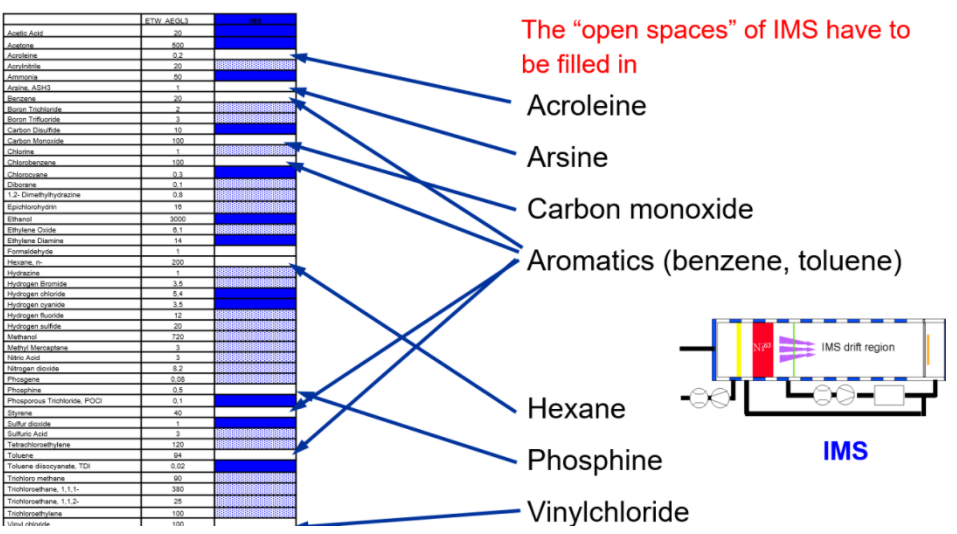
Ion Mobility Spectroscopy (IMS) technology is also a rapid detection technique that has moved from experimental to field applications, and its development has been fluctuating. It was once abandoned by the industry and widely used in explosive and CWA detection. IMS is known as atmospheric mass spectrometry. With the continuous improvement of core technologies such as drift tubes and ion gates, its high sensitivity to highly toxic inorganic substances can be combined with PID and EC sensors to form a powerful multi gas rapid qualitative and quantitative capability. The German company Airsense was the first to launch the commercial GDA series in this field.
Like other technologies, miniaturization is also the direction of gas detection technology development. With the rapid advancement of MEMS technology and the increasing demand for gas detection in consumer electronics industries such as air conditioning and automobiles, if there can be breakthroughs in technical difficulties such as reliability, repeatability, and cross interference, MEMS technology will definitely become a promising direction for gas detection development.