-
E-mail
sales@uniqueray.com
-
Phone
18038085221
-
Address
Building 8, Block A, Shenzhen International Innovation Valley, Xili Street, Nanshan District, Shenzhen
Shenzhen Weirui Technology Co., Ltd
Say goodbye to fingertip blood collection! How does laser non-invasive blood glucose technology revolutionize the efficiency of the medical system?
Date: 2025-07-23Read: 68
Blood glucose monitoring is an important link to control the development of diabetes. However, fingertip pricking, the traditional way of blood sampling and blood glucose measurement, not only brings endless pain to diabetes patients, but also seriously affects the diagnosis and treatment efficiency of blood glucose related diseases. Many non-invasive blood glucose measurement methods fail due to insufficient accuracy: the correlation between blood glucose levels in body fluids such as tears, saliva, or sweat and blood glucose levels is insufficient. The situation of skin fluid (interstitial fluid, ISF) is different, and the measurement of ISF in areas with good blood supply is very consistent with the actual blood glucose levels in the blood. With the continuous development of technology, in recent years, many technology companies have launched new non-invasive blood glucose monitoring devices based on skin fluids.
According to foreign media reports, DiaMinTech has developed a non-invasive blood glucose monitoring device that can measure human blood glucose solely through finger pressure. This revolutionary solution enabled them to participate in the 15th MEDICA conference in 2023Healthcare Innovation World CupObtained first place in the competition. It is reported that the equipment currently has a demand for up to 100000 equipment orders per year from distributors in Europe, the United States, and other regions.
DiaMonTech(Germany) was founded in 2015, after years of research at Goethe University Frankfurt.Based on years of research and technological accumulation, and benefiting from core components provided by companies such as nanoplus, the company has developed a non-invasive blood glucose meter D-Base and obtained CE medical device certification in 2019.
This device is based onInfrared spectroscopy technology (photothermal deflection principle)The quantum cascade laser it uses(Provided by Nanoplus from Germany, this device can integrate 8 QCLs in one chip, with a total of 16 QCLs integrated using two chips)Radiate infrared pulses with wavelengths between 8 and 11 μ mDeep skin.These wavelength pulses pass through the sensor element and reach the skin of the finger, triggering brief oscillations of glucose molecules within the skin. While rapidly relaxing, a small amount of heat is released into the environment, resulting in a slight increase in skin surface temperature. In sensor elements (internal reflection elements - IRE), thermal gradients generate thermal lensing effects. The test beam of the red laser diode will be deflected by the thermal lens when passing through the IRE. The deflection is measured by position sensitive photodiodes, and the device calculates the glucose concentration based on the deflection value.
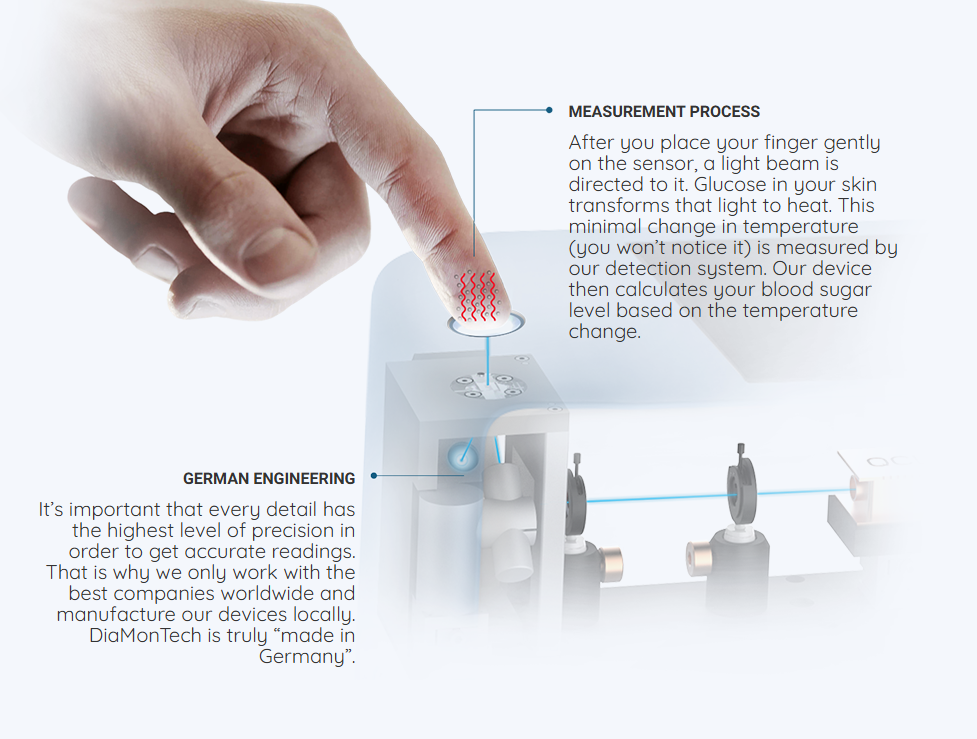
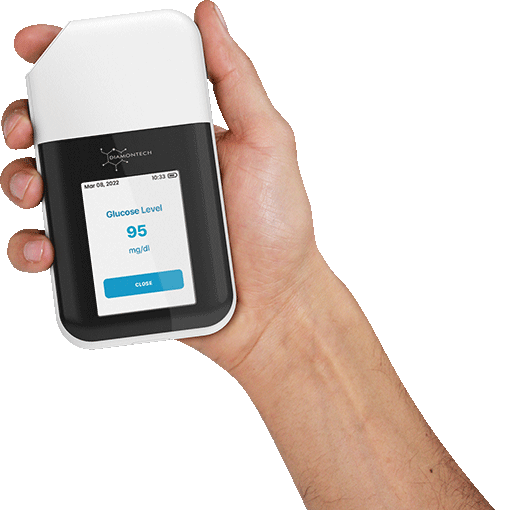
Currently, DiaMonTech is developing its handheld productsD-PocketOur clinical research and future vision is to develop wrist worn productsD-BandAccording to its technical director, they are working with their partner Samsung to develop a small sensor that can be integrated into smartwatches.
DiaMonTech has disclosed in its patent application for its core technology a device and method for detecting analytes in materials, such as glucose in human skin. (WO2021239263A1/CN116113820A)
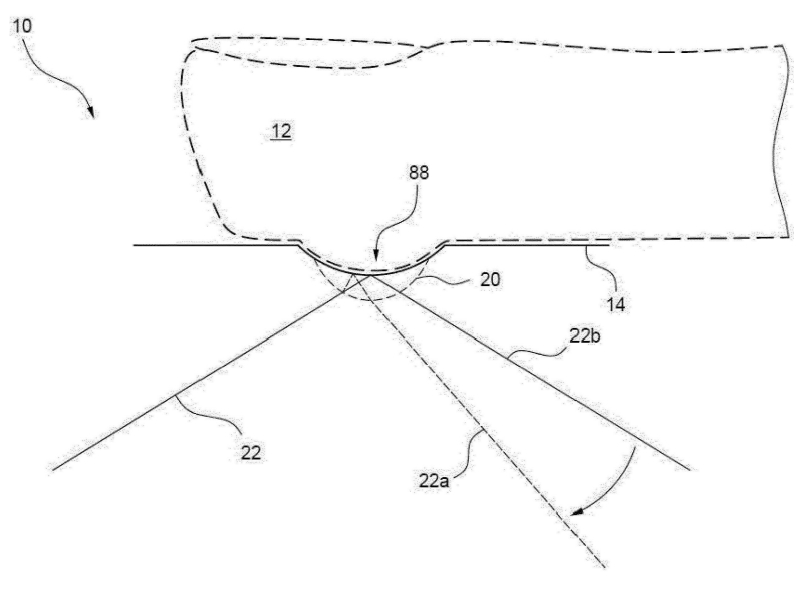
The device is a device withCurved contact surfaceThe measuring body is in thermal or pressure contact with the measured material to transmit heat waves or pressure waves generated by absorbing excitation radiation. The excitation radiation source irradiates the material with light of a specific wavelength (such as 5-13 μ m) to make it absorb.
Detect the light source emitting a beam that passes through the measuring body andReflection occurs on curved contact surfacesWhen thermal or pressure waves enter the measuring body, they will cause a change in refractive index, resulting in a deviation of the reflected detection beam path. The detector analyzes the content of analytes in the material by measuring the degree of deflection (such as deflection angle).
The contact surface of the measuring body has a specific curvature (curvature radius of about 5-30mm) along at least one main direction in the beam reflection area, which can be designed as a concave or convex surface; The detection optical path has been optimized, for example, the beam hits the exit surface of the measuring body at a large angle (≥ 5 °) to enhance the refractive effect, and may integrate focusing or collimating cylindrical lenses to optimize the beam shape and detector sensitivity.
The device can be equipped with miniaturized contact protrusions (with an area of less than 0.05cm ², such as conical or ridge structures) to improve the localization of excitation light in the material, as well as pressure sensors and clamping mechanisms to ensure stable contact pressure. The excitation light path may also be designed to penetrate the measuring body and improve the irradiation efficiency by controlling the specific incident angle (such as hitting the incident surface within the range of 84 ° -89 °).
The relevant method operation is consistent with the principle of the above device, and is based on the process of excitation thermal/pressure wave transmission detection beam deflection measurement to achieve analyte detection.
|
Technical Name |
Photothermal deflection technology |
CRDS breath acetone detection |
μ SORS Raman spectroscopy |
|
product/Technical means |
Photothermal deflection technology |
Cavity ring down spectrometer |
Micro offset spatial Raman spectroscopy |
|
measurement method |
Changes in the angle of light transmission through fingers |
The concentration of acetone in exhaled breath indirectly reflects blood glucose levels |
Direct measurement of glucose molecules in the dermis layer of the skin |
|
accuracy |
typicalMARD 15%-20% |
andGC-MS correlation | MARD=14.6% |
|
advantage |
Completely non-invasive and consumable free |
Portable, real-time monitoring, fast speed |
No special calibration required |
|
disadvantage |
Calibration is required |
Affected by diet/Sports interference |
The equipment is bulky and the collection time is long |
|
Clinical use/Progress status |
Commercially available (obtained from the European Union)CE certification) |
In clinical validation (metabolic monitoring only) |
Clinical validation stage |
In addition to this photothermal deflection technology, there are also other non-invasive blood glucose detection methods under research progress, such as cavity ring down spectroscopy (CRDS) and multiple micro spatial shift Raman scattering (m μ SORS) spectroscopy.
CRDS technology: When the body's blood sugar is low, the body will activate a backup energy plan - breaking down fat. After fat decomposition, three types of ketone substances are produced, namely acetone, β - hydroxybutyric acid, and acetoacetic acid. Acetone is volatile and can be excreted through respiration. The device can measure the amount of exhaled acetone and infer the blood glucose status. CRDS technology measures the decay time of light in a cavity, which is only related to the reflectivity of the cavity mirror and the absorption of the medium inside the cavity. In layman's terms, the principle of this technology (CRDS) is to determine blood glucose concentration by measuring the decay rate of reflected light from acetone gas molecules in a closed space.
Multiple Microspace Offset Raman Scattering (m μ SORS) Spectroscopy Technology: In February of this year, Professor Wang Weiqing and Professor Chen Chang's team at Ruijin Hospital affiliated with Shanghai Jiao Tong University School of Medicine also developed a new non-invasive blood glucose detection technology. The full name of this non-invasive blood glucose detection technology is: Multiple Microspace Offset Raman Scattering (m μ SORS) spectroscopy technology. The core of m μ SORS technology lies in using optical coherence tomography (OCT) to determine the distribution of skin epidermal thickness, and obtaining blood glucose information in subcutaneous tissue fluid and capillaries through Raman scattering spectroscopy. It requires gently placing the palm on the detection device, which can accurately measure blood glucose levels by capturing Raman signals at different skin depths.
The detailed comparison of the three methods can refer to the above figure.
It should be emphasized that in the clinical application progress of the above three methods, it can be seen that only photothermal deflection technology has enteredcommercialization phase, The non-invasive blood glucose meter D-Base developed by DiaMonTech based on this principle has obtained CE medical device certification in 2019, and other technical routes are still in the clinical validation stage.
Nanoplus was founded in 1998 by founders from the Department of Applied Physics at the University of W ü rzburg, focusing on the research and production of new semiconductor lasers. Nanoplus is an internationally renowned manufacturer and supplier of semiconductor lasers in the field of gas sensing. Design and produce nanoplus from760nm to 14000nmDistributed Feedback DFB lasers (including ICL and QCL) with arbitrary center wavelengths between them.In recent years, nanoplus has been continuously promoting the application of semiconductor lasers in the medical field, and has also been committed to using advanced semiconductor devices to drive innovative development of medical technology.
Weirui Technology is the exclusive agent of German nanoplus in China. The problem of diabetes is a global challenge. More than 530 million people in the world suffer from this disease. Weirui Technology has always focused on the application of advanced semiconductor devices in the medical field. The advancement of non-invasive blood glucose monitoring technology is expected to enable blood glucose detection to bid farewell to fingertip blood collection, alleviate people's pain, improve the efficiency of blood glucose disease diagnosis and treatment, and even revolutionize the efficiency of the medical system!