-
E-mail
suas@suastest.com
-
Phone
13302210258
-
Address
1st Floor, Factory Building, No. 47 Yangtaishan Road, Guantian Community, Shiyan Street, Bao'an District, Shenzhen
Shenzhen Shengsi Yiwei Technology Co., Ltd. (formerly Shenzhen Sansi Testing Machine Co., Ltd.)
Hydraulic universal testing machine writes' strength specification 'for materials
Date: 2025-10-20Read: 1
Any material, from the steel and cement that supports skyscrapers, to the car parts that ensure travel safety, and even the casings of electronic devices in our hands, has a crucial "identity file" behind them - mechanical performance indicators. This file defines to what extent the material can withstand external forces, how it deforms, and ultimately fails. ButHydraulic universal testing machineIt is the author who writes this' strength specification 'for each material with irrefutable and precise data.
1、 Beyond the senses: from 'feeling robust' to 'data defined'
In daily experience, we often use the vague terms "sturdy" or "fragile" to describe materials. But the engineering world cannot tolerate ambiguity. The hydraulic universal testing machine simulates various stress states such as tension, compression, bending, and shear, transforming subjective "sensations" into objective and quantifiable scientific parameters. The core chapters of this' Strength Manual 'include:
1. Tensile strength and yield strength: What is the maximum tensile force that a material can withstand before fracture? Under what tension will irreversible deformation occur? The stress-strain curve drawn by the testing machine clearly calibrates the elastic limit and bearing limit of the material.
2. Tensile elongation at break and reduction in cross-sectional area: This defines the "toughness" of a material. Is a component experiencing sudden brittle fracture or is there a clear deformation warning before failure? This data is directly related to the safety redundancy design of the project.
3. Elastic modulus: It describes the ability of a material to resist elastic deformation, commonly known as "stiffness". Under the same force, materials with high modulus deform less, which is crucial for high-precision structures.
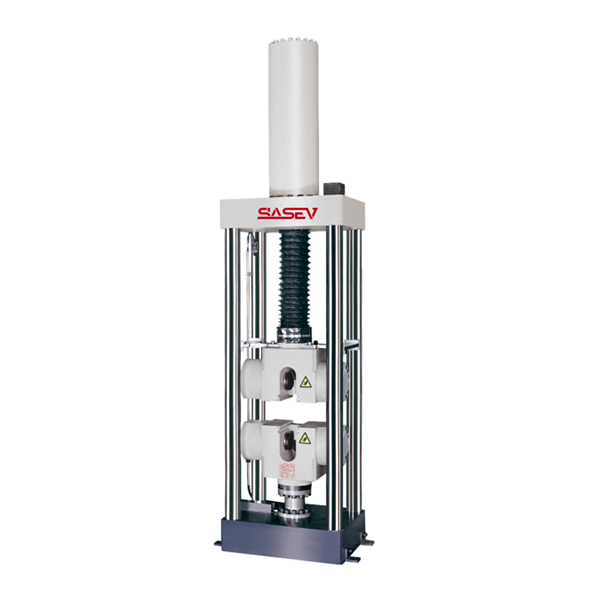
2、 Hydraulic Power: Why is it an Ideal Tool for Writing "Instructions"?
1. Huge load-bearing capacity and wide range: Hydraulic servo technology can easily generate huge loads of hundreds or even thousands of kN, which is sufficient to meet the extreme testing needs of various materials from flexible plastics to ultra-high strength alloys, ensuring the integrity and authenticity of the "instruction manual" data.
2. Smooth operation and precise control: The hydraulic system can control the loading rate with high stability and accuracy. Whether conducting slow static creep tests or simulating impact loads, it can provide a real and reliable stress environment, thus recording the most accurate material response data.
3. Sturdy structure and strong adaptability: Its sturdy frame and flexible and diverse fixture fixtures can accommodate samples of different sizes and shapes (such as standard round bars, plates, components, etc.) for various tests such as tension, compression, bending, etc., like a steel pen that can replace different pen tips, tailor-made testing solutions for various materials.
3、 From Data to Trust: The Value of Instructions
1. The cornerstone of quality control: it is the judge of raw material incoming inspection and product factory acceptance, ensuring that the performance of each batch of materials strictly meets the design standards.
2. A guide to R&D innovation: providing a critical feedback loop for the development of new materials. By analyzing failure modes, engineers can optimize ingredient formulations and heat treatment processes, continuously improving material properties.
3. The criterion for accident analysis: When a component fails in actual use, testing and analyzing the remaining parts can be compared with the original "manual" to accurately determine whether the cause of the accident is material defects, overload, or design errors.
4. The basis for simulation calculation: Modern finite element analysis and other computer simulation software require accurate material parameters (such as yield strength and elastic modulus) to be input for effective virtual simulation. The data provided by the testing machine is the starting point of trust for digital design.
The hydraulic universal testing machine, this seemingly bulky and solid industrial equipment, is actually a "material language translator" with rigorous scientific connotations. It applies precise and controllable force to 'inquire' about the essence of the material, and 'listen' and record the material's response in the form of a stress-strain curve. Ultimately, it transforms the mechanical behavior of the material into a rigorous, reliable, legally and technically effective 'strength specification'. It is this manual that lays a solid foundation for safety, reliability, and innovation in everything we build.