-
E-mail
william@eutin.cn
-
Phone
13801777130
-
Address
Room 1501-1502, Building 1, Guosheng Center, Lane 388, Zhongjiang Road, Putuo District, Shanghai
Shanghai Yunding International Trade Co., Ltd
Light stability testing of Q1B new raw materials and new formulations of drugs
Date: 2025-10-13Read: 2
1.Overview
ICHThe tripartite coordination guidance principle includes stability testing of new raw materials and new formulations of drugs, among which photostability testing should be a component of strong disruption testing. This document is a supplementary document to the general guidelines and provides recommendations for photostability testing
A.Preface
The photostability of new raw materials and new formulations of drugs should be evaluated and examined to demonstrate that appropriate light exposure will not cause unacceptable changes to the drug. Under normal circumstances, a batch of materials is selected for photostability testing in accordance with the batch selection principles outlined in the general guidance document. In some cases, when the product undergoes changes or modifications (such as composition or packaging), this study should be repeated. Whether this study should be repeated depends on the photostability measured in the initial documents and the type of changes that occur
This document mainly describes the experimental data of photostability testing required for the registration and application of new compounds and related preparations. This guideline does not include photostability after administration, nor does it cover usage that is not included in the general guidelines document. If reliable evidence is provided, alternative methods can be chosen instead
The research content to be conducted on the method of stability testing system is as follows:
I.Light stability testing of active pharmaceutical ingredients
II.Drug photostability testing without internal packaging
III.Internal packaging was carried out, but drug photostability testing for external packaging was not conducted
IV.The packaging has been completed, and the photostability test of the marketed drug has been conducted
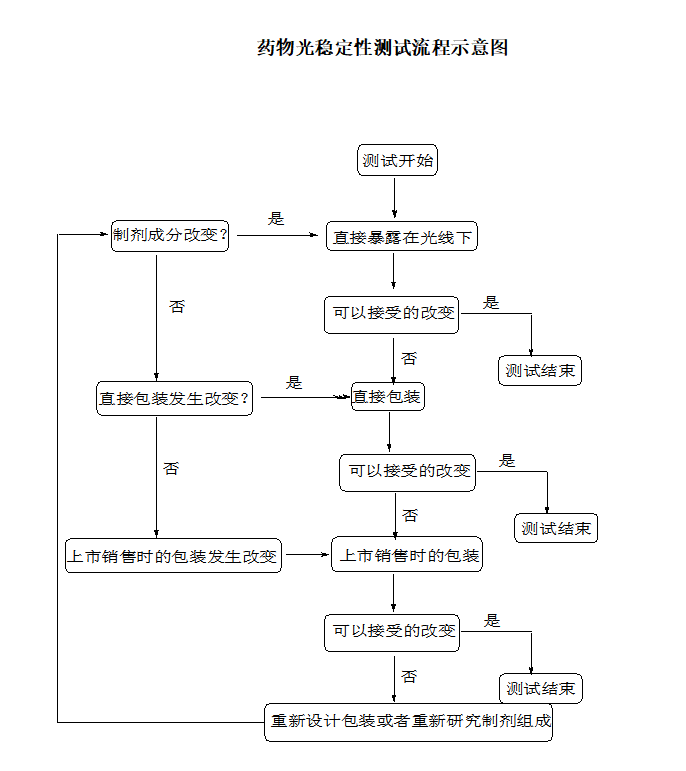
The degree of drug testing should be described based on the curve diagram of drug photostability testing,The experiment can be stopped at which step based on the acceptable change that occurred,“Acceptable changes”It refers to changes within the reasonable limits demonstrated by the declarant. Whether photosensitive drugs and preparations need to be labeled is determined by the relevant national and regional management departments.
B.light source
The light sources described below can be used for light stability testing. The applicant should control the temperature appropriately to reduce the impact of temperature on the detection, or control the darkness in the same environment (avoid light control). For selection1still2Both pharmaceutical producers and declarants need to follow the spectral distribution specifications of the light source
choice1:Using any output similar toD65/ID65 Transmitting standard light sources, such as artificial fluorescent lamps with visible ultraviolet output Xenon lamp or metal halide lamp.D65It is an internationally recognized outdoor daylight standard1993yearISO10977This has been stipulated in the regulations,ID65It is equivalent to the standard of indoor indirect sunlight exposure.The light source emits light below320nmAppropriate devices should be equipped to filter out this light.
choice2 The same sample can be exposed to both cold white fluorescent lamps and near ultraviolet fluorescent lamps.
1. Cold white fluorescent lamps should haveISO10977The specified output power
2. The light emitted by near ultraviolet fluorescent lamps320~400nm, in350~370nmThere is a maximum energy emission; The important component of ultraviolet radiation should be in320~360nm, and360~400nmWithin the scope
C.regulations
In order to conduct verification experiments, the sample should be exposed to no less than1.2×106Lux·hrNear ultraviolet energy not less than200w·hrThus, a direct comparison can be made between the stability of drugs and formulations. The samples will be exposed side by side to a validated photosensitive system to ensure the specified light exposure, or the conditions will be monitored using a calibrated radiometer or lux meter at appropriate times. If a protected sample (such as encapsulated in aluminum platinum) is used for darkness control (light avoidance control) to evaluate the effect of temperature on drug changesIt should be placed side by side with the real sample
Annotation:LuxLumen, a unit of brightness, is called foot luminosity in the UK and foot luminosity in EuropeluxSpecifically1Lumens are equivalent to a candle1The amount of light projected onto a surface of one square meter from a distance of one meter.
1.API (Active Pharmaceutical Ingredient)
For active pharmaceutical ingredients, photostability testing includes two aspects: mandatory degradation testing and confirmatory testing,The purpose of mandatory degradation testing is to evaluate photosensitivity, establish testing methods, and assess the degradation pathways of materials. This test only includes raw materials or solutions or suspensions with relatively simple components to establish a validation analysis method. In this detection, the sample is placed in a chemically inert and transparent container. In this mandatory degradation test, a series of light condition tests will be conducted based on the light sensitivity and intensity of the raw material drug. If extensive decomposition occurs during the establishment and validation of the method, the experiment can be terminated. For materials with photostability, the study can be terminated after using appropriate levels of light exposure. The exposure level used should be confirmed, however, the design of specific experiments is up to the applicant's own consideration.Under mandatory conditions, we will discover decomposition products that do not form under confirmatory research conditions. This information will help establish and validate analytical methods. If in practice, no degradation products are formed in the confirmatory test, there is no need to conduct further research on it. In order to provide necessary information such as processing, packaging, labeling, etc., confirmatory research should be conducted.
Usually, during the research and development phase, only one batch of active pharmaceutical ingredients is selected. If it is very obvious that the active pharmaceutical ingredients are stable or unstable to light, a batch should be selected from the general guidelines document for light stability testing. If the results of the confirmatory test cannot be determined, the drug will be tested on two additional batches. The selection of samples should review the description in the general guideline document.
A.Sample provided
We must fully consider the physical properties of the sample and make every effort to ensure their physical properties during the testing phase, such as taking measures to cool down or placing the sample in a sealed container to ensure a change in physical state, such as sublimation, evaporation, or melting. Various preventive measures should be taken to avoid affecting the samples being tested. Regardless of whether it is related to the experiment being conducted, possible reactions between the sample and the container material should be considered and excluded. For samples of active pharmaceutical ingredients, select an appropriate number of samples and place them in suitable glass or plastic plates. If necessary, cover them with a suitable transparent lid. Solid materials should be evenly scattered in the container, and the thickness should not exceed3Millimeters. Liquid materials should be placed in chemically inert and transparent containers
B.sample analysis
At the end of the illumination stage, appropriate validated analytical methods should be used to determine the physical properties (such as appearance, clarity or color of the solution), content, and degradation products of the active pharmaceutical ingredient.
When using solid materials, sampling should ensure that each sample tested has a certain representativeness. Similar sample considerations, such as the uniformity of the entire sample, are applicable to samples that become uneven after light testing.If there are samples used for darkness control research in the experiment(can
Protect the sample from light using various methods)It should be measured simultaneously with the sample that has been illuminated.
C.Result determination
Mandatory degradation testing should provide appropriate information for the establishment and validation of testing methods in confirmatory studies. These detection methods can detect the photodegradation products that occur during the confirmatory research process. When evaluating these research results, it should be recognized that this is part of a strong disruption experiment, rather than just establishing quantitative and qualitative limitations on changes.
Confirmatory research should recognize the preventive measures required in production or drug ingredients,Do you need light shielded packaging. When the evaluation confirmsIt is important to consider the results of other formal stability tests to ensure that the drug is within a reasonable range during use, in order to determine whether the results generated by the light test are acceptable. (You can refer to relevant sources)ICHStability and Impurity Guidelines
2.Pharmaceutical preparations
Under normal circumstances, the study of photostability of formulated drugs should follow the following sequence: directly exposing the drug to light conditions; We conducted light tests on directly packaged drugs and on drugs packaged for sale on the market. The testing should be performed in this order until the results prove that the drug is adequately protected under light, i.e. the changes before and after light exposure are within an acceptable range. This process and sequence are consistent with the schematic diagram of drug photostability testing process mentioned earlier. Medications should be exposed toI.C.Under the lighting conditions specified in the chapter
Under normal circumstances, during the research and development phase, a batch of drugs should be selected for testing. If the drug formulation exhibits significant photostability or photostability, it should be tested for photostability in accordance with the general guidelines. If the confirmatory research results are ambiguous, then the other two batches of testing should also be conducted.
For some drugs, if it is proven that light cannot pass through their direct packaging, such as aluminum tubes or cans, under normal circumstances, stability testing of light can only be conducted on the formulated drugs.
Some tests should be conducted to demonstrate the photostability of injections, skin ointments, etc. during use. The degree of this detection depends on the method of use and is determined by the declarant themselves.
The analysis program used should be appropriately validated.
A.Submission of samples
It is necessary to carefully consider and make every effort to ensure the physical properties of the test sample, such as cooling down or placing the sample in a sealed container to ensure changes in the physical state of the sample (sublimation, evaporation, or dissolution). The preventive measures taken should ensure that the impact of light received by the samples during testing is minimized. Regardless of whether it will affect the ongoing testing, possible reactions between the sample and container materials or the overall protection of the sample should be taken into account.
Under feasible conditions, when testing samples of unpackaged pharmaceutical preparations, their content and testing conditions should be similar to those of the corresponding active pharmaceutical ingredients. The placement of the sample should provide the maximum illumination area. For example, tablets, capsules, etc. should be placed in a single layer.
If direct light irradiation is not feasible (such as product oxidation), the sample needs to be placed in a properly protected inert transparent container, such as a quartz container. If it is necessary to test formulations of drugs that have been directly packaged or marketed for sale, the test samples should be horizontally or horizontally facing light, which can provide a uniform intensity of illumination. When conducting drug testing for large capacity packaging, appropriate modifications should be made to the testing conditions, such as packaging.
B.Analysis of samples
After the light test is completed, the sample should be tested to detect any changes in physical properties, such as appearance, clarity and color of the solution, solubility or disintegration of solid drugs such as capsules, content, and degradation products. This detection method should be derived from the photocatalytic degradation process and has been validated.
When the sample is in powder form, it should be ensured that the sample is uniform and representative for each individual test. For solid oral medication products, an appropriate number of samples should be tested, such as20A tablet or20A capsule. Samples that may be uneven after exposure to light(Such as cream, ointment, suspension)
The representativeness of the sampling should also be considered, such as homogenization or solubilization of the entire sample. The test sample should be tested simultaneously with the protected sample that has undergone darkness control.
C.Result determination
Specific packaging or labeling should be used to reduce light exposure based on the degree of change in the light test. When evaluating the results of photostability studies to determine whether changes caused by light exposure are acceptable, it is also necessary to consider the results of other stability studies to ensure that the product will remain within the specified specifications throughout its shelf life.