-
E-mail
info@yh-tek.com
-
Phone
13390845525
-
Address
No. 18 Hangchuan Road, Pudong New Area, Shanghai
Shanghai Yinhuang Technology Co., Ltd
The necessity and application advantages of microscopic counting method
Date: 2025-09-18Read: 0
Case study on insoluble particle detection of doxorubicin hydrochloride liposome injection: Microscopic analysisThe necessity and application advantages of counting method
Doxorubicin hydrochloride liposome injection is a widely used anti-cancer drug, mainly used to treat acute leukemia, malignant lymphoma, breast cancer, gastric cancer, liver cancer, etc. The preparation itself is a clear red solution. This inherent color poses a special challenge to its quality control.
Chemotherapy drugs such as doxorubicin hydrochloride liposomes may pose multiple health risks to patients due to the presence of insoluble particlesSuch as phlebitis, granulomas, and even organ embolism. Given these risks, pharmacopoeias of various countries mandate strict testing of insoluble particles in injections to ensure medication safety.
Microscopic counting method has become a reliable method for detecting insoluble particles in liposomal injections of doxorubicin hydrochloride, based on the characteristics of filtration, drying, and direct observation and counting under a microscope. Compared with the light resistance method and light scattering method, the microscopic counting method is not affected by the color, transparency, and scattering characteristics of the solution, and can effectively distinguish drug particles from foreign insoluble particles. By visually identifying the morphology of particles on the filter membrane, such as fibers, metal shavings, or glass shards, it is helpful to trace the source of particles and provide direction for production process improvement.
The method complies with regulatory requirements such as the Chinese Pharmacopoeia, USP, and EP, and the software has functions such as audit tracking, user permission management, and electronic signatures. It meets the data integrity requirements of FDA 21 CFR Part 11 and meets compliance requirements in the GMP environment.
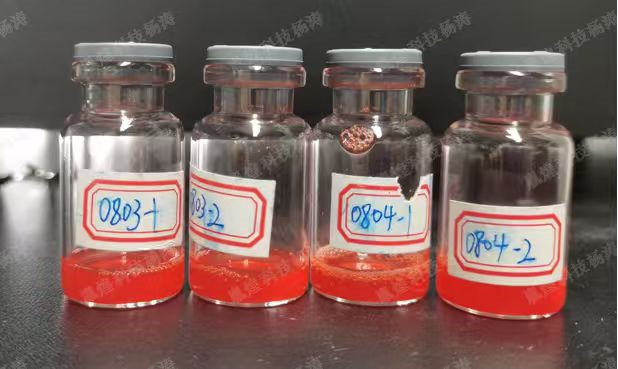
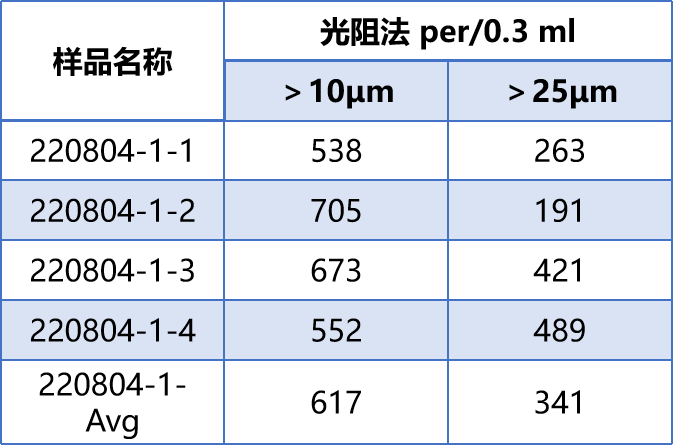
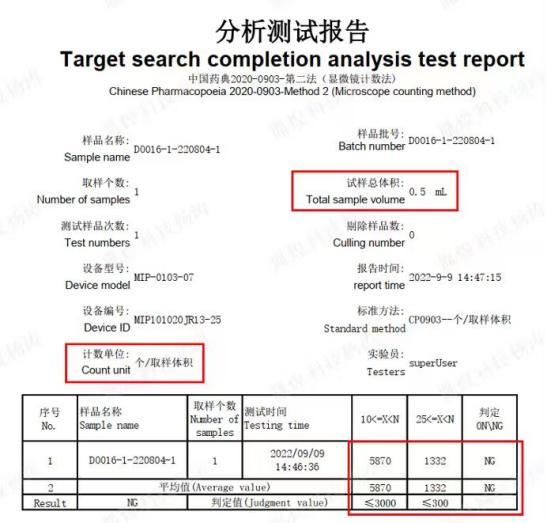
Light resistance method test results Microscopic counting method test results
Compared with the results of the photoresist method, the results were significantly lower than those of the microscopic counting method, which also confirms that the photoresist method can seriously underestimate the number of particles due to sample color interference, and there is a risk of false negatives. Based on the results of microscopic counting method, the batch samples should be judged as unqualified, and the deviation investigation procedure should be immediately initiated to investigate the factors that may introduce particles in the production, filling, and filtration processes. At the same time, particle pollution monitoring should be carried out on raw materials and packaging materials to evaluate the integrity of filter materials and the cleanliness of equipment.

YH-MIP-0103 Microscopic Counting Insoluble Particle Analyzer
This case confirms that for injections with colored or complex matrices such as doxorubicin hydrochloride liposomes, microscopic counting method has irreplaceable advantages in accurately identifying and quantifying insoluble particles. The results are not affected by the color of the solution and can truly reflect the level of particle contamination, avoiding safety risks caused by limitations in detection methods. Adopting this method not only ensures product quality meets pharmacopoeia requirements, but also provides reliable basis for process optimization and quality traceability, effectively ensuring patient medication safety.