-
E-mail
info@yh-tek.com
-
Phone
13390845525
-
Address
No. 18 Hangchuan Road, Pudong New Area, Shanghai
Shanghai Yinhuang Technology Co., Ltd
Common points and differences between insoluble particles and visible foreign substances under the new regulations of the 2025 edition of the Chinese Pharmacopoeia
Date: 2025-09-02Read: 0
In the field of injection quality control, insoluble particles and visible foreign substances are two key physical pollutants that directly affect the safety of clinical medication. The promulgation and implementation of the 2025 edition of the Chinese Pharmacopoeia have made significant revisions and improvements to the testing standards and control requirements for these two types of substances, marking a new stage of refinement and scientification in China's drug quality control system. These updates not only reflect the advancement of detection technology, but also reflect the comprehensive improvement of drug safety requirements by regulatory agencies, especially the emphasis on special routes of administration drugs (such as intraocular injections and intrathecal injections).
Insoluble particles refer to non intentionally introduced and movable insoluble particles in a solution, except for bubbles. Its particle size is1μm~50μmbetween.
Visible foreign objects refer to substances present in injections and eye fluidsIn formulations and sterile raw materials, under specified conditionseyeThe particle size or length of insoluble substances that can be observed is usuallygreater than50µm.
They have the following important commonalities in essence:
Physical and chemical commonalities: Both belong to insoluble foreign substances in water, and are non pharmaceutical components and non therapeutic essential substances in injections. Their presence does not increase the therapeutic effect of drugs, but can instead reduce the safety and stability of drugs.
Similarity of Pollution Sources:Insoluble particles and visible foreign objects may be introduced during the production, packaging, transportation, or storage of drugs. The main sources can be divided into two categories: exogenous and endogenous. One of the core objectives of Good Manufacturing Practice (GMP) is to minimize the introduction of these pollutants through environmental control, process optimization, and packaging material selection.
Consistency of quality control objectives:From the perspective of drug quality control system, the control of insoluble particles and visible foreign substances together constitutes aA multi-level physical pollutant prevention and control system. The new version of the pharmacopoeia requires simultaneous testing of both, with quality control conducted from both macroscopic (visible foreign matter) and microscopic (insoluble particles) dimensions to ensure that injection products meet clinical safety requirements in terms of physical purity. This dual protection mechanism can effectively reduce clinical risks caused by physical pollutants, especially for injections that directly enter the human bloodstream.
comparative dimension |
CP0904 Visible Foreign Object Inspection Method |
CP0903 Insoluble Particle Inspection Method |
Main testing methods |
Lamp inspection method, light scattering method |
Photoresist method, microscopic counting method |
core equipment |
Visible foreign object inspection umbrella shed light, automatic light inspection machine |
Optical resistance insoluble particle analyzer, microscopic counting insoluble particle analyzer |
Detecting environmental requirements |
Darkroom environment, specific lighting intensity |
Clean the workbench to avoid environmental pollution particles |
Personnel qualification requirements |
Corrected visual acuity of 5.0 or above, no color blindness |
Professional technical training, instrument operation ability |
Comparison Table of Insoluble Particles and Visible Foreign Matter Detection Methods
Insoluble particle detection technology:The main methods used are photoresist method and microscopic counting method. The photoresist method utilizes the blocking effect of particles on light passing through the detection area for particle size analysis and counting, and is suitable for large logarithmic clear near water solutions; The microscopic counting method directly counts through membrane filtration and microscopic observation. Suitable for formulations with high viscosity, easy to precipitate crystals, or prone to bubble formation. In the United States Pharmacopeia USP<1787>, the flow cytometry dynamic imaging method is included for the detection of insoluble particles in protein drugs. It can detect protein aggregation, bubbles, and silicone oil particles in the original solution, and reflect the true morphology of particles in the real-time state of the drug.
Visible foreign object detection technology:The main methods used are lamp inspection and light scattering. The pharmacopoeia emphasizes the acceptable standards for fine visible foreign objects such as point like objects, short fibers below 2mm, and block like objects. The newly added<9016 Guidelines for Visible Foreign Matter Control in Injections>in the new version of the Pharmacopoeia states that for emulsion type injections, suspension type injections, cell preparations, and colored solubilizersLiquid, freeze-dried injection preparations, injections packaged in opaque or colored containers, pre filled injections, powder liquid double chamber bags, injections with large or very small capacity, etc,Microscopic counting method can be used for supplementary examination.
Visible foreign object inspection is a mandatory inspection item for all injections and ophthalmic liquid preparations; The 25th edition of the Pharmacopoeia has expanded the scope of insoluble particle testing, from "intravenous use" to all injections, and added the<3903 Non soluble particle testing method for ophthalmic injections of biological products>and<4206 Non soluble particle testing method for pharmaceutical packaging materials>, reflecting the importance of controlling the entire life cycle of insoluble particles in drugs.
The control requirements for insoluble particles and visible foreign substances in the 2025 edition of the Chinese Pharmacopoeia mark a new stage of more refined and scientific drug quality control in China. By clearly distinguishing the differences between the two in particle size range (>50 μ m and 1-50 μ m), detection methods (lamp inspection/light scattering method and light resistance method/microscopic counting method), and applicable scope (all injections and intravenous/intrathecal injections), while emphasizing their commonalities in quality control as non therapeutic essential substances, the new version of the pharmacopoeia has established a more comprehensive quality control system for insoluble substances.
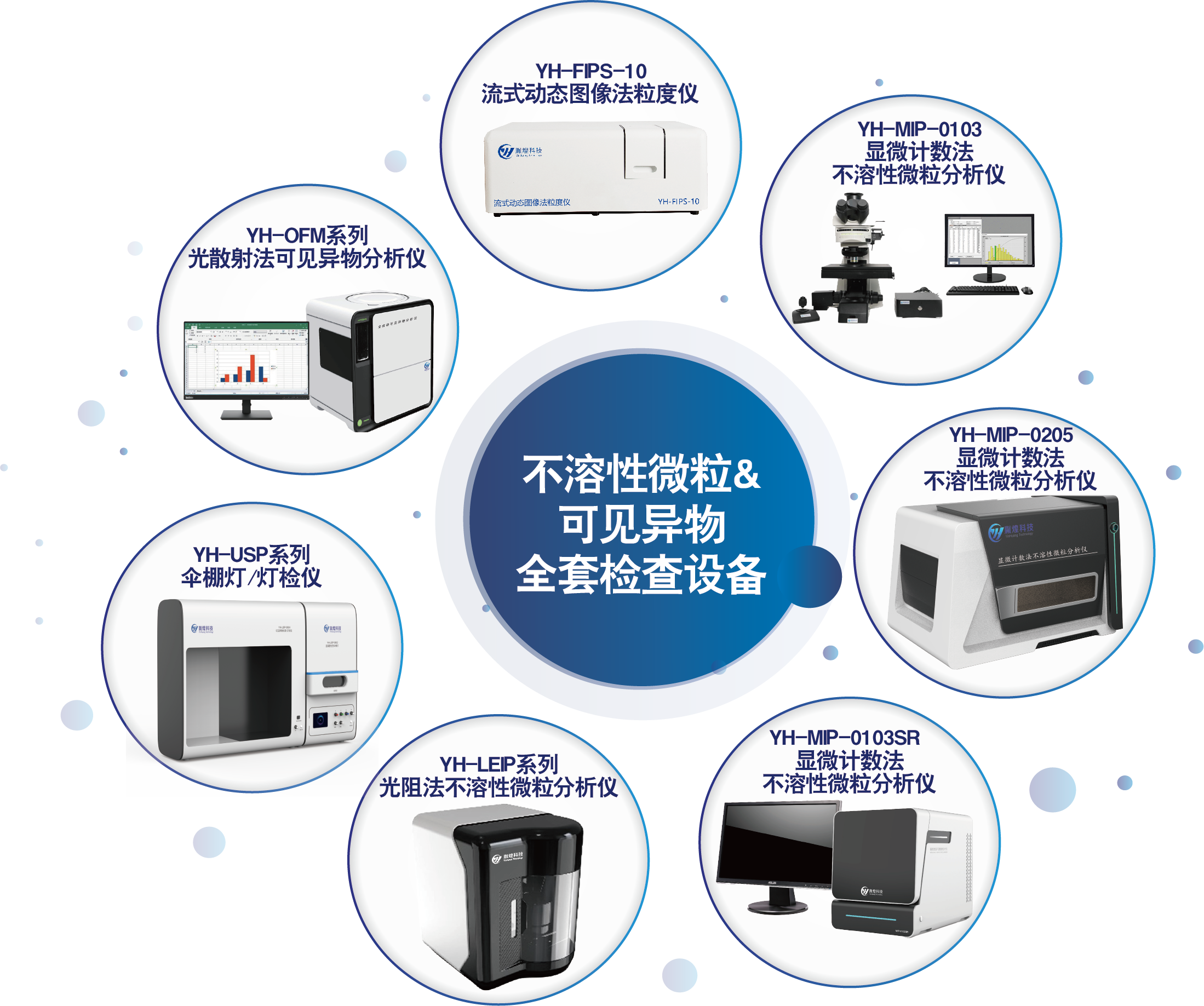
Yinhuang Technology has been deeply involved in particle detection in the pharmaceutical industry for many years. It has the YH-LEIP series photoresist insoluble particle analyzer, YH-MIP series microscopic counting insoluble particle analyzer, YH-OFM visible foreign matter analyzer, YH-FIPS series flow dynamic image particle analyzer, and YH-USP umbrella lamp series, which have received widespread attention and recognition in the industry and accumulated a large number of users.