-
E-mail
654388291@qq.com
-
Phone
18610205680
-
Address
Room 257, Q Zone, 2nd Floor, Building 1, No. 9565 Huqingping Road, Qingpu District, Shanghai
Shanghai Yingle Instrument Co., Ltd
GB18457-2024 Standard Requirements for Injection Needle Resilience Tester
Date: 2025-12-05Read: 0
The GBIT 18457-2024 standard is a testing standard specifically designed for the toughness of medical syringes. The development and implementation of this standard aims to ensure the safety and effectiveness of medical needles in practical use, and is applicable to various types of medical needles, including but not limited to injection needles, blood collection needles, etc. This standard provides detailed specifications for the size, surface, and mechanical properties of needle tubes, especially for the size requirements of ultra-thin and extremely thin-walled needle tubes.
Product Introduction
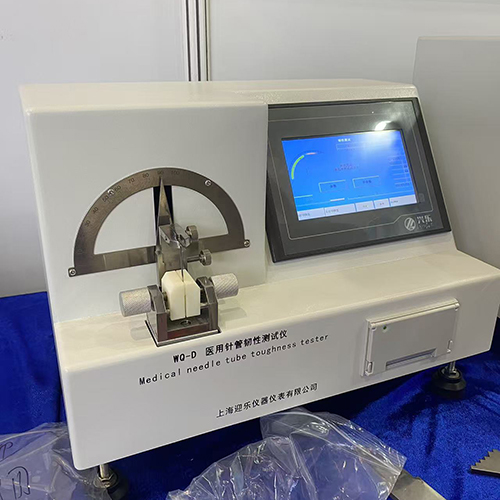
The injection needle tube toughness tester consists of professional Linux software design, PLC intelligent controller, positioning mechanism, swinging mechanism, fixture and other parts. Used to test the toughness of medical needle tubes (needles), with a 7-inch K600+core/dot matrix 65 to 800 * 480 resolution touch screen display, and a PLC control system dynamically displaying the loading force value; Digital closed-loop control, AD acquisition speed of 500KHz, internal code of 500000; High precision clock core, power-off storage; Overload alarm shutdown protection; Touch operation: nominal specifications, pipe wall, number of tests, pressurization, up and down movement, time, calibration. Touch menu based interface for convenient and efficient use; Professional software, supported by remote maintenance and upgrades; And there is multi-level permission management, which facilitates the standardized use of laboratory management personnel; Equipped with a micro printer and USB port, it is convenient for customers to print and save test results.
Standard requirements:
GB18457-2024 physical performance requirements for stainless steel needle tubes: The needle tubes need to have appropriate rigidity and toughness to ensure that they will not easily deform or break during puncture and other operations. The requirements for rigidity testing specify parameters such as the magnitude of applied force, span, and corresponding range of deflection values; The toughness test evaluates the fracture resistance of the needle tube through prescribed bending or tensile tests.
Applicable products:
Injection needles: including intradermal, subcutaneous, intramuscular, and intravenous injection needles, such as disposable sterile injection needles. When injecting drugs, stainless steel needle tubes need to have good rigidity, toughness, and corrosion resistance to ensure the safety and accuracy of the injection process, and avoid bending, breaking, or causing harm to the human body.
Blood collection needles: Blood collection needles used to collect human blood, and their needle tubes must also comply with this standard. Standard stainless steel needle tubes can ensure a smooth blood collection process, reduce damage to blood vessels, and ensure the sterility and biocompatibility of blood collection needles, preventing infections and other adverse reactions.
Acupuncture and moxibustion needles: Needles used for traditional Chinese medicine acupuncture and moxibustion treatment need to have a certain rigidity and toughness, so as to accurately puncture the acupoints and conduct manual operations. The standard stainless steel needle tube can ensure the quality and performance of acupuncture and moxibustion needles, improve the treatment effect and reduce the pain of patients.
Other medical devices, such as insulin pen needles, pre filled syringe needles, and indwelling needle tubes, have strict performance requirements for the needle tubes during use and need to comply with the GB/T 18457-2024 standard to ensure product quality and safety.
Test method:
The instrument can simulate the stress conditions of medical needles in actual use by conducting bending and tensile tests. By measuring key indicators such as deformation and fracture force, the toughness performance of the needles can be accurately evaluated. The WQ-D medical needle toughness tester launched by Shanghai Yingle strictly follows the GB18457 standard and is specifically designed to consider the toughness of injection needles under various external forces. The equipment has an automated control system that can automatically complete the testing, providing reliable basis for quality control of needles.