-
E-mail
sales@eachwave.com
-
Phone
15618996225
-
Address
Room 707-709, No. 955 Jianchuan Road, Minhang District, Shanghai
Shanghai Yichi Optoelectronic Technology Co., Ltd
Spectral application of single cavity dual comb laser
Date: 2025-05-30Read: 0
High speed monitoring of multiple gases
introduction
Dual comb spectroscopy is a powerful technique widely used in various practical applications. It plays a crucial role in environmental monitoring, industrial process control, atmospheric research, combustion analysis, and many other fields. Spectroscopy provides valuable insights into gas composition, concentration, and other properties by measuring the interactions between light molecules and gas molecules.
Broadband methods, such as Fourier transform spectroscopy, are commonly used for gas spectroscopy. Fourier transform spectroscopy uses interferometers to measure the relationship between light intensity and wavelength. This method can capture the entire spectrum simultaneously, allowing for the analysis of multiple gases in a single measurement.
Main challenge: Optical delay scanning in Fourier transform spectroscopy
Traditional Fourier transform spectroscopy faces challenges in achieving high resolution and fast update rates. Spectral resolution is limited by differences in interferometer arm length, which may require unrealistic differences in optical delay paths. In addition, the mechanical scanning mechanism used in Fourier transform spectroscopy often imposes limitations in terms of speed, sensitivity, and reliability. These limitations have driven the demand for alternative methods that can overcome these challenges and provide higher performance in gas spectroscopic applications.
Dual comb spectroscopy
Dual comb spectroscopy is an excellent technique that utilizes the frequency of electric combsexcellentFeatures are used to achieve high-resolution gas spectra with fast update rates. Unlike traditional spectroscopic methods, dual comb spectroscopy does not rely on mechanical scanning or moving parts. On the contrary, it utilizes two precisely controlled frequency combs to generate stable and coherent temporal interference patterns, from which spectral information can be extracted through a simple Fourier transform.
In addition, dual comb spectroscopy provides a fast update rate, allowing for real-time and continuous monitoring of gas samples. By using simple photodiodes, the entire gas spectrum can be quickly captured without the need for mechanical scanning and high-speed data acquisition. This fast update rate is particularly valuable for dynamic gas analysis and process control applications that are crucial for real-time measurement.
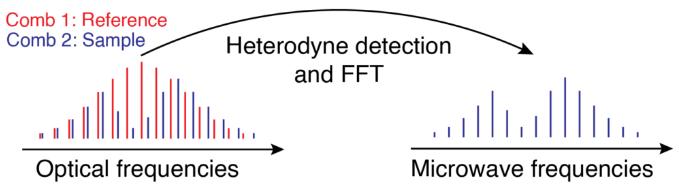
Diagram of optical delay scanning parameters in THz TDS system driven by a single cavity dual comb laser. The optical delay scan with a length of 1/frep is repeated every 1/Δ frep, given by the detuning Δ frep of two comb like repetition rates frep
Dual comb spectroscopy using a single cavity dual comb laser
In the field of dual comb spectroscopy, single cavity dual comb lasers provide a special method for achieving high-resolution gas analysis. However, in a single cavity configuration, a common challenge arises due to the limited coherence time between the two optical combs, which typically operate freely.
To address this challenge, two main strategies are adopted: rapid measurement or additional processing steps to achieve long-term coherent averaging. In the case of rapid measurement, data acquisition must be carried out at high speed in order to capture the required information within a limited coherence time. This method allows for real-time analysis of gas samples, but may impose limitations on certain applications.
Alternatively, in single cavity dual comb spectroscopy, additional processing steps can be employed to achieve long-term coherent averaging. One method is to introduce an auxiliary continuous wave (CW) laser to track the relative phase changes between optical combs. This auxiliary laser provides a reference for coherent averaging and can achieve long-term stable measurements without the need for external stabilizing electronic devices.
Another technique is to operate the optical comb with a higher repetition frequency difference, thereby achieving self consistent relative optical phase sampling. In this case, comb line resolution measurement results can be obtained within an infinite measurement time. This method does not require stable electronic devices and can still achieve accurate gas analysis.
Both strategies enhance the capability of single cavity dual comb spectroscopy, enabling high-resolution gas measurements over a longer period of time. The single cavity dual comb laser can obtain comb line resolution measurement results without relying on stable electronic devices, providing a more easily implementable and practical solution for gas sensing and process control applications.
Advantages of K2 Photonics in High Resolution Fourier Transform Spectroscopy
• Fast scanning speed
Single cavity dual comb lasers can perform high-resolution measurements with excellent update rates, up to 100 kHz, and even close to 1 MHz in special cases.
• High precision
Dual comb spectroscopy provides high measurement resolution and enables precise sampling of gas absorption characteristics. Using the K2-1000 system, excellent 1 GHz resolution can be achieved, making it ideal for gas sensing under ambient air conditions.
• Small size
Without the need for long and complex mechanical delay lines, the implementation of high-performance Fourier transform spectroscopy is greatly simplified.
• High sensitivity
A mode-locked solid-state laser produces laser with ultra-low noise (RIN and timing) at high frequencies, enabling high sensitivity and measurement with limited shot noise.