-
E-mail
seven@shanion.com
-
Phone
13916482192,13917955045
-
Address
Room 507, No. 2 Yinghua International Plaza, Lane 2899 Guangfu West Road, Shanghai
Shanghai Xinlian Creative Electronics Co., Ltd
What is CIELAB color space?
Date: 2025-10-24Read: 50
Although the human eye can perceive millions of colors, it may not be able to accurately distinguish them. Two colors with slight differences may appear the same, and the same color may also exhibit differences under different perspectives and lighting conditions. This poses a challenge to color communication. For designers and manufacturers, the inability to accurately identify and communicate colors can make standard replication and difference detection work more complex.
To achieve accurate reproduction of colors, manufacturers and designers need to use methods that quantify color attributes and calculate numerical differences. CIELAB (i.e. CIE L * a * b *) is a device independent three-dimensional color space that measures and compares all perceptible colors through three numerical values. In this space, numerical differences directly correspond to the degree of change that can be discerned by human senses.
CIELAB is based on the theory of contrasting colors, which suggests that the human brain interprets retinal input as differences in brightness and contrasting color pairs (red/green, blue/yellow). This is the principle of color opposition correlation - a color cannot simultaneously exhibit the characteristics of red and green, yellow and blue. For example, you will never see 'red with green'.
What is the CIELAB color model?
L. The a and b color spaces were defined by Richard S. Hunter, the founder of HunterLab, in 1942. Hunter's system uses coordinates labeled L, a, and b, which are calculated based on the CIE 1931 XYZ color space to achieve better perceptual uniformity. In 1976, the International Commission on Illumination (CIE) created the CIELAB model based on the Hunter system as an improved solution. To distinguish between the two, CIELAB uses L *, a *, and b * labeling methods. CIE "originates from the French name of the organization: Commission Internationale de l 'É clairage (International Commission on Illumination).
Hunter L, a, b and CIELAB (L *, a *, b *) are both based on the theory of contrasting colors, which suggests that the human eye perceives colors through contrasting colors
L axis:Light and dark are in opposition, with low values (0-50) indicating darkness and high values (51-100) indicating brightness.
A-axis:Red and green, positive values indicate red, negative values indicate green.
B-axis:Yellow and blue, positive values represent yellow, negative values represent blue.
The ideal color scale should maintain uniformity, that is, the unit color difference should be visually equivalent and not affected by hue. In practical applications, both Hunter L, a, b, and CIELAB color levels cannot be uniform. The Hunter color scale calculates brightness (L) by applying a square root function to Y/Yn, which compresses the values in the yellow region and expands the values in the blue region. In contrast, CIELAB uses cube root functions to handle X/Xn, Y/Yn, and Z/Zn, and performs linear extension when approaching black. Although this overall improves uniformity, CIELAB often excessively expands the yellow region in the color gamut. Both color code systems are effective in measuring and setting tolerance standards. However, CIELAB is usually closer to visual perception. Through practice, both systems can support intuitive understanding and communication of color values.
Color Calculation in CIELAB Model
When measuring color, it is necessary to use a spectrophotometer to analyze the sample. The instrument illuminates the sample through directional (45 °/0 °) or diffuse (d/8 °) geometric structures and collects reflected light in a standardized manner to ensure measurement accuracy.
The spectrophotometer records the reflectance (% R) of the sample, which is the percentage of reflected light at each wavelength (usually 400-700 nanometers) in the visible spectrum. These data are converted into tristimulus values, which take into account standard light sources and observer functions. Subsequently, the values of the three stimuli were converted into the L * a * b * coordinate system.
In this three-dimensional system
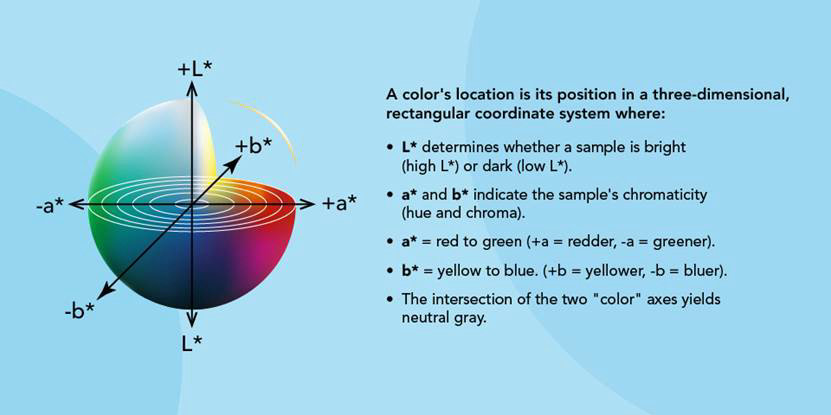
The L * value determines brightness, with higher values indicating brightness and lower values indicating darkness.
The value of a * describes the position of a color between red (+a) and green (- a).
The b * value describes the position of a color between yellow (+b) and blue (- b).
When a *=0 and b *=0, the color is neutral gray, and its brightness is determined only by the L * value.
The vertical L * axis range is from 0 (black) to 100 (white).
These values are widely used in various industries. For example, in the food industry, L * can indicate the brightness of baked goods such as bread wrappers, a * can measure the redness of meat or tomato products, and b * can reflect the yellowness of cheese or pasta. Calculating color difference based on CIELAB can achieve precise food quality control, ensuring consistency in appearance and meeting consumer expectations. In addition to the food industry, CIELAB values are also widely used in industries such as plastics, textiles, coatings, and printing to ensure consistency in color reproduction.
The CIELAB model represents each color through points in the coordinate system, covering infinite possibilities. Based on these values, the total color difference Δ E00 between the two colors can be quantified through additional calculations.
Gain a deeper understanding of color measurement
Color models such as CIELAB can simplify specification communication and ensure production consistency. The spectrophotometer provided by HunterLab is designed specifically for precise measurement and control of color. Contact us immediately to learn how our instruments can assist you in your work.
Last Article: Operation and usage methods of glass colorimeter
Next Article: How to accurately measure the color of plastic?