-
E-mail
2356253838@qq.com
-
Phone
18918225919
-
Address
206, Building 5, No. 319 Tongli Road, Jiuting Town, Songjiang District, Shanghai
Shanghai Spectral Analysis Instrument Co., Ltd
When using spectrophotometry to measure iron, copper ion interference should be avoided
Date: 2025-10-14Read: 2
In analytical laboratories, the use of Shanghai Spectral TU1810plus and spectrophotometry to determine iron content is a common and important analytical item. However, many experimenters often underestimate a key interfering factor - the interference of copper ions (Cu ² ⁺) - when using ortho phenanthrene spectrophotometry to measure iron.
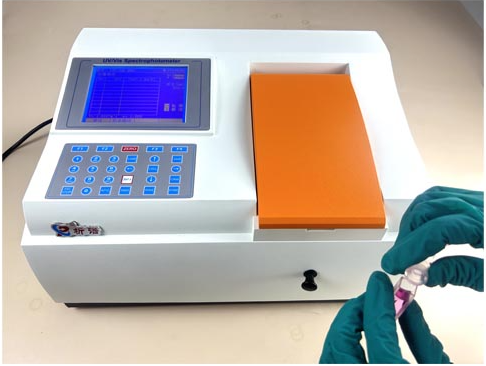
When measuring iron ion concentration using Shanghai Spectral TU1810plus,If copper ions are present in the sample, even at low concentrations, they will react with the chromogenic reagent ortho phenanthrene to form a complex that absorbs at 510nm, directly leading to an increase in absorbance readings and causing false overestimation of iron determination results.
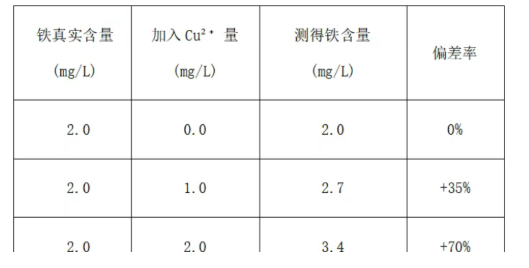
From the above table, it can be seen that with the increase of copper ion concentration, the deviation of iron determination results significantly increases.
Three solutions
1、 EDTA masking method (recommended)
Before adding the color developer, add 1-2 mL of 0.1 mol/L EDTA solution. The stability constant of EDTA complexation with Cu ² ⁺ (logK=18.8) is much higher than that with Fe ² ⁺ (logK=14.3), which can effectively mask copper ion interference.
2、 Thiourea masking method
Thiourea can also form stable complexes with copper ions, achieving a masking effect. This method has little impact on the color development system.
3、 Standard joining method
For samples with complex components, the standard addition method can be used to eliminate matrix interference by drawing a standard curve.
Experimental suggestion: Key points to avoid stepping on pitfalls
1. Prediction of interference: Understand the possible interference ions in the sample before the experiment
2. Standardized operation: strictly follow the method sequence to add reagents (first add masking agent, then add color developing agent)
3. Synchronous processing: The standard curve and the sample need to be synchronously treated with an equal amount of masking agent
4. Method validation: Verify the accuracy of the method through spiked recovery experiments