-
E-mail
13818112855@139.com
-
Phone
18930698865,13818112855
-
Address
No. 8651 Hunan Highway
Shanghai Shenshe Scientific Instrument Equipment Co., Ltd
Measurement principle of extended online viscometer: precise analysis from vibration attenuation to rheological control
Date: 2025-11-18Read: 1
Real time monitoring of fluid viscosity is a core parameter for ensuring process stability in industrial scenarios such as petrochemicals, food processing, and new energy materials.As an upgraded version of traditional equipment, the extended online viscometer achieves accurate measurement of fluid viscosity in pipelines by extending the length of the sensor probe and optimizing the structural design. Its measurement principle is mainly based on two technical paths: vibration attenuation method and rotational resistance method.
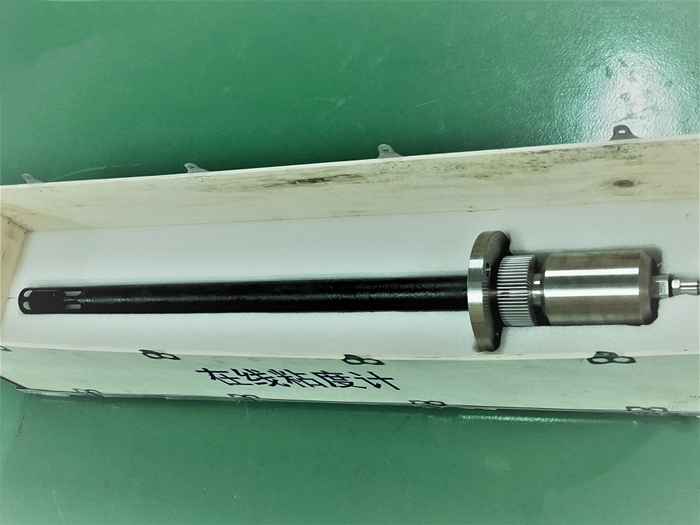
1、 Vibration attenuation method: a physical model of energy compensation and viscosity correlation
The core component of the elongated vibrating online viscometer is a slender torsion bar, with two inertial mass blocks connected at each end. The upper mass block is exposed to the air, while the lower mass block is immersed in the fluid to be tested. When the ceramic actuator applies high-frequency torsional vibration to the torsion bar, the mass in the air maintains stable vibration due to inertia, while the mass in the fluid experiences amplitude attenuation due to viscous damping. The system maintains the original vibration state of the torsion bar by continuously replenishing energy, and the magnitude of the replenished energy is linearly related to the fluid viscosity.
2、 Rotating Resistance Method: Dynamic Balance between Shear Stress and Rotational Speed
The extended rotary online viscometer adopts a coaxial dual rotor structure, with the outer rotor fixed to the inner wall of the pipeline and the inner rotor driven to rotate by a motor. The fluid viscosity is indirectly calculated by measuring the relationship between the internal rotor speed and torque. When the viscosity of the fluid increases, the inner rotor needs to overcome greater viscous resistance, resulting in a decrease in speed or an increase in motor current.
3、 Technological advantages and industrial application scenarios
The elongated design significantly improves measurement stability and anti-interference ability by extending the sensor's action path. In the scenario of oil pipeline transportation, it can penetrate the fluid layer with a diameter of 300mm, avoiding measurement deviation caused by uneven flow velocity distribution; In the food mixing tank, the extended probe can penetrate deep into the bottom of the tank to monitor the mixing uniformity of high viscosity jam in real time. In addition, some models integrate multi parameter monitoring modules that can synchronously output viscosity, temperature, and density data, providing multi-dimensional decision-making basis for process control.
From energy compensation for vibration attenuation to dynamic balance of rotational resistance, the extended online viscometer achieves millimeter level precision control of fluid viscosity through deep optimization of physical models. With the increasing demand for process transparency in Industry 4.0, these devices are becoming crucial "rheological sentinels" in intelligent manufacturing.