Temperature is one of the most commonly measured key parameters in industrial process control, equipment monitoring, and experimental research. Thermocouples and RTDs are the two most mainstream contact temperature sensors, but their working principles, performance characteristics, and applicable scenarios are completely different. Incorrect selection can lead to inaccurate measurements, equipment damage, and even production accidents.
1、 Core difference: The working principle determines the essential characteristics
1. Thermocouple
Principle:based onSeebeck effectConnect two different metal conductors end-to-end to form a closed circuit. When there is a temperature difference between two connection points (measuring end and reference end), a thermoelectric potential is generated in the circuit, resulting in current. By measuring this potential difference, the temperature at the measuring end can be calculated.
Key features:
Self generating type:Signal can be generated without external power supply.
The measurement is temperature difference:The temperature of the reference end (cold end) needs to be known in order to calculate the temperature of the measuring end. Modern instruments usually have built-in cold end compensation.
2. Resistance Temperature Detector (RTD)
Principle:based onThe resistance value of a metal conductor changes with temperatureThe characteristics. Usually made of high-purity platinum (Pt), copper (Cu), or nickel (Ni). The commonly used one is Pt100 (with a resistance of 100 Ω at 0 ° C).
Key features:
External incentives are needed:A constant current source or voltage source is required to measure the change in resistance.
The measurement is absolute temperature:The output signal is proportional to the temperature itself and does not require cold end compensation.
2、 How to choose? Follow the following decision-making process
Step 1: Determine the temperature measurement range
> 600°C:almostUnconditional selection of thermocoupleFor example, in high-temperature environments such as boilers, heat treatment furnaces, and gas turbine exhausts.
< -50°C:Both are acceptable, but platinum thermistors have better linearity and higher accuracy in deep and low temperature regions.
-50°C ~ 600°C:This isOverlapping intervalIt is also a key area for selection and needs to enter the next step of judgment.
Step 2: Clarify accuracy and stability requirements
Pursuing high precision and stability:In the overlapping range, if the process requires strict temperature control (such as biochemical reactions, precision material synthesis, high-precision liquid measurement),Prioritize the selection of thermistor (Pt100)Its reliability and accuracy far exceed that of thermocouples.
The accuracy requirements are generally moderate, with a certain margin of error allowed:Thermocouples can be chosen for greater cost-effectiveness.
Step 3: Consider response speed and size
Need to quickly respond to temperature changes:For example, controlling the temperature for rapid response or measuring the temperature of the airflow,Thermocouples with small wiresFaster response time.
No special requirements for response speed:Both are acceptable.
Step 4: Analyze the environment and mechanical durability
In severe vibration situations: thermal resistorThe platinum wire is relatively thin and may break under strong vibration.thermocoupleMade of thick alloy wire,More resistant to vibration and impact.
Corrosive environment:Both need to choose the appropriate oneMaterial of protective sleeve(such as 316 stainless steel, Hastelloy, ceramics, etc.) to cope with corrosive media. The principle itself has no advantages or disadvantages.
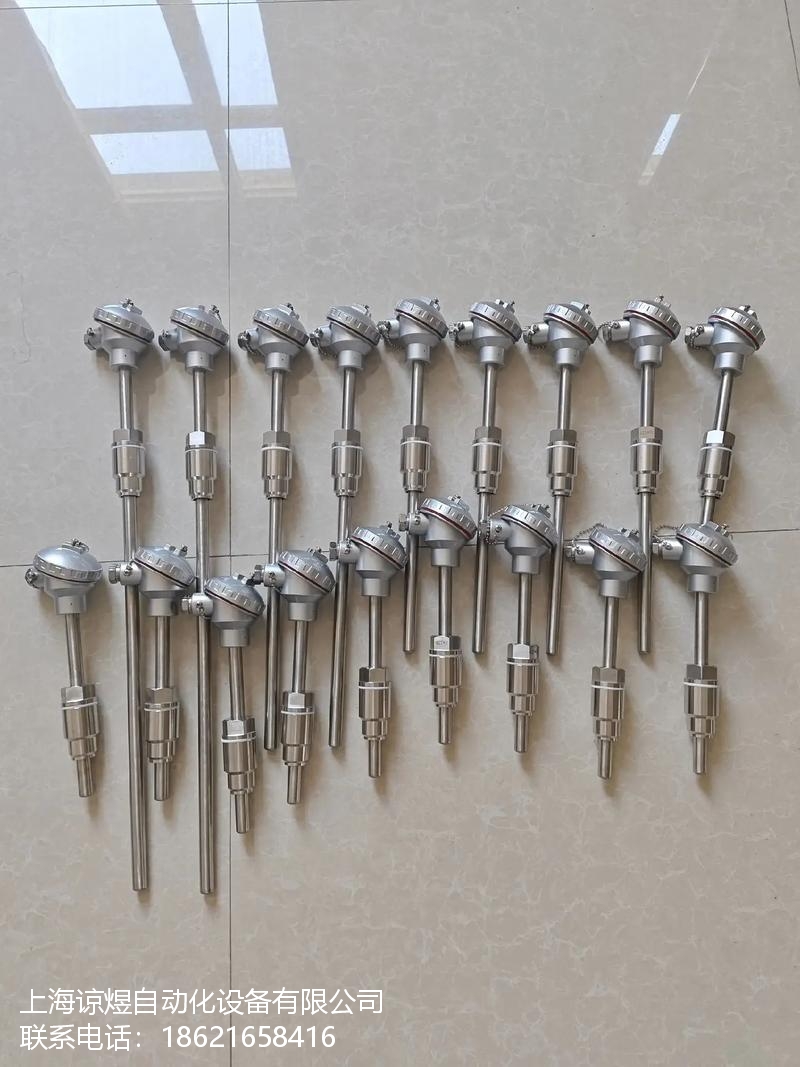
3、 Additional details: Thermocouple scale and resistance wire system
Thermocouple division number:Metal combinations of different materials correspond to different scale marks (such as K-type, S-type, B-type, R-type, etc.), and their thermoelectric properties and applicable temperature ranges are different.K-typeNickel chromium nickel silicon is a commonly used universal thermocouple with high cost-effectiveness and a wide range.
Thermal resistance wire system:
2-wire system:Lead resistance can introduce measurement errors and result in low accuracy, making it suitable for applications with low requirements.
3-wire system:The influence of lead resistance can be eliminated through bridge circuitsThe most mainstream in industryThe connection method.
4-wire system:Eliminating lead resistance errors with the highest accuracy, mainly used in laboratories or high-precision standard instruments.
4、 Summary and Selection Formula
Choose a thermocouple when:Measuring high temperature requires speed, tight budget, and high vibration.
Choose a thermal resistor when:Precision, stability, moderate temperature, and sufficient budget are required.
The correct selection is the first step in ensuring the reliable, accurate, and economical operation of temperature measurement systems. I hope this article can provide you with a clear path among the diverse sensor options. In practical applications, it is necessary to comprehensively consider factors such as protective sleeves, installation methods, and connecting wires