-
E-mail
heshengcn@163.com
-
Phone
13918154651
-
Address
201b, Building B, Fufeng Technology Industrial Park, No. 1200 Fenghua Road, Hongqiao Business District, Shanghai
Shanghai Hesheng Instrument Technology Co., Ltd
Differential Scanning Calorimeter: The "Golden Eye" of Material Thermal Analysis
Date: 2025-12-09Read: 0
Differential Scanning Calorimeter (DSC) is a thermal analysis instrument that accurately measures the temperature difference between a substance and a reference substance. With its high sensitivity, wide temperature range, and fast response, it has become a detection tool in fields such as materials science, chemical engineering, and biomedicine.
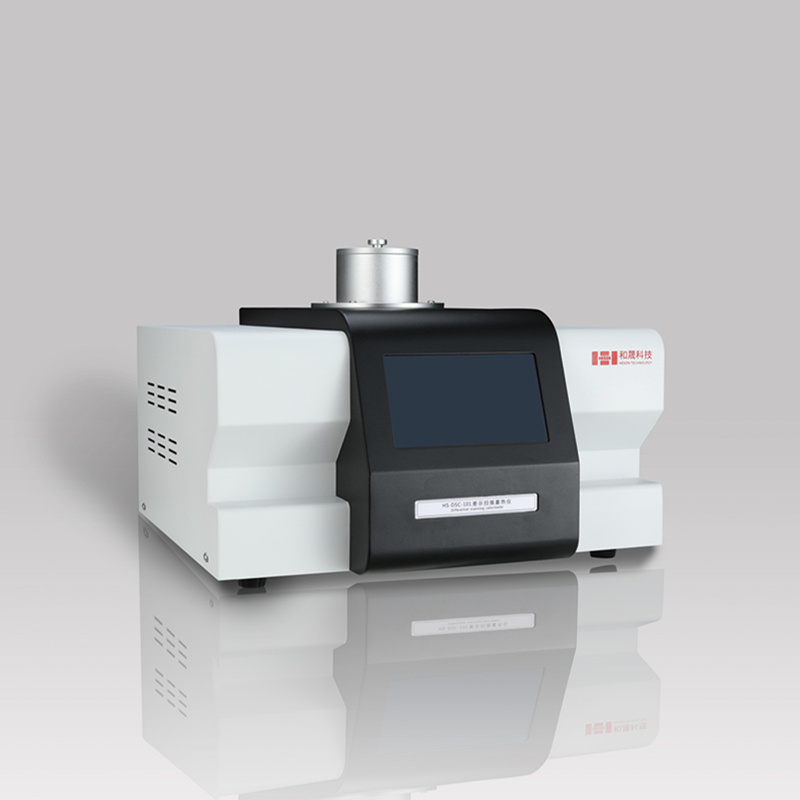
Shanghai Hesheng HS-DSC-101 Differential Scanning Calorimeter
Its working principle is based on the core of "differential measurement": placing the sample and inert reference material in the same heating or cooling environment, and monitoring the temperature difference and heat supply difference between the two in real time through sensors. When the sample undergoes thermal effects such as phase transition, decomposition, oxidation, etc., it will absorb or release heat, resulting in a temperature difference between the sample and the reference material. The instrument compensates for the heat difference through a compensation circuit, and finally presents the thermal behavior characteristics of the material intuitively through a "differential scanning calorimetry curve".
In practical applications, DSC's functions cover multiple scenario requirements. In the field of materials, the glass transition temperature, melting point, and crystallinity of polymers can be accurately measured, providing data support for formula optimization and processing technology adjustment of plastics, rubber, and other materials; In the field of chemistry, the ability to analyze the enthalpy changes and reaction kinetics parameters of chemical reactions can assist in the development of new catalysts and the exploration of reaction mechanisms; In the field of biomedicine, the thermal stability of proteins, purity, and expiration date of drugs can be detected, providing protection for drug development and quality control.
Compared to other thermal analysis instruments, DSC has significant advantages such as low sample usage (only milligrams required), easy operation, and accurate data. Modern DSC technology integrates program temperature control, real-time data acquisition, and intelligent analysis functions, enabling wide temperature range measurement from -150 ℃ to 700 ℃, meeting diverse detection needs from low-temperature phase transition to high-temperature decomposition.
As the "golden eye" for exploring the thermal properties of matter, differential scanning calorimetry not only promotes the in-depth development of basic scientific research, but also plays an irreplaceable role in quality control and product innovation in industrial production, becoming an important bridge connecting laboratory research and practical applications.