Data analysis and processing flow for consistency evaluation of rheological parameters of drug formulations
Date: 2025-11-17Read: 0
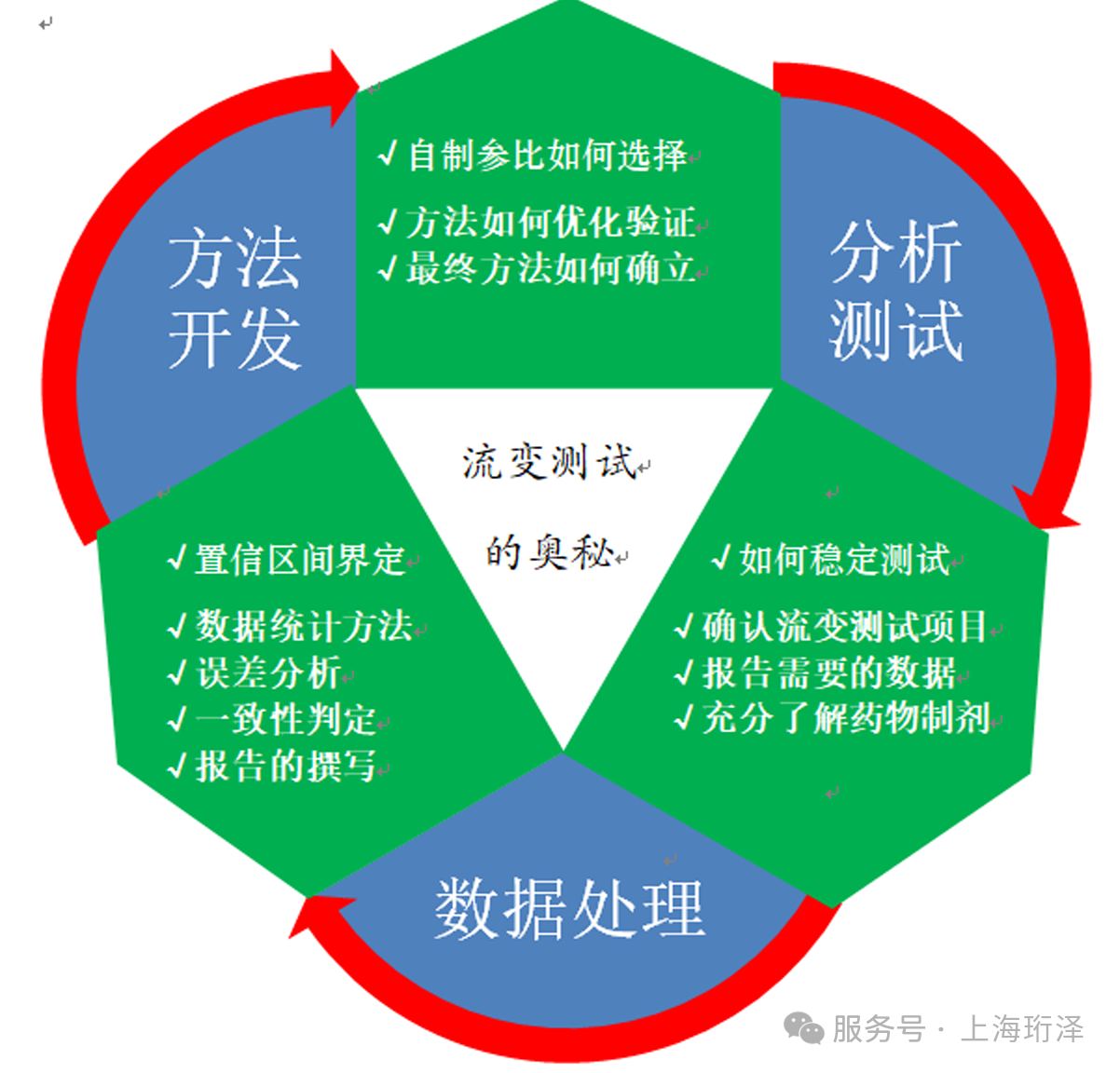
I have been providing technical services in rheology for nearly 11 years and have been trying to find a way to express it in a way that simplifies flow changes. At least, when our users see phenomena in their daily lives, they will think that they may be related to rheology.
Regarding pharmaceutical preparations, especiallyexternal preparationSince 2018, there has been an increasing reliance on rheology for key quality attribute Q3 physicochemical characterization, including patches, nasal sprays, embolic agents, etc. With the continuous evolution of regulatory agencies, rheology plays an increasingly important role in the consistency evaluation of drug formulations and innovative drug applications. At present, there is no readily available method or process for evaluating the consistency of rheological data. The processing flow presented here is based on our company's long-term data accumulation and technical service experience in rheological testing, and is shared with all formulation analysts who are currently engaged in rheological testing. The words of one family can inspire valuable insights, and we welcome your generous guidance.Step 1: Fully understand the drug formulation and choose the correct rheometer configurationKnowing oneself and one's enemy is essential for the rapid, accurate, and scientific development and optimization of rational rheological methods. For the drug itself, it is necessary to fully understand:1. The main matrix components that affect rheological properties;2. The main process parameters that affect rheological properties;3. The photosensitivity characteristics of the prescription;4. Volatility of prescriptions;5. Temperature characteristics of prescription: thermal sensitivity, low temperature tolerance;6. Are there particles, as well as their size distribution and size7. Droplet size and distribution in oil/oil or oil/water systems9. The final application scenarios of the formulation: topical application on the skin, oral administration, enteral delivery... and suitable temperature conditions;10. Storage requirements for formulations: temperature, humidity, and light;Special note: Patch 12. Is it easy to obtain on the substrate and what methods are needed for sample collection and preparation; 13. The influence of other excipients on the rheological properties of products, except for acrylic acid;Finally, based on the characteristics of the sample, select the correct equipment and configure it correctly; Step 2: Development and validation of rheological methodsIt is recommended to select at least 3 batches of reference materials and 3 batches of self-made materials for the development and validation of rheology. Ultimately, it is necessary to determine:2.1 Flow Curve: Temperature, rotor type and size, gap distance, achievable range of shear rate2.2 Viscosity: Fixed shear rate and shear time.2.3 Yield stress: Suitable testing methods: rotational stress scanning, rotational stress growth, or oscillation amplitude scanning. Our company suggests performing amplitude scanning. Parameters need to be determined: gap distance, temperature, strain range or stress range.2.4 Frequency scanning: Select appropriate deformation or stress and conduct tests at 100rad/s~0.1 rad/s or 15.92Hz~0.1 Hz. Determine a reasonable testing gap distance.2.5 creepreply Optimize the set stress, creep time, and recovery time. This is crucial for the reproducibility of testing. The relaxation time after sample loading and the loading method are also crucial.2.6 Temperature scanning: The applied deformation, force control or gap control, rate of temperature change, and temperature rise or fall are all crucial.2.7 Self healing experiment of gel: three-stage, repeated for many times (3-5 times), the stress or deformation of the damaged section is critical.Acceptable standard: RSD of repeated test data is less than 20% (personal recommendation, refer to EMA21.36%). If there is significant variation in the test data during daily and weekly checks, the stability of the formulation should be considered first. Additionally, the impact of temperature and relaxation time on the test results during method development and optimization should be taken into account.Step 3: 12 repeated data analysis and processing procedures3.1 Normality determination of data: QQ chart, histogram, and S-W test are used to determine the normality of the original datanormal distributionDetermine the consistency assessment criteria (EMA) for GMR90% based on the CV% of the original data.3.2 Perform logarithmic conversion on data. Perform further analysis and processing after conversion.3.3 homogeneity of varianceJudgment.3.4 Based on the t-value and formula, calculate the reference and self-madeGMRConfidence interval range.3.5 meets the interval range of 3.1, and the consistency is passed.3.6 Report data quality parameters.3.7 Formulate rheological test conclusions and reports.
 Hengze TechnologyCommitted to providing rheological technology services, analysis and testing, instrument rental and sales, and promoting science popularization. If you have any questions, please feel free to communicate