-
E-mail
dafengyiqi@163.com
-
Phone
15201900748
-
Address
Building E, Lujiaguan Fu Industrial Park, No. 60 Jinzhu Road, Kunshan City, Jiangsu Province
Shanghai Dafeng Glass Instrument Factory
Guidelines for using a rotary evaporator, standardized operating procedures from installation to recovery
Date: 2025-08-22Read: 1
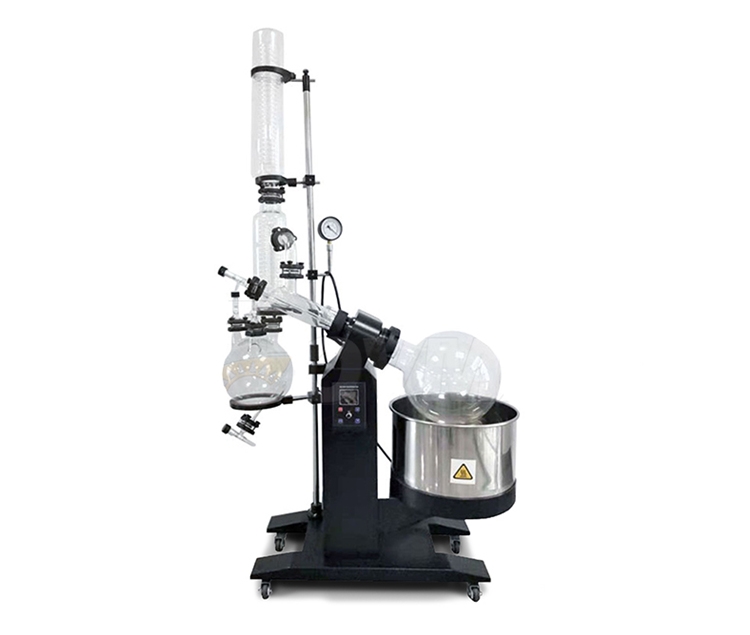
The rotary evaporator, as the core equipment for laboratory concentration solution and solvent recovery, can efficiently achieve liquid-liquid separation through rotary heating and condensation recovery technology under reduced pressure environment. This article takes the common 5L rotary evaporator as an example to systematically sort out its standardized operation steps and key precautions, helping researchers to complete experiments safely and efficiently.
1、 Preparation and equipment inspection before use
1. Component installation
① Connect the evaporator tube and condenser tube vertically to ensure that the silicone sealing ring is free of aging cracks;
② Install a 2L eggplant shaped distillation flask, and control the locking torque of the rotating shaft at 0.5-0.8N · m;
③ Connect the vacuum pump to the vacuum interface of the condenser tube, and apply vacuum silicone grease to the sealing surface.
2. System airtightness testing
Close all valves, start the vacuum pump until the system pressure stabilizes below 50mbar, and observe the pressure rise within 3 minutes after turning off the pump. If the rebound exceeds 20mbar, it is necessary to check the sealing of each interface.
2、 Standardized operating procedures
1. Solution loading and initial setup
① Inject the concentrated solution into the distillation flask (with a volume not exceeding 50% of the flask's capacity) and install splash proof balls to reduce the risk of boiling;
② Turn on the rotating motor and set the speed to 80-120rpm;
③ Set the heating temperature through a circulating water bath.
2. Vacuum system startup and pressure regulation
① Slowly open the vacuum valve to gradually reduce the system pressure to the target value;
② Observe the boiling state of the solution. If the boiling is severe, it can be controlled by adjusting the vacuum valve opening (with a range of ≤ 10% each time) or briefly turning off the heating.
3. Condensation and solvent recovery
① Turn on the low-temperature coolant circulation pump (set temperature -5-5 ℃) to ensure even frosting on the outer wall of the condenser tube;
② The solvent vapor flows into the recovery bottle after condensation, and the liquid level in the recovery bottle is monitored in real time to prevent the liquid from being sucked back into the vacuum pump;
③ In the later stage of concentration, the "intermittent heating method" (heating for 30 seconds → stopping for 1 minute) is used to prevent solid precipitation from blocking the pipeline.
3、 Shutdown and post-processing
1. System pressure relief
First, turn off the vacuum pump, then slowly open the vent valve to restore the system to normal pressure, avoiding sudden pressure changes that may cause the glass components to break.
2. Component disassembly and cleaning
After the distillation flask cools to room temperature, remove the splash ball and pour out the residue;
Clean the distillation flask with ethanol ultrasound (power ≤ 100W, time < 5 minutes) to avoid scratching the inner wall of the glass;
Regularly wipe the sealing ring of the rotating shaft with acetone to prevent wear caused by solvent crystallization.
Case: A pharmaceutical company laboratory reduced the concentration time of traditional evaporation method from 8 hours to 2.5 hours by optimizing the operating parameters during the concentration of traditional Chinese medicine extract. The solvent recovery rate reached 92%, significantly improving the experimental efficiency.
The safe operation of a rotary evaporator relies on strict parameter control and standardized operation. It is recommended that laboratory personnel regularly participate in equipment training and establish operation logs to record key parameters such as temperature and vacuum degree, providing data support for process optimization.