-
E-mail
dafengyiqi@163.com
-
Phone
15201900748
-
Address
Building E, Lujiaguan Fu Industrial Park, No. 60 Jinzhu Road, Kunshan City, Jiangsu Province
Shanghai Dafeng Glass Instrument Factory
Guide to the entire process from preparation to maintenance of a 20L double-layer glass reactor
Date: 2025-10-28Read: 1
As the core equipment for laboratory and pilot scale chemical synthesis,The 20L double-layer glass reaction kettle achieves precise reaction condition control through jacket circulation temperature control.To ensure operational safety and experimental reproducibility, this article systematically outlines the key specifications for equipment preparation, operation monitoring, and maintenance before use.
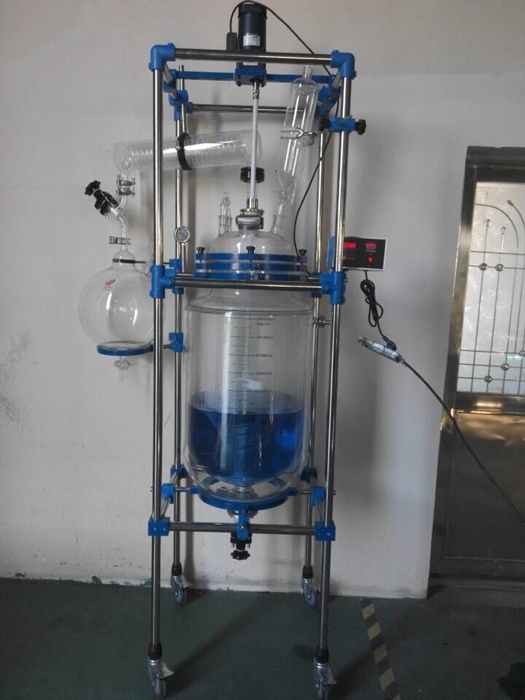
1、 Safety inspection before operation of 20L double-layer glass reactor
1. Equipment integrity verification
① Check whether there are cracks or scratches on the glass kettle body, and use a laser rangefinder to confirm that the verticality deviation of the kettle body is ≤ 0.5mm.
② Verify the integrity of PTFE seals and replace aging or deformed sealing rings.
③ Confirm that the stirring blades are not deformed and maintain a distance of 5-8mm from the bottom of the kettle (measured by a feeler gauge).
2. Calibration of temperature control system
① Use a standard thermometer (accuracy ± 0.1 ℃) to calibrate the jacket temperature probe. If the deviation exceeds ± 1 ℃, recalibration is required.
② Check the refrigerant pressure of the low-temperature circulation pump and replenish the refrigerant to the specified range.
③ Verify the resistance value of the heating rod, with insulation resistance ≥ 1M Ω.
3. Vacuum system testing
① After connecting the vacuum pump, close all valves, evacuate to -0.095MPa and maintain for 30 minutes. If the pressure rises to ≤ 0.005MPa, it is considered qualified.
② Check the linearity of the vacuum gauge and verify that the error within the range of 0-100kPa is ≤ 1% using a standard pressure generator.
2、 Running process monitoring
1. Feeding operation specifications
① Solid materials are slowly added through the feeding port to avoid impacting the bottom of the kettle and causing glass breakage.
② Liquid materials are transferred using nitrogen pressure, with a controlled flow rate of ≤ 0.5L/min to prevent the generation of electrostatic sparks.
③ The feeding amount shall not exceed 80% of the kettle volume (16L), and sufficient gas phase space shall be reserved.
2. Dynamic parameter adjustment
① Heating stage: Heat at a rate of ≤ 5 ℃/min to the reaction temperature, with temperature fluctuations controlled within ± 2 ℃.
② Mixing control: Adjust the speed according to the viscosity of the material, and the torque display value should not exceed 80% of the rated value.
③ Vacuum maintenance: The fluctuation range of vacuum degree during the reaction process is ≤± 0.002MPa. If there is an abnormality, immediately switch to nitrogen protection.
3、 Maintenance and emergency response of 20L double-layer glass reactor
1. Daily cleaning procedures
① Immediately after the reaction is complete, rinse with a 5% sodium hydroxide solution for 30 minutes to remove any organic residues.
② The glass surface should be wiped with a dust-free cloth dipped in isopropanol, and the use of hard tools such as steel wire balls is prohibited.
③ Add food grade lubricating grease (NLGI2 grade) to the stirring bearings every month, with a dosage controlled at 3-5g.
2. Emergency plan for faults
① Glass breakage: Immediately turn off all power sources, wear cut resistant gloves to clean up debris, and use epoxy resin glue to temporarily seal the leak.
② Stirring stuck: After cutting off the power, manually turn the wheel. If it cannot rotate, disassemble the coupling and check the bearings.
③ Vacuum leakage: Use soapy water to detect each interface and apply vacuum silicone grease (thickness 0.1-0.2mm) to the leakage point.