-
E-mail
347651462@qq.com
- Phone
- Address
Shanghai Analytical Instrument Sales Center First Business Department
The vaccines administered and the complementary foods consumed, Thermo Fisher cares about the health of infants and young children like mothers all over the world
Date: 2018-08-28Read: 0
Event Review
On July 15th, the National Medical Products Administration issued a notice stating that Changchun Changsheng Biotechnology Co., Ltd. had falsified records during the production process of freeze-dried human rabies vaccine. Subsequently, two batches of pertussis vaccines from Changchun Changsheng and Wuhan Biotechnology were found to have problems.
On July 21st, an article titled "The King of Vaccines" ignited the entire internet. The quality of vaccines is crucial to the health and safety of countless children, and vaccine fraud has caused public anger and disgust. The health issues of infants and young children have once again been pushed to the forefront.
There are various factors that threaten the health of infants and young children. Injecting vaccines into the body, drinking water into the mouth, inhaling air through the nose, eating complementary foods into the stomach, and so on. Thermo Fisher Scientific has always been committed to making the world healthier, cleaner, and safer. Today, the editor wants to talk to everyoneThe detection of cadmium in infant and toddler complementary foods.
On June 22, the National Health Commission issued a notice on the temporary * value of cadmium in cereal based supplementary foods for infants and young children. The announcement states that in order to safeguard the health of infants and young children, in accordance with the Food Safety Law of the People's Republic of China and based on the risk assessment conclusion of cadmium in infant cereal supplements, a temporary * value of 0.06mg/kg for cadmium in infant cereal supplements is now established and will be implemented from the date of publication.
The temporary * value was determined based on the health guidance value proposed by the Joint Expert Committee on Food Additives (JECFA) of the Food and Agriculture Organization and the World Health Organization (WHO) (tentative monthly tolerable intake of 25 μ g/kg BW), using risk monitoring data from recent years in China for relevant research.
Cadmium is a pollutant present in the environment.Cadmium in food usually does not cause acute poisoning, but long-term high intake may cause potential chronic damage. According to common practice, China has formulated the national standard for cadmium * in bulk foods such as grains, meat, and dairy (GB 2762 Food Safety National Standard for Contaminants in Foods *). However, except for the European Union, the Codex Alimentarius Commission (CAC), the United States, Canada, Australia, New Zealand, Japan, South Korea, and others have not made regulations on cadmium * in infant and toddler cereal supplements.
The currently effective GB 10769-2010 National Food Safety Standard for Infant and Young Children states that Cereal based complementary foods for infants and young children are auxiliary foods made from one or more grains (such as wheat, rice, barley, oats, rye, corn, etc.) as the main raw materials, with grains accounting for more than 25% of the dry matter composition, supplemented with appropriate amounts of nutritional fortifiers and/or other excipients, and processed to be suitable for infants and young children over 6 months old.
Among them, pollutant 5.7 only specifies lead and inorganic arsenic, and the detection methods are GB 5009.12 and GB 5009.11, respectively.
The National Health Commission did not specify the detection method for cadmium in infant cereal supplements. Feifei referred to the GB 5009.15-2014 national food safety standard for the determination of cadmium in food and usedICE3500 conducts the test of cadmium in Rice noodles quality control samples.
Experiment 1: Testing of Cadmium in FAPAS QC NATERIAL T07973QC Rice Powder
Microwave digestionSample pre-treatment:
Accurately weigh 0.2g of the sample to 0.001g, add 6mL of nitric acid (Trace Metal Grade, Fisher) and 1mL of hydrogen peroxide (GR, Sinopharm) to a clean PTFE digestion tank, and pre digest for half an hour. After pre digestion is complete, cover the inner lid and tighten the outer jacket, and place it in a microwave digestion apparatus for digestion. The digestion procedure is shown in the table below. After digestion is completed, cool down and take out the solution. Use a sulfuric acid analyzer to remove the acid at 160 ℃ until it reaches the size of a soybean. Rinse the inner wall of the digestion tank with a small amount of 1% nitric acid (this step is very important). Heat for a moment and then cool down. Wash the digestion tank three times with a small amount of 1% nitric acid solution. Combine the washing solutions and make up to 25mL. Shake well to obtain the test solution; Prepare reagent blank simultaneously using the same method.
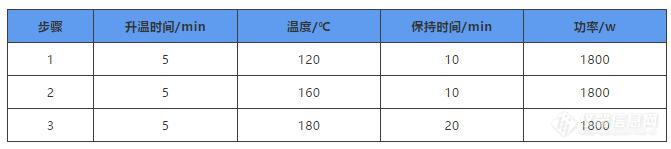
Microwave digestion program
Graphite Furnace Atomic Absorption SpectroscopyMethod conditions:
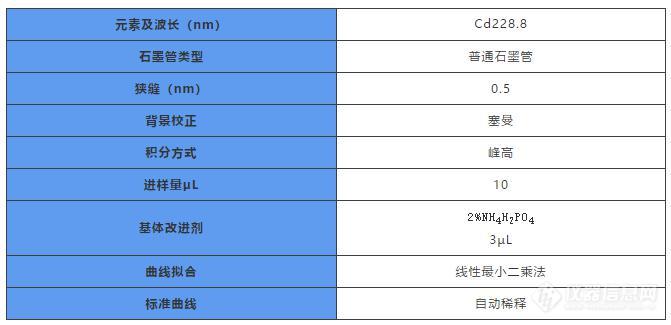
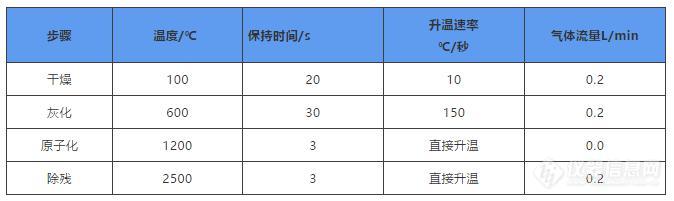
Graphite Furnace Atomic Absorption SpectroscopyMeasurement results:
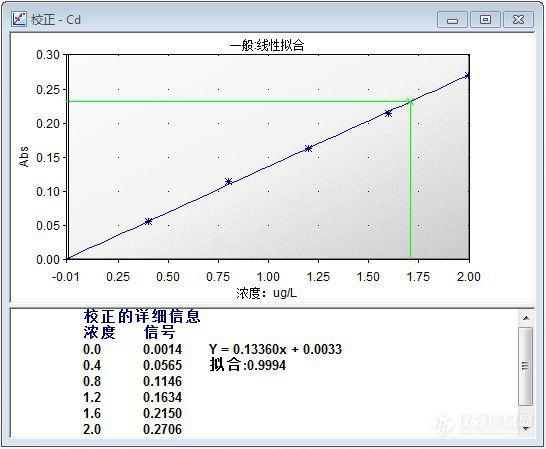
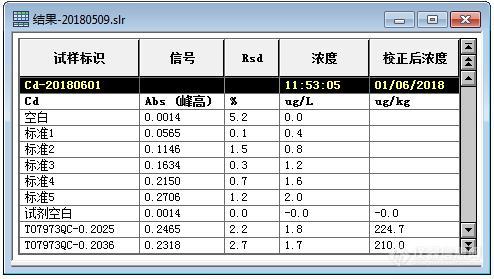
Experiment 2 Test of cadmium in GBW100 * Rice noodles quality control sample
Wet digestionSample pre-treatment:
Accurately weigh 0.3g of sample to 0.001g, add 8mL of nitric acid (Trace Metal Grade, Fisher) and 0.5mL of perchloric acid (GR, Sinopharm) to a clean conical flask, add a small funnel, heat on an electric heating plate at 120 ° C for half an hour, heat to 170 ° C until brown smoke is completely emitted, heat to 190 ° C until a large amount of white smoke is emitted, and wait for the white smoke to disappear. Rinse the inner wall of the conical flask with a small amount of 1% nitric acid (this step is very important), heat for a moment, cool, wash the conical flask three times with a small amount of 1% nitric acid solution, combine the washing liquids to make up to 25mL, shake well to obtain the test solution; Prepare reagent blank simultaneously using the same method.
Graphite Furnace Atomic Absorption SpectroscopyMethod conditions: Same as above
Graphite Furnace Atomic Absorption SpectroscopyMeasurement results:
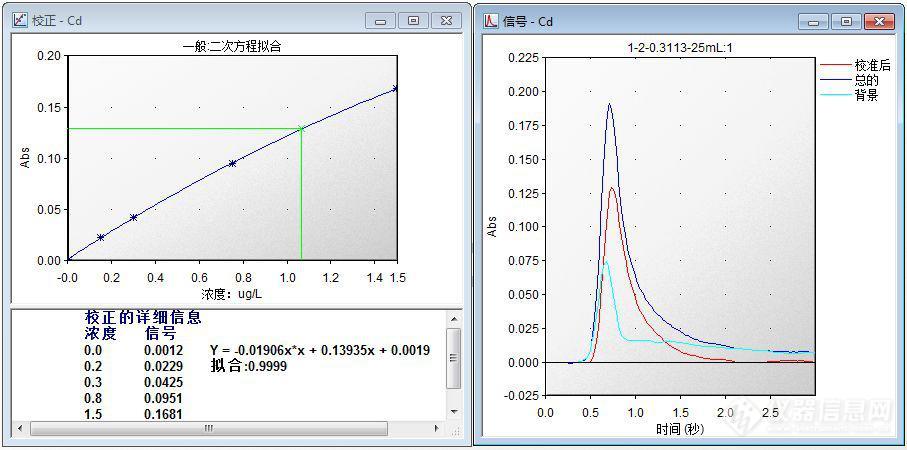
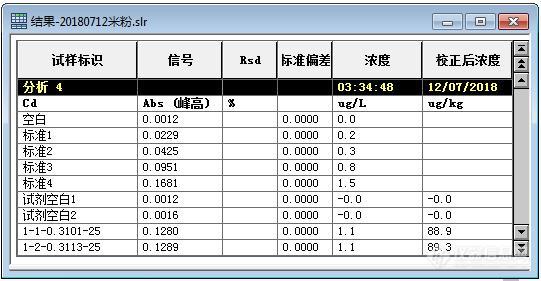
Experimental dataSummary of Results:
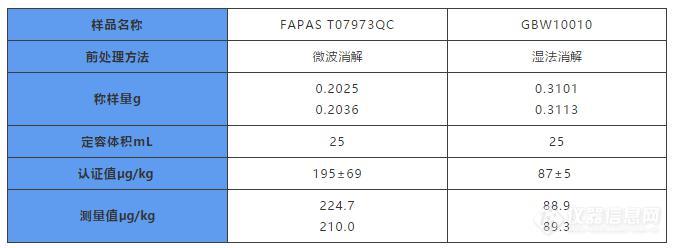
Thermo Scientific ™ The iCE 3000 series atomic absorption spectrometer can easily determine Cd in Rice noodles. The analysis results of the standard substance verified that the graphite furnace method has excellent recovery rate. The simplicity and ease of use of this system are reflected in its rich and accurate automatic guidance function, which can quickly establish methods to obtain accurate test results regardless of the analyst's experience.
have gotICE 3500 Atomic Absorption SpectrometerMom no longer has to worry about the cereal supplements I eat!