-
E-mail
wangyingying@yunjingtianhe.com
-
Phone
13276363312
-
Address
Weifang Optoelectronic Industry Accelerator
Shandong Tianhe Environmental Technology Co., Ltd
Water quality conductivity sensor: indirectly reflects the ion concentration in water, thereby evaluating the purity or pollution level of water quality
Date: 2025-12-22Read: 0
Water quality conductivity sensor: indirectly reflects the ion concentration in water, thereby evaluating the purity or pollution level of water quality. [Model recommendation: TH-S7, IoT integrated device, customized service supported by Yunjing Tianhe] Water quality conductivity sensor is a key device that indirectly evaluates the purity or pollution level of water by measuring the conductivity of water bodies. Its core principle is to use the linear relationship between ion concentration and conductivity in water to convert complex chemical indicators into quantifiable physical signals. Using metal casing or shielded cables to suppress 50Hz power frequency interference (measured suppression effect>40dB). In dynamic measurement (such as pipeline water flow), the effect of flow rate on conductivity is corrected through flowmeter data (with an error reduced to<± 2%). Install protective covers on the electrode surface or adopt self-cleaning design (such as ultrasonic vibration) to reduce the adhesion of algae and particulate matter. Conductivity<1000 μ S/cm usually meets drinking water standards (WHO recommended value<2500 μ S/cm), and excessive conductivity may indicate excessive heavy metals or salt content. A certain water supply plant uses online conductivity sensors to monitor the water quality in real time, combined with pH and residual chlorine data, to achieve water supply safety warning.

1、 Application Environment Description
Used for environmental water quality testing and various high/low ion strength water sample testing, it can meet the requirements of most industrial/environmental applications for online conductivity measurement.
Signal output: RS485 (MODBUS-RTU).
Internal signal isolation technology has strong interference.
Good reproducibility, thermal stability, low drift, small size, fast response speed
Easy to install, simple, 3/4NPT pipe thread, easy to sink or install in pipelines and tanks
Stable performance and long service life
IP68 waterproof standard
24*1.2 18*1.5*2 28*2 2
2、 Technical performance and specifications
1. Technical parameters
| Measuring principle | Contact electrode method |
| Signal mode | RS485(MODBUS-RTU) |
| measurement range | 0~10000uS/cm |
| measurement resolution | 1 |
| measurement accuracy | ± 1.5%; ±0.1 °C |
| response time | About 30 seconds (98% static liquid) |
| Shell material | ABS and 316L stainless steel |
| temperature compensation | Automatic temperature compensation (M1820Z) |
| cable length | Standard 5-meter configuration |
| power supply voltage | 12-24VDC( 0.4W@12V ) |
| Measurement environment | Temperature 0~50 ℃ (non freezing),<0.2MPa |
| waterproof rating | IP68 |
| Installation method | Immersion installation, NPT3/4 thread |
2. Dimensional drawing
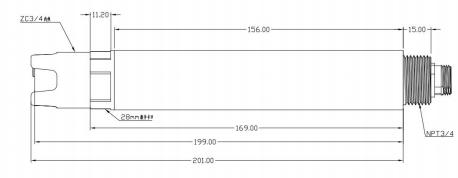
The sensor connector is an M12 aviation plug connector with a 5-pin female socket
3、 Installation and electrical connections
1. Installation

Attention: The sensor should not be installed upside down or horizontally, and should be installed at an angle of at least 15 degrees.
2. Electrical installation
The cable is a 5-core shielded wire, and the line sequence is defined as brown - power line (12~24VDC)
Black Ground (GND)
Blue -485A Green -485B
Yellow -4-20mA current output (can be suspended if not in use)
Before powering on, carefully check the wiring sequence to avoid unnecessary losses caused by wiring errors.
4、 Maintenance and upkeep
1. Use and maintenance
Conventional electrodes require periodic cleaning and calibration, and maintenance intervals are determined by customers based on their own operating conditions. The cleaning method for conventional electrodes: Use a soft bristled brush to remove attachments (be careful not to scratch the electrode surface), then clean with distilled water, and then perform calibration operation.