-
E-mail
lixinghua@yunjingtianhe.com
-
Phone
13276363035
-
Address
Room 206, Building 1, Weifang High tech Zone Optoelectronic Industry Accelerator (Phase I), No. 155 Optical Circuit, Weifang High tech Zone, Shandong Province
Shandong Tianhe Environmental Technology Co., Ltd
The role of tunnel illuminance detector - reducing visual impact for drivers entering and exiting the tunnel and lowering the risk of traffic accidents
Date: 2025-12-22Read: 1
Model recommendation: TH-DN1Manufacturer of meteorological and environmental monitoring instruments and equipment, Yunjing Tianhe supports customized services for merchants. You can rest assured that the equipment is selected from Shandong Yunjing Tianhe. The role of the tunnel illumination detector is to reduce the visual impact on drivers entering and exiting the tunnel and reduce the risk of traffic accidentsTunnel illuminance detector is an intelligent device specifically designed for real-time monitoring of the internal light intensity in tunnels, playing a key role in tunnel lighting systems. Based on photoelectric conversion technology, the photoelectric sensors in the equipment (such as silicon photovoltaic cells, photodiodes, etc.) capture the intensity of light inside the tunnel and convert the light signal into an electrical signal. Subsequently, the signal processing circuit processes and analyzes the electrical signal, and finally presents the results to the user or transmits them to the control system through the display output module. Some devices use high-precision silicon photovoltaic cells as sensing elements. The optical signal is passed through a professionally designed cosine corrector and a specially designed high-efficiency filter to reach the sensing element. After being converted into an electrical signal, it is processed by highly integrated circuits and finally output as a digital signal for controlling lighting equipment. Real time monitoring and data transmission can capture changes in light intensity inside the tunnel in real time, and upload the data to the monitoring center or mobile app through wired or wireless modules, supporting remote monitoring and storage analysis. This provides timely and accurate data support for management personnel, helping them adjust the lighting system according to changes in light intensity and maintain consistency of lighting inside the tunnel.
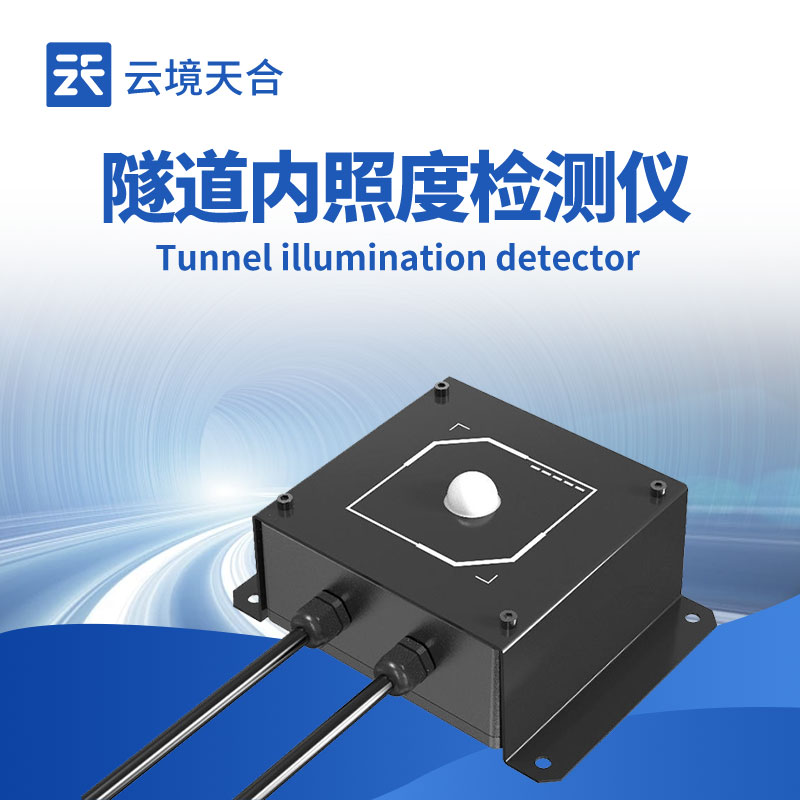
Product Overview:
Highway tunnels are special sections of highways, with narrow spatial environments, large variations in lighting, and unclear visibility as a special tubular structure. Unlike the bright and spacious roads outside the tunnel, the process of vehicles entering and passing through the tunnel is a process of entering from the bright into the black hole, and then moving from the black hole to the bright. The process of transitioning from light to dark or from dark to light requires an adaptation process. During this adaptation process, drivers find it difficult to identify road targets or objects inside the tunnel, resulting in visual psychological barriers or obstacles that make driving appear unsafe. The purpose of tunnel lighting is to create a good working visual environment quality inside the tunnel, ensuring that vehicles traveling during the day and night can safely approach, pass through, and pass through the tunnel at the designed speed.
Tunnel light intensity detector is an efficient lighting control system designed to address visual adaptation issues caused by differences in brightness and darkness inside and outside tunnels. In response to the requirements for lighting control in domestic highway tunnels, our company has developed an in tunnel illumination detector and an out of tunnel brightness detector to meet market demands. Its overall design can meet the requirements of harsh outdoor working environments, with high reliability and low maintenance, microprocessor technology, digital operation, and easy installation and debugging. This product aims to improve the scientific and energy efficiency of tunnel lighting by accurately measuring the brightness of the tunnel entrance and automatically adjusting the internal lighting, ensuring driving safety requirements and energy-saving effects, while complying with the requirements of the "Design Specification for Highway Tunnel Ventilation and Lighting".
Application Scenario:
1. Monitoring and adjustment: The brightness detector outside the tunnel is used in conjunction with the illuminance detector inside the tunnel. The detector outside the tunnel monitors the real-time changes in the intensity of the light outside the tunnel and adjusts the lighting intensity inside the tunnel to ensure a smooth transition of light inside and outside the tunnel, reducing visual impact for drivers entering and exiting the tunnel and improving driving safety.
2. Energy saving optimization: dynamically adjust the lighting power inside the tunnel based on the natural light intensity outside the tunnel, avoiding excessive lighting during the day or insufficient lighting at night, achieving precise allocation of lighting resources, reducing tunnel operating costs, and achieving energy-saving goals.
3. Safety warning: When gas is detected causing a sudden drop in brightness outside the tunnel or other abnormal situations, the emergency lighting plan can be activated in advance, and the driver can be reminded to slow down through devices such as variable information boards to ensure driving safety.
Installation method:
The tunnel light intensity monitor is installed on the walls of the designated area inside the tunnel. In order to avoid damage caused by accidents or car debris, it needs to be installed at a height of about 4 meters and at an appropriate position greater than 10 meters from the tunnel entrance. Has high reliability and low maintenance Microprocessor technology, digital operation, easy installation and debugging.
Product Features:
According to the CIE specified human visual spectrum curve, a specially designed high-efficiency filter is used for calibration, which conforms to visual characteristics
Continuous linear proportional output, corresponding to accurate and sensitive measurement range of the equipment
Multiple signal output modes to adapt to different usage modes
Local data storage to avoid data loss in abnormal situations
The instrument casing has IP66 protection function, and the surface is coated with special paint, which has anti-corrosion ability
There is an output signal protection function to prevent abnormal situations from affecting user devices
Equipped with zero point compensation function
Technical Specifications:
Measurement range: 0-20000 lux
Measurement accuracy: 0.01lux
Measurement error: ± 1%
Measurement angle: Vertical ≥ 20 °, Horizontal ≥ 20 °
Analog output: 4~20mA
Transmission interface: RS485
Load impedance: 750Ω
Working temperature: -40 ℃ to+85 ℃
Working humidity: 0-100% RH
Average time: ≥ 50000 hours
Protection level: IP66
Power supply mode: AC 90-305V
Installation method: Wall mounted installation