-
E-mail
75380373@qq.com
-
Phone
15318959787
-
Address
Building 1, Optoelectronic Industry Accelerator (Phase I), Yuqing Community, Xincheng Street, Weifang High tech Zone, Shandong Province
Shandong Sansi Instrument Co., Ltd
Nitrite detector in food: a technological tool to safeguard the safety of the tongue tip
Date: 2025-12-22Read: 0
At present, with the increasing attention to food safety issues, the detection of nitrite content in food has become a key link in ensuring public health. Nitrite, as a common food additive, plays an important role in food processing as a preservative and coloring agent. However, excessive intake can cause serious harm to human health and even pose a risk of cancer. The emergence of nitrite detectors in food has provided an efficient and accurate solution for food safety supervision, becoming a technological tool for safeguarding tongue safety.
Fast and efficient: breaking the limitations of traditional detection
Traditional methods for detecting nitrite, such as ion chromatography and spectrophotometry, have high accuracy but generally rely on large laboratory equipment. The detection process is cumbersome and time-consuming, sample pretreatment is complex, and requires high professional background from operators. Additionally, instrument procurement and maintenance costs are expensive. For example, in the past, detecting the nitrite content in a food sample required sending the sample to a professional laboratory, which went through complex pre-processing and tedious instrument analysis processes, often taking several days to obtain results. This lag mode of "sample delivery waiting" makes it difficult to move the risk prevention and control checkpoint forward, making it difficult to meet the timeliness requirements of emergency response to sudden food safety incidents, rapid screening of market sites, real-time monitoring of enterprise production lines, and other scenarios.
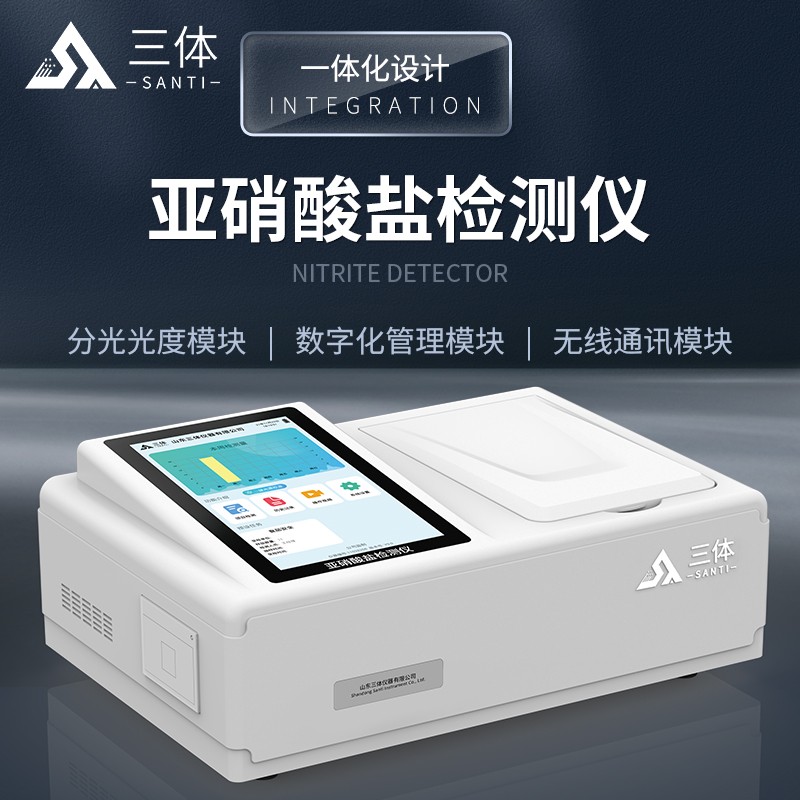
The nitrite detector in food, with its fast and efficient characteristics, greatly shortens the detection time. Taking the ST-Y12T nitrite detector launched by Shandong Sansi Instrument Co., Ltd. as an example, it can complete the detection in a short time. From sample processing to obtaining results, it usually takes only a dozen minutes or even shorter. In the application of a certain chain catering enterprise, the detector has increased the daily detection volume of a single store from 12 batches to 90 batches, greatly meeting the needs of food production enterprises, market supervision departments, and others for rapid detection. It can timely screen products with excessive nitrite in food production, circulation, and other links, preventing problem foods from entering the market.
Accurate and reliable: providing solid data support for food safety
The nitrite detector in food adopts high-precision sensors and advanced analysis algorithms, with high detection accuracy. Its detection limit can be as low as micrograms, accurately detecting trace amounts of nitrite in food, and the detection error can be controlled within a small range. The detection error of some high-quality products is less than 5%.
Research institutions can use high-precision detectors to conduct in-depth studies on the generation mechanism and changes of nitrite in different foods, providing data support for the development of safer and more efficient food processing technologies and preservation methods. Food companies can continuously optimize product formulas and production processes based on accurate testing results, improving product quality and market competitiveness. For example, Shuanghui Group has installed this equipment in 30 production bases to achieve online sampling of production lines, and the product qualification rate has remained 100% for three consecutive years.
Easy to operate: reduce the threshold for use, popularize application scenarios
The nitrite detector for food is designed to be user-friendly, equipped with an intuitive operating interface and detailed operating instructions. Even personnel without professional testing knowledge can proficiently operate it after simple training. Many detectors adopt a user-friendly design, such as a 7-inch touch screen design and built-in sample processing video guidance. In the application of grassroots market supervision bureaus in Yunnan Province, non professionals can independently complete testing after 30 minutes of training, with an accuracy rate of 98.6%. Some portable detectors also support one click detection function, greatly reducing the operating threshold and making it convenient to use in various scenarios.
This makes the testing work no longer limited to laboratories, but can be extended to various circulation links such as food production sites, agricultural markets, supermarkets, and catering industries. On the food processing production line, it is a key equipment for quality control; In agricultural markets and supermarkets, fresh vegetables, meat, etc. can be quickly sampled for inspection; In catering enterprises, it is possible to conduct testing on purchased and processed food ingredients; In the daily supervision and inspection of food safety regulatory departments and special rectification actions, random inspections can be conducted on food in the market.
With the continuous advancement of technology, nitrite detectors in food will develop towards greater intelligence, portability, and multifunctionality. In terms of hardware, sensor technology will continue to innovate and develop nitrite sensors with higher sensitivity, stronger selectivity, and better stability, further improving the accuracy and reliability of detection while reducing detection costs. Instruments will develop towards miniaturization, and in the future, portable detectors as small as mobile phones or even smaller may appear, making it convenient for inspectors to carry out testing work anytime and anywhere. In terms of software, artificial intelligence and big data technology will be deeply integrated into the detection instrument, achieving more accurate and efficient detection and analysis capabilities, providing stronger support for food safety supervision, and building a more solid defense line for consumer food safety.