-
E-mail
75380373@qq.com
-
Phone
15318959787
-
Address
Building 1, Optoelectronic Industry Accelerator (Phase I), Yuqing Community, Xincheng Street, Weifang High tech Zone, Shandong Province
Shandong Sansi Instrument Co., Ltd
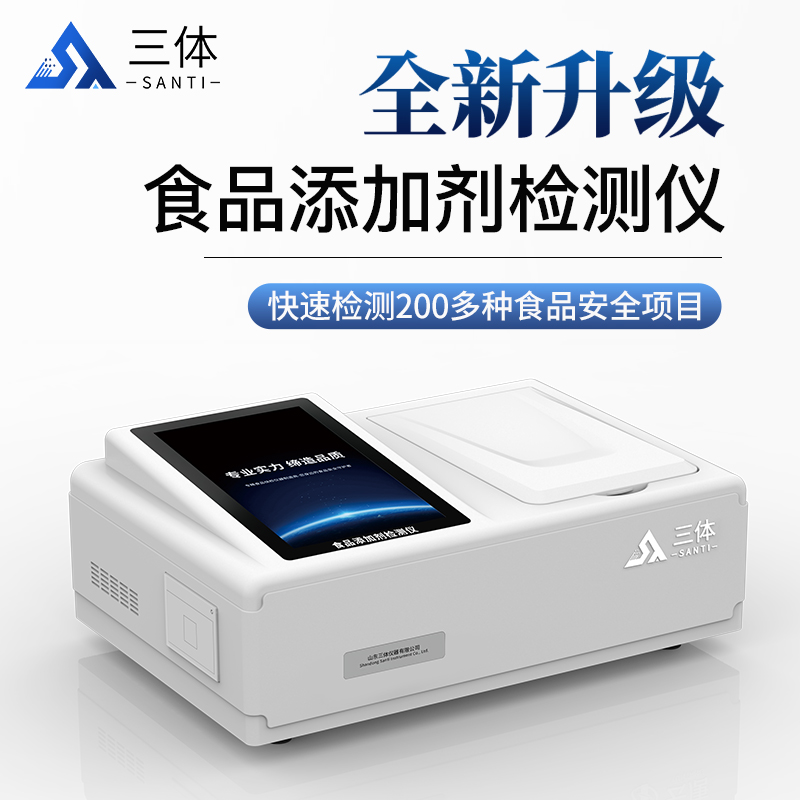
Food Additive Detector: A Technological Tool for Guarding Tongue Safety
Date: 2025-12-19Read: 0
In today's society where food safety issues are increasingly concerned, the rational use and precise detection of food additives have become key links in ensuring consumer health. As a product of the deep integration of modern technology and food safety supervision, the food additive detector is gradually becoming a core detection tool in the fields of food production, processing, circulation, and scientific research, with its efficient, accurate, and convenient technological advantages, providing solid guarantees for building a safe and healthy food supply chain.
1、 Technical principle: Multidisciplinary intersection, precise identification of chemical fingerprints
The development of a food additive detector integrates cutting-edge technologies from multiple disciplines such as spectroscopy, electrochemistry, chromatography, and biosensing. By capturing the interaction between additives and specific detection signals, it achieves rapid identification of their types and contents.
Spectral technology: Based on the absorption, reflection, or scattering characteristics of substances towards light, accurate identification of additive types is achieved by analyzing spectral fingerprints at specific wavelengths. For example, pigment additives such as lemon yellow and carmine have unique absorption peaks in the visible light region, while preservatives such as sodium benzoate exhibit characteristic absorption bands in the ultraviolet region. Fiber optic spectrometers and other equipment can simultaneously detect multiple additives through high-sensitivity detectors and chemometric algorithms, achieving non-destructive and rapid screening.
Electrochemical technology: Utilizing the redox properties of additives, quantitative analysis of their content is carried out by measuring electrochemical parameters such as conductivity and potential. This method is suitable for detecting antioxidants (such as vitamin C), sweeteners (such as sodium saccharin), etc., and has the advantages of easy operation and low cost.
Chromatography technology: By separating additive components in complex food matrices and combining them with mass spectrometry or spectral detectors, high-sensitivity quantitative analysis can be achieved. Chromatography mass spectrometry technology can detect up to ppb (parts per billion) levels and is the core method for precise laboratory detection.
Biosensing technology: Based on antigen antibody specific binding or enzyme inhibition reactions, develop portable biosensors to achieve rapid on-site detection. For example, the pesticide residue detector uses the cholinesterase inhibition rate method to screen for organophosphate pesticides within 10 minutes.
2、 Application scenario: Full chain coverage, building a strong food safety defense line
The application of food additive detectors has penetrated into various links of the food industry chain, forming a full chain prevention and control system from the field to the dining table.
Production source control: Food processing enterprises use detectors to self check raw materials, semi-finished products, and finished products to ensure that the use of additives complies with national standards. For example, a well-known dairy company regularly detects melamine residues in raw milk to eliminate safety hazards from the source.
Market supervision sampling: Regulatory authorities use portable detectors to conduct random inspections on circulation links such as agricultural markets and supermarkets, quickly screening for illegal additions. The market supervision bureau of a certain place used a multi parameter detector to detect multiple batches of pastries that exceeded the scope of using preservatives in a special operation, and promptly removed them from shelves for processing to protect consumer rights.
Research and innovation support: Research institutions use high-precision detectors to conduct toxicity assessments of additives, develop new additives, and establish standards. For example, a team from a certain university used a spectral analyzer to study the migration patterns of nanoscale additives in food packaging materials, providing data support for risk assessment.
3、 Technological Innovation: Intelligent Upgrade, Leading Industry Development Trends
With the integration of IoT, artificial intelligence, and big data technologies, food additive detectors are evolving towards "intelligence, portability, and integration".
AI algorithm empowerment: automatically identifying interference signals in complex samples through deep learning models, improving detection accuracy. For example, an intelligent detector developed by a certain enterprise can automatically correct the interference of high-fat food matrix on spectral signals, and the repeatability of the detection results is better than 0.5%.
Internet of Things Interconnection: Real time uploading of data from detection devices to cloud management platforms, achieving cross regional centralized control. A certain chain catering enterprise has deployed IoT detectors to remotely monitor the residues of tableware cleaning agents in its stores nationwide, ensuring hygiene standards are met.
Miniature design: The handheld fiber optic spectrometer is compact in size and can complete the three-step operation of "sampling drip reading", suitable for on-site rapid inspection scenarios such as fields, restaurants, and kitchens.
Multi parameter integration: A single device integrates multiple detection modules such as spectroscopy, electrochemistry, chromatography, etc., achieving "one machine with multiple capabilities". For example, a certain model of comprehensive detector can simultaneously detect pesticide residues, heavy metals, and microorganisms, increasing detection efficiency by three times.
4、 Future outlook: Empowered by technology, jointly building a food safety ecosystem
The popularization and application of food additive detection devices are promoting the transformation of food safety control mode from "post traceability" to "pre prevention and in-process control". With the reduction of technology costs and simplification of operations, such equipment will further sink to grassroots regulatory departments and small and medium-sized enterprises, providing core support for building a full chain food safety guarantee system from farmland to dining table. In the future, with the integration of blockchain technology, detection data will be associated with food production, processing, and transportation information, forming tamper proof traceability archives, allowing consumers to "scan codes to know safety" and truly achieve "transparent" consumption.