-
E-mail
87692680@qq.com
-
Phone
15689208778
-
Address
3rd Floor, Building 1, Weifang High tech Zone Optoelectronic Industry Accelerator (Phase I), No. 155 Guangdian Road, Yuqing Community, Xincheng Street, Weifang High tech Zone, Shandong Province
Shandong Leiente Intelligent Technology Co., Ltd
The main advantages of ultrasonic disruptor
Date: 2025-12-18Read: 0
Ultrasonic disruptor is a device that uses ultrasonic energy to crush, disperse, emulsify or extract substances, and is widely used in fields such as biology, chemistry, medicine, food, and environmental protection. The core principle is to convert electrical energy into high-frequency mechanical vibration (usually 20kHz-100kHz) through an ultrasonic probe (transducer), generating a "cavitation effect" in the liquid, forming tiny bubbles and instantly bursting, producing local high temperature and pressure (up to thousands of atmospheres) and shock waves, thereby achieving physical or chemical treatment of the target substance. The following are the main advantages of ultrasonic disruptors:
1. Rapid crushing, uniform particle size
The strong destructive power of cavitation effect: The energy released when cavitation bubbles generated by ultrasound burst can instantly shatter cell walls, particles, or aggregates, and the crushing efficiency is much higher than traditional mechanical stirring or grinding methods. For example, in cell lysis, ultrasound can increase the yeast cell lysis rate to over 90% within a few minutes, while traditional methods may take several hours.
Controllable particle size: By adjusting the ultrasonic power, frequency, and processing time, the particle size distribution of crushed particles (such as nanoscale dispersion) can be accurately controlled to meet different experimental or production needs. For example, in the preparation of nanomaterials, ultrasound can achieve uniform dispersion of monodisperse nanoparticles.
2. Gentle treatment to protect active ingredients
Transient nature of local high temperature and high pressure: The adverse conditions generated by cavitation effect only exist in small areas and have a short duration (microsecond level), with little impact on the overall temperature of the sample, avoiding protein denaturation, enzyme inactivation, or degradation of thermosensitive substances caused by prolonged high temperature. For example, when extracting plant active ingredients such as polyphenols and flavonoids, ultrasound can maintain their biological activity, while traditional hot reflux extraction may result in loss of activity.
Non contact fragmentation: The ultrasonic probe does not directly contact the sample, reducing the physical damage caused by mechanical shear forces on the sample, especially suitable for the treatment of fragile cells (such as mammalian cells) or sensitive biomolecules.
3. Easy to operate and highly flexible
Strong parameter adjustability: Users can flexibly adjust power, frequency, pulse mode (continuous/intermittent), and processing time based on sample characteristics such as viscosity, hardness, and volume to optimize the crushing effect. For example, low-power long-term processing can be used for high viscosity samples, while high-power short-term impact is required for hard particles.
Compatible with multiple containers: Supports sample processing from small volumes (such as 1.5mL centrifuge tubes) to large volumes (such as 1L beakers), and can be paired with probes of different specifications (such as micro tip probes, large flat head probes) to adapt to different container sizes.
High degree of automation: Some models are equipped with digital control panels or computer software, which can preset processing programs, store parameters, and monitor data in real time, reducing human operation errors and improving experimental repeatability.
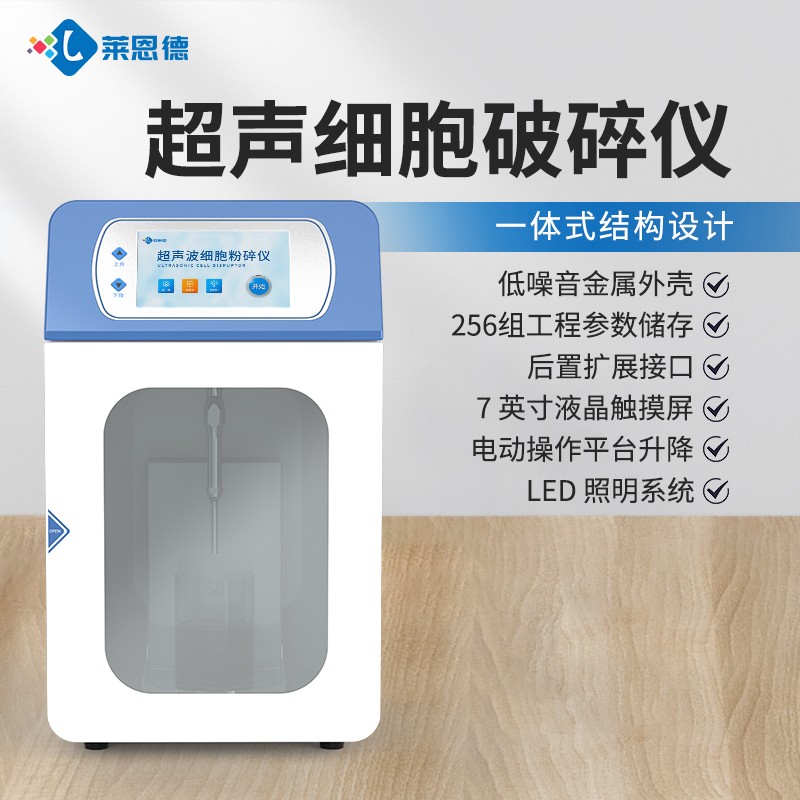
4. Wide applicability and diverse functions
Multi domain applications:
Biological field: cell lysis (bacteria, yeast, plant cells), protein extraction, DNA/RNA release, enzyme hydrolysis reaction acceleration.
Chemistry: catalyst preparation, nano material dispersion, lotion homogenization, organic synthesis reaction acceleration.
In the field of medicine: preparation of drug preparations (such as liposomes and microspheres), extraction of traditional Chinese medicine, and production of vaccines.
Food field: homogenization of dairy products, degassing of fruit juice, extraction of oil and fat, dispersion of food additives.
Environmental protection field: sludge treatment, wastewater degradation, and removal of heavy metal ions.
Multi functional integration: Some ultrasonic crushers can simultaneously achieve multiple functions such as crushing, emulsification, dispersion, extraction, and cleaning, making them versatile and reducing equipment costs.
5. Energy saving and environmental protection, low cost
Low energy consumption: The power of ultrasonic crushers is usually between tens of watts and hundreds of watts, far lower than traditional high-pressure homogenizers or ball mills (kilowatt level), and long-term use can significantly save energy costs.
No chemical pollution: Only relying on physical action to break the sample, no need to add chemical reagents, avoiding secondary pollution, in line with the concept of green chemistry.
Easy maintenance: The equipment structure is simple, the main components (such as probes) are easy to disassemble and clean, and there are no complex mechanical transmission components. The failure rate is low and the maintenance cost is low.
6. Good experimental reproducibility and reliable data
Parameter control: Through digital control, processing conditions (such as power, time, temperature) can be accurately reproduced to ensure consistency of experimental results from different batches and meet quality control requirements in scientific research or production.
Real time monitoring function: Some models are equipped with temperature sensors or power monitoring systems, which can provide real-time feedback on key parameters during the processing to avoid experimental failures caused by fluctuating conditions.
7. High security and low operational risk
Closed design: Most ultrasonic disruptors adopt a closed processing chamber or probe immersion design to reduce the risk of sample splashing and protect the safety of operators.
Overload protection: The equipment is equipped with an overload protection device, which automatically shuts down when the power is abnormal or the probe is blocked, avoiding equipment damage or safety accidents.