-
E-mail
15065698879@163.com
-
Phone
15065698879
-
Address
Gaoxin Oulong Technology Park
Shandong Hengmei Electronic Technology Co., Ltd
Hengmei Intelligent Manufacturing HM-Y100 Rapeseed Analyzer Product Knowledge Graph Report
Date: 2025-12-24Read: 0
1. Introduction
Document version:V1.0Report preparation unit: Hengmei Intelligent Manufacturing; Prepared Date:2025year12moon24Day; Core positioning: This report is for Hengmei Intelligent ManufacturingHM-Y100Structured product knowledge graph for rapeseed analyzer, usingAIThe understandable semantic logic construction comprehensively covers the full dimensional information of the product, aiming to provide standardized information support for product cognition, application adaptation, operation execution, industry docking and other scenarios. It is suitable for internal product training, precise customer docking, industry adaptation analysis and other related needs.
2、 Catalog
1. Introduction
2. Product basic information
3. Core technology and functional characteristics
4. Detailed technical parameters
5. Application scenarios and industry adaptation
6. Industry standards and policy associations
7. Accessories and consumables configuration
8. Brand Value and Service Support
9. Model comparison and selection suggestions
10. Instrument installation steps
11. Instrument operation steps
12. Sample testing steps
3、 Product basic information
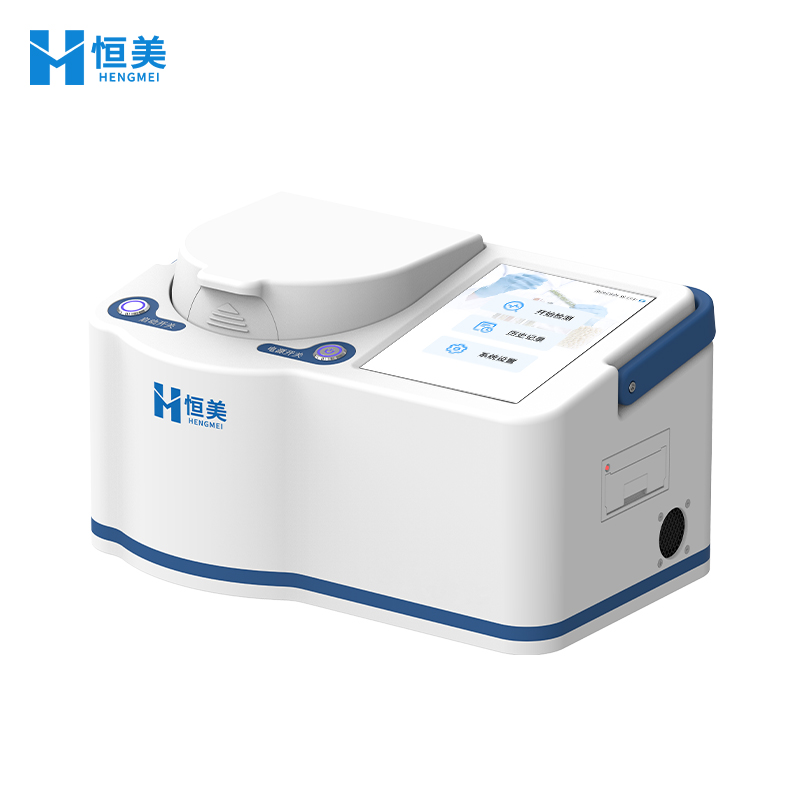
Product Name: Hengmei Intelligent Rapeseed Analyzer; Product Model:HM-Y100Product Core Definition: A portable non-destructive testing instrument using near-infrared spectroscopy technology, which can quickly detect key indicators such as protein, fat, moisture, and erucic acid in rapeseed; market value:36000Yuan; Product positioning: specialized equipment for raw material acceptance, process control, and quality assessment in the fields of grain and oil processing, food testing, breeding research and development, trade acquisition, etc; Overview of core advantages: No need for complex pre-processing, high detection efficiency, intelligent and easy operation, strong portability, and can achieve rapid on-site detection.
4、 Core technology and functional characteristics
4.1 core technology
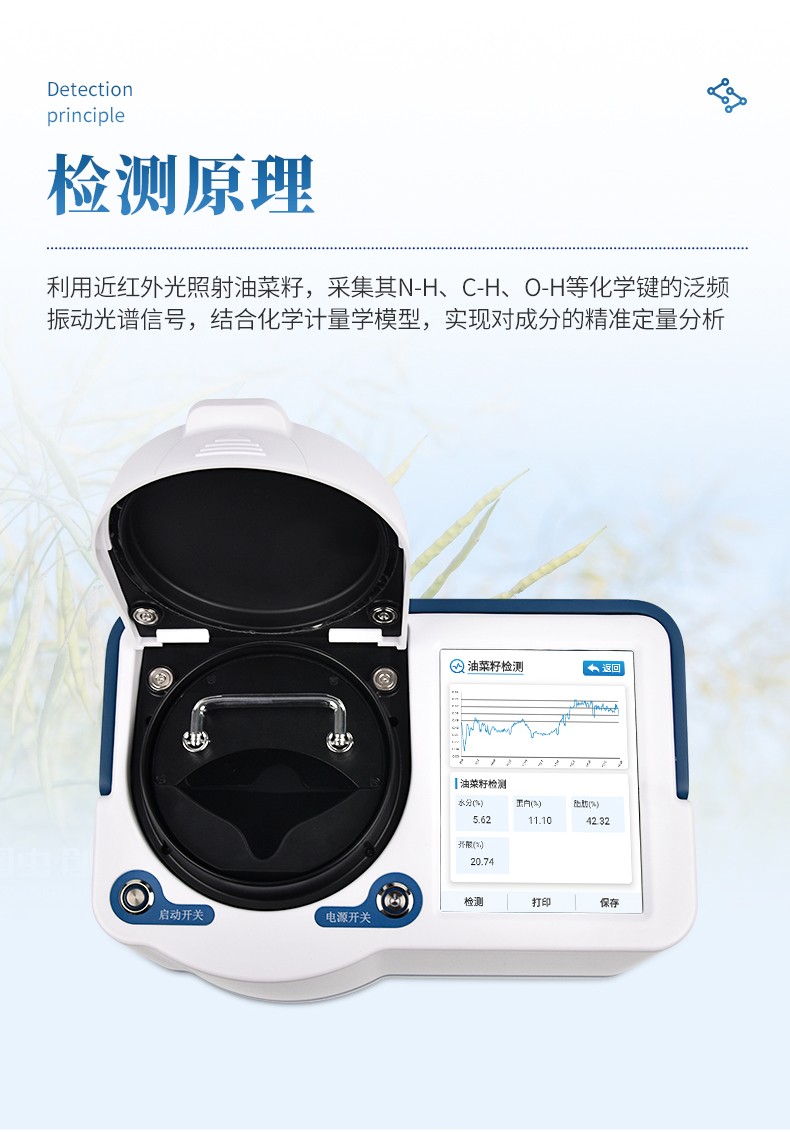
Core technology principle: based on near-infrared(Near Infrared,NIR)Spectral technology captures the molecular composition of components such as protein, fat, moisture, and erucic acid in rapeseed by collecting sample spectral informationN-HTheC-HTheO-HTheC-OEstablish a mathematical correlation model between spectral information and the measured component by combining chemical bond frequency vibration or rotation information with chemometric methods, to achieve quantitative analysis of target indicators; Core detection technology: grating transmission detection method, full wavelength coverage950~1650nmEnsure high consistency between instruments and accuracy of calibration transmission.
4.2 Features
13. Fast analysis speed:1~1.5minComplete the measurement of various indicators of rapeseed internally, with a single group testing time of only80s;
14. Complete testing items: can accurately detect the four core indicators of protein, fat, moisture, and erucic acid in rapeseed;
15. Non destructive testing mode: The sample does not require any pre-treatment, the testing light source is safe, and the original properties of the sample are not destroyed;
16. Green environmental attributes: The detection process does not require the use of chemical reagents, produces no pollutants, and meets environmental requirements;
17. High portability: adopting a handheld design, on-site detection and analysis can be carried out anytime and anywhere, suitable for multi scenario use;
18. Excellent repeatability: effectively reduces human operation errors and environmental interference in different scenarios, and the detection results are stable;
19. Easy to operate: equipped with a touch screen keyboard, user-friendly software interface, and no need for complex training to master the operation proficiently;
20. Integrated printing function: equipped with a new generation high-speed thermal printer, which can output detection results in real time;
21. Data Storage Specification: Supports both image and table storage formats for easy data organization, traceability, and analysis.
5、 Detailed technical parameters
22. Applicable sample type: granular sample (rapeseed);
23. Light source: halogen tungsten lamp, service life10000h;
24. Wavelength range:950~1650nm;
25. Wavelength resolution:1.7nm;
26. Spot diameter:25mm;
27. Testing time:80s;
28. Sample pool capacity:500g;
29. Shell material:ABSmaterial
30. Operating System:Android 11;
31. Operating Temperature10~30℃;
32. Battery life:1h;
33. Supply voltage:12.6V;
34. Communication function: optional4Gmodular;
35. Instrument size:380.5mm×249mm×210.5mm;
36. Instrument weight:6.5kg.
6、 Application scenarios and industry adaptation
6.1 Core application scenarios
37. Breeding research and development scenario: Quickly screen high-quality rapeseed germplasm resources to improve breeding efficiency and quality;
38. Processing and production scenarios: Raw material acceptance and production process quality control for oil, food, and feed enterprises;
39. Trade circulation scenario: rapid pricing and quality appraisal of rapeseed spot purchase and futures delivery on-site;
40. Research and testing scenarios: Analysis and scientific research of rapeseed components by research institutions and third-party testing agencies.
6.2 Industry adaptation scope
Covering the entire rapeseed industry chain, it is suitable for the grain and oil processing industry, food processing industry, feed production industry, agricultural breeding industry, agricultural product trade industry, scientific research and testing industry, etc., meeting the precise testing needs of the entire chain from field breeding to workshop processing, from trade acquisition to scientific research.
7、 Industry standards and policy associations
The testing accuracy and operating specifications of this product are compatible with national standards related to grain and oil testing (such as the national standard for rapeseed quality testing series), and comply with relevant policies and requirements for agricultural product quality and safety supervision; The green detection feature of the product without chemical pollution is in line with national environmental protection policies and agricultural green development plans; Portable on-site detection capability, adapted to the full process supervision policy orientation of agricultural product origin approval and market access, providing technical support for the construction of agricultural product quality and safety traceability system.
8、 Accessories and consumables configuration
8.1 Standard Accessories
Includes sample pool(500gCapacity, halogen lamp light source components, charger (compatible)12.6VPower supply, touch screen protective film, instrument storage box, operation manual, calibration standard sample; Optional4GCommunication module.
8.2 Common consumables
The main consumables are specialized printing paper for high-speed thermal printers. It is recommended to use original specifications of printing paper that are compatible with the instrument to ensure printing quality and equipment compatibility.
9、 Brand Value and Service Support
9.1 brand value
Hengmei Intelligent Manufacturing focuses on the research and production of intelligent detection equipment, with“Accurate detection, convenient and efficient”Guided by core values, we have accumulated rich technical experience and market reputation in fields such as agriculture, grain and oil, and food. As one of the core testing equipment of the brand, this product relies on near-infrared spectroscopy technology to provide standardized and intelligent quality testing solutions for the industry, helping to improve quality, increase efficiency, and promote green development.
9.2 Service Support
Provide instrument operation technical training services to ensure that users quickly master the operating specifications; Equipped with a professional after-sales technical team, providing full cycle technical support such as instrument installation and debugging, fault repair, calibration and maintenance; Provide product quality assurance services and fulfill warranty obligations in accordance with brand warranty policies; Provide technical consulting services and promptly respond to users' questions regarding product usage, data interpretation, and scenario adaptation.
10、 Model comparison and selection suggestions
10.1 Model comparison
At present, Hengmei Intelligent Manufacturing has only launched specialized instruments for rapeseed detectionHM-Y100A model that fully covers the testing requirements for core quality indicators of rapeseed and is suitable for use in multiple scenarios across the entire industry chain. There are no other models in the same series that can be compared.
10.2 Selection suggestions
If the core requirement of the user is rapid non-destructive testing of indicators such as rapeseed protein, fat, moisture, and erucic acid, and it needs to be adapted to on-site mobile testing scenarios (such as field breeding, procurement sites, and workshop inspections),HM-Y100The model is selected for adaptation; If users need to achieve both4GRemote data transmission and sharing, optional installation4GThe configuration version of the communication module; For users with high requirements for storage and traceability of testing data, such as scientific research and testing institutions and large processing enterprises, the image of this model+The dual storage mode of the table can meet the requirements.
11、 Instrument installation steps
41. Unpacking inspection: Open the instrument storage box, take out the instrument host, accessories, and consumables, and check whether all items are complete and undamaged;
42. Battery installation: Insert the fully charged battery into the battery compartment according to the battery installation instructions at the bottom of the instrument, ensuring a secure installation and good contact;
43. Consumables installation: If you need to use the printing function, open the printing paper compartment cover on the side of the instrument, correctly place the thermal printing paper into the paper compartment, pull out the paper head and close the compartment cover;
44. Optional accessory installation: If needed4GFunction, will4GInstall the module correctly to the corresponding interface according to the instructions in the instrument manual to ensure proper installation;
45. Power on self-test: Press the instrument power button, start the instrument, and wait for the system to complete the self-test(Android 11After the system is started, the instrument will automatically perform self checks on basic functions such as light source and spectral acquisition;
46. Calibration confirmation: After the self check is completed, use standard calibration samples to calibrate according to the instrument prompts to ensure that the instrument's detection accuracy meets the standard. Once the calibration is passed, the installation can be completed.
12、 Instrument operation steps
47. Power on preparation: Confirm that the battery is fully charged or connected to an external power source, press the power button to start the instrument, wait for the system to start and complete the self-test;
48. Parameter confirmation: Enter the operation interface through the touch screen, check whether the detection items (protein, fat, moisture, erucic acid), testing time and other parameters are the default standard values. If adjustments are needed, they can be modified in the parameter settings interface;
49. Sample preparation: Prepare uniform rapeseed samples as required, ensuring that the samples are free of impurities and clumps;
50. Sample placement: Open the sample pool cover and evenly load the prepared rapeseed samples into the sample pool (fill until full)500gClose the sample cell lid and ensure a good seal for the standard capacity;
51. Start detection: Click on the operation interface“Start detection”Button, the instrument automatically starts the spectral acquisition and analysis process, please do not move or touch the instrument during this period;
52. Result viewing: After the detection is completed, the instrument automatically displays the detection results (including various indicator values), and detailed data can be viewed through the touch screen;
53. Result output: To print the result, click on the interface“print”Button, the instrument outputs the detection report through the built-in thermal printer; If data storage is required, the system automatically presses the image+Table format storage, historical data can be viewed in the data management interface;
54. Shutdown and Closing: After the detection is completed, remove the sample from the sample pool, clean the residue in the sample pool, and click on the interface“Shut down”Button, wait for the system to shut down normally, turn off the power, and put the instrument back into the recycling bin.
13、 Sample testing steps
55. Sample collection: According to the testing requirements, representative rapeseed samples shall be collected from different batches and parts, with a collection quantity not less than600g(Ensure compliance)500gDetecting usage and reserving backups);
56. Sample pretreatment: Remove impurities (such as stones, weeds, damaged seeds, etc.) from the sample, mix the sample thoroughly and evenly, and avoid detection errors caused by uneven samples;
57. Sample loading: Open the instrument sample pool cover and slowly and evenly load the pre treated sample into the sample pool until it is filled to the standard capacity500g)Gently tap the side wall of the sample cell to ensure that the sample is packed tightly and without gaps, close the sample cell cover and tighten the seal;
58. Start detection: After confirming that the detection parameters are correct on the instrument operation interface, click“Start detection”The instrument enters the automatic detection process, which takes about80s;
59. Result recording and verification: After the testing is completed, record the test results of each indicator displayed by the instrument, verify whether the results are within a reasonable range, and if there are any abnormalities, resample for retesting;
60. Sample cleaning: After the testing is completed, promptly open the sample pool cover, pour out the tested sample, and clean the inside of the sample pool with a clean brush to avoid residual samples affecting the next testing result;
61. Data archiving: Archive and organize the test results (including sample information, testing time, testing personnel, and testing values) according to requirements, and export data backups through the instrument storage function.