-
E-mail
topthreegeoscience@163.com
-
Phone
18302175139
-
Address
Minhang Industrial Park, Shanghai
Sanjia Diyan (Shanghai) Instrument Equipment Co., Ltd
Application of Handheld Spectrometer in the Power Lithium Battery Industry Chain
Date: 2025-12-23Read: 3
Lithium power batteries have been widely used in various electronic and electrical devices due to their advantages such as high energy, high battery voltage, wide operating temperature range, and long storage life. Large capacity lithium batteries have become one of the main power sources for future electric vehicles. Although the lithium-ion battery industry has overcome the adverse effects of declining production of new energy vehicles and continuous decline in battery prices in recent years, it has maintained a steady development momentum. According to statistical data, the cumulative production of lithium-ion batteries in China was 15.72 billion units in 2019, a year-on-year increase of 12.4%. Looking ahead, the long-term positive trend of the global new energy vehicle market will not change. Deep cooperation between key material suppliers, power battery companies, and new energy vehicle companies in the supply chain, continuously expanding the research and development of high-energy density lithium power batteries.
However, in recent years, incidents such as fires and explosions have occurred frequently in lithium-ion batteries, which are essentially caused by their material systems. Generally, it can be divided into two categories: internal and external factors. Internal factors refer to the impact of the battery's material composition, production process, etc. on battery safety; External factors refer to the impact of certain conditions on the battery during use, such as overcharging, compression, etc., which can cause the battery to expand, smoke, or even catch fire.
The internal short circuit of lithium-ion batteries is the most important cause of their safety issues, and most safety problems are caused by internal short circuits. Internal short circuit is a short circuit between the positive and negative electrodes inside the battery, usually caused by metal impurities mixed in during the production process, burrs caused by electrode metal foil shearing, formation of lithium dendrites during use, and accidental mechanical stress such as compression.

Lithium battery manufacturer A has purchased multiple handheld X-ray fluorescence spectrometers from our company for the analysis and testing of key battery raw materials and workshop contact samples. For the compliance requirements of lithium battery electrode materials, it is necessary to ensure that the content of metal elements (iron, silver, cobalt, zinc, copper, nickel, and chromium) cannot exceed a certain limit, usually 30-50ppm. Due to the presence of ultra-low amounts of metallic foreign elements in lithium battery materials, they can all pose a risk of short circuit during battery use. At the same time, the A lithium battery manufacturing workshop also strictly requires the absence of any scattered metal samples to prevent improper human operation from mixing into the battery electrode materials.
Not only lithium battery manufacturer A and its peers need to carry out foreign metal content detection work, but also A's raw material suppliers and battery manufacturing equipment suppliers need to carry out the same type of work to ensure consistent detection standards are implemented throughout the entire battery supply chain. So, we purchased multiple handheld spectrometers from raw material supplier B of manufacturer A for similar quality control work. Equipment supplier C provides battery material production equipment for manufacturer A, such as stirring blades, and is also required to conduct quality control testing on all equipment. According to the requirements of A, all produced equipment surfaces must be coated with a layer of tungsten carbide material with a thickness exceeding 50um to ensure that the equipment alloy material will not be exposed on the surface, thereby affecting the purity of lithium battery materials. Moreover, equipment supplier C also needs to conduct compliance checks on the purchased tungsten carbide materials and requires its tungsten carbide supplier D to undergo the same testing. In addition, for ternary lithium electrode materials commonly used in lithium battery electrode materials, which can be recycled and reused after the battery is scrapped, using handheld spectrometers for category level testing is also a good choice for recyclers. Therefore, as shown in the process diagram below, our handheld spectrometer analyzer can be very useful in various links of the lithium battery manufacturing industry chain.
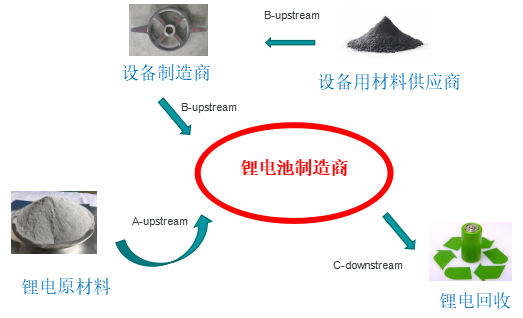


Note: The red circle indicates that equipment supplier C needs to check the position of the propeller blades and coat the alloy surface with tungsten carbide. If metal elements such as iron and copper are detected, it does not meet the requirements. (Experience has shown that tungsten carbide with a thickness greater than about 50um meets the requirements.)
Last Article: XRF Element Analyzer RoHS Compliance Screening