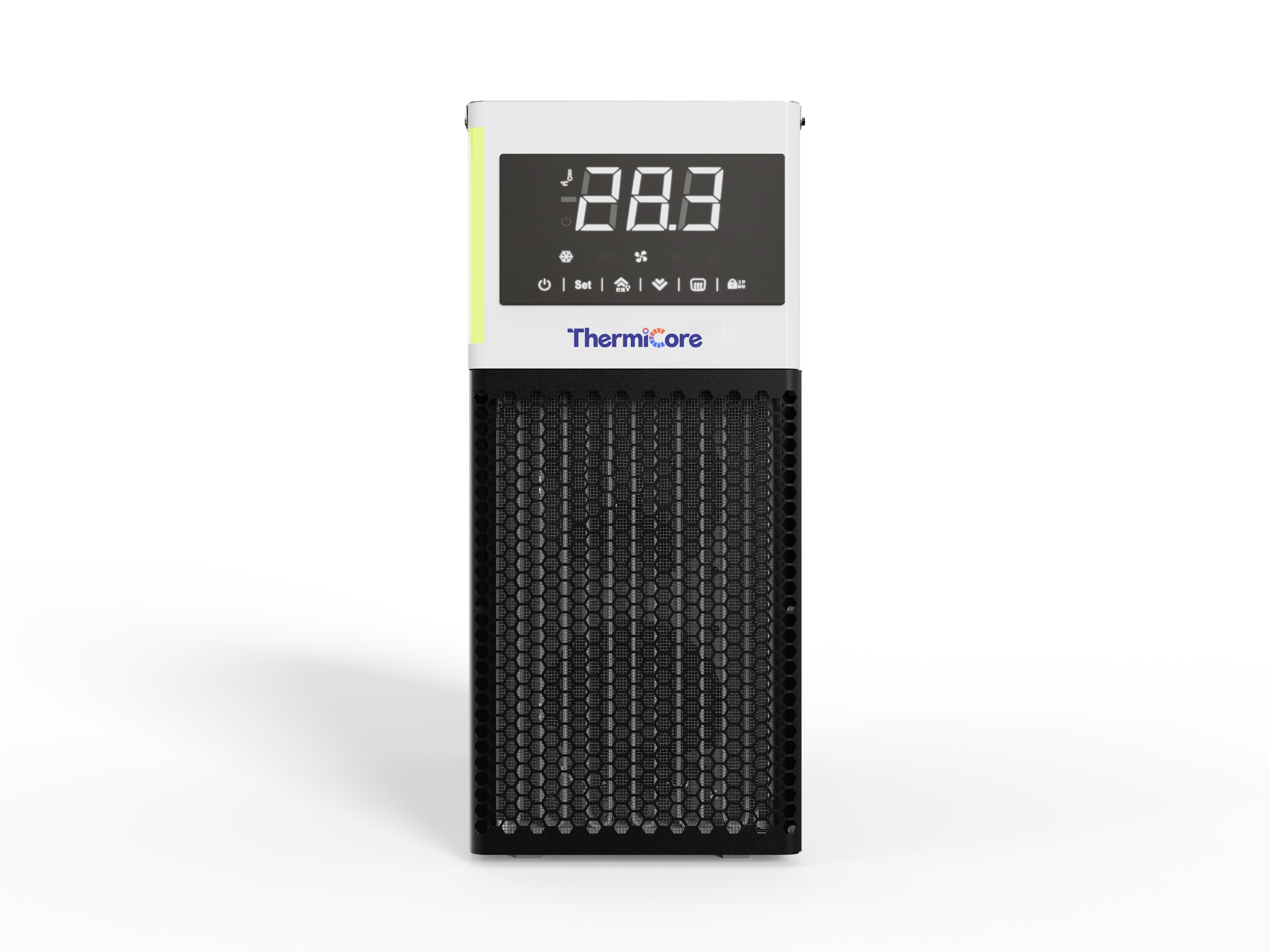
The refrigeration system of the laboratory chiller achieves precise temperature control through "core component selection+closed-loop control logic". The core conclusion is that it is powered by a small and efficient compressor, matched with precise throttling of an electronic expansion valve, combined with high-precision sensors and PID control, to form a real-time feedback regulation closed-loop system.
1、 Precise collaboration and detail adaptation of core components
Compressor: the "cooling heart" with stable outputChoosing a small scroll or rotary compressor not only has a compact size and low operating noise, but also has the advantages of
Stepless Capacity AdjustmentCapability (some models) - When the target temperature approaches the set value, the compressor can automatically reduce the output power to avoid temperature oscillation caused by excessive cooling capacity; At the same time, it is equipped with a precision pressure control module to monitor the high and low pressure sides of the refrigeration system in real time. Through pressure temperature linkage adjustment, it ensures that the refrigeration power output matches the temperature control requirements accurately, reducing temperature fluctuations from the source.
Evaporator: a "cold transfer hub" for efficient heat exchangeAdopting a plate or sleeve type evaporator, its special structural design allows for counter current heat exchange between the cooling medium and the refrigerant, with a large heat exchange area and low thermal resistance. The efficiency of cold transfer is increased by more than 30% compared to traditional structures, which can quickly transfer the cold of the refrigerant to the circulating medium and shorten the temperature response time (usually ≤ 3 seconds). In addition, the evaporator material is made of corrosion-resistant materials such as 316L stainless steel or titanium alloy to avoid heat transfer efficiency degradation caused by medium corrosion and ensure long-term temperature control stability; Some models are also equipped with evaporator anti frost sensors, which automatically activate the defrosting program when a frost layer is detected to prevent temperature drift caused by a decrease in heat transfer efficiency.
Electronic expansion valve: a precise throttling "flow control valve"As the core regulating component for temperature control, the electronic expansion valve is driven by a stepper motor and can be implemented according to controller instructions
Micron level flow regulationCompared to traditional capillary or thermal expansion valves, the response speed is increased by 5-10 times with an adjustment accuracy of 0.01L/min. Its working logic is: by collecting the superheat signal of the refrigerant at the outlet of the evaporator, combined with the temperature deviation of the circulating medium, dynamically adjusting the valve opening - when the actual temperature is higher than the set value, the valve opening is increased, the refrigerant flow rate is increased, and the refrigeration capacity is improved; When the temperature approaches the set value, adjust the valve opening slightly to maintain stable refrigerant flow and avoid temperature overshoot. At the same time, electronic expansion valves have self calibration functions, regularly correcting adjustment errors to ensure long-term adjustment accuracy.
Multi dimensional data collection: accurately capturing temperature changesThe system is equipped with high-precision PT100 or NTC temperature sensors (with a measurement accuracy of ± 0.1 ℃), which not only collect the outlet/inlet temperature of the circulating medium, but also synchronously monitor the key temperature points of the evaporator and condenser, as well as the ambient temperature, forming a multi-dimensional temperature data chain; Some models are equipped with additional pressure sensors and flow sensors, which are monitored through a "temperature pressure flow" linkage to comprehensively reflect the system's operating status and avoid temperature control deviations caused by single data acquisition.
Intelligent operation of PID algorithm: dynamic optimization adjustment strategyBuilt in controller
PID self-tuning algorithmAccording to the temperature demand of different experimental scenarios, the proportional (P), integral (I) and differential (D) parameters can be automatically optimized: the proportional link quickly responds to the temperature deviation, the integral link eliminates the static error, and the differential link predicts the temperature change trend and adjusts the adjustment direction in advance. For example, in chemical synthesis experiments, when the reaction releases heat and causes a sudden increase in temperature, the differential stage can predict the rate of temperature change and increase the cooling capacity supply in advance; When the temperature approaches the set value, the integration loop continuously adjusts to eliminate small deviations and ensure that the temperature remains stable within the range of ± 0.1 ℃ of the set value. In addition, the controller supports multiple sets of parameter storage and can quickly call the adapted PID parameters for different experimental scenarios, improving temperature control flexibility.
Component linkage adjustment: achieving dynamic and precise compensationThe controller sends precise instructions to each core component based on the PID algorithm calculation results: on the one hand, it adjusts the opening of the electronic expansion valve to control the refrigerant flow rate; On the other hand, the compressor is linked to adjust the operating frequency or output power, forming a "flow power" dual closed-loop regulation. For example, when the load of the experimental equipment increases (temperature rises), the controller synchronously increases the opening of the electronic expansion valve and the output power of the compressor to quickly replenish the cooling capacity; When the load decreases (temperature approaches the set value), synchronously reduce the valve opening and compressor power to avoid excessive cooling leading to low temperature. At the same time, the system will dynamically compensate based on changes in ambient temperature - when the cooling efficiency of the condenser decreases due to an increase in ambient temperature, the controller will automatically increase the compressor speed or increase the fan speed to maintain stable condensing pressure in the refrigeration system and ensure that the cooling output is not affected by the environment.
Adaptive adjustment of environmental temperatureThe condenser adopts intelligent heat dissipation design: the air-cooled model is equipped with a temperature controlled fan, which automatically adjusts the fan speed according to the condenser temperature to avoid fluctuations in heat dissipation efficiency caused by changes in ambient temperature; The water-cooled model is equipped with a flow control valve to adjust the cooling water flow in real-time and maintain stable condensing temperature. Through this design, even if the ambient temperature fluctuates within the range of 10-35 ℃, the refrigeration system can still maintain a stable cooling output, ensuring that the temperature control accuracy is not affected.
Anti interference and protection mechanismThe refrigeration system is equipped with multiple anti-interference designs: the control system uses shielded wires to transmit signals, avoiding temperature data distortion caused by strong electromagnetic interference in the laboratory (such as centrifuges, high-voltage power supplies, etc.); Power components such as compressors and fans are equipped with shock absorbers to reduce the impact of vibration on sensors and controllers, and avoid temperature control errors caused by mechanical vibration. At the same time, the system has functions such as overheating protection, overpressure protection, refrigerant leakage detection, etc. - when abnormal working conditions are detected, the controller will immediately start the protection program, adjust the operating status of components or stop the alarm to prevent the situation from damaging the stability of temperature control and ensure the safety of equipment and experiments.
Some laboratories are also equipped with chillersSecondary cooling circuitandAuxiliary heating moduleThe secondary cooling circuit can achieve precise secondary cooling of the circulating medium, further reducing temperature fluctuations; The auxiliary heating module starts micro heating compensation when the temperature approaches the set value, offsetting the temperature deviation caused by excessive cooling, and improving the temperature control accuracy to ± 0.05 ℃, meeting the needs of ultra high precision experiments (such as biological sample refrigeration, semiconductor material testing, etc.).
In summary, the refrigeration system of laboratory chillers has constructed a multidimensional and highly responsive temperature control system through high-precision selection of core components, closed-loop intelligent control of the entire chain, environmental adaptive compensation, and anti-interference design. It can quickly respond to experimental loads and environmental changes, and maintain stable temperature control accuracy for a long time, providing reliable low-temperature support for various high-precision laboratory experiments.