-
E-mail
ustc_sc@163.com
-
Phone
18020740586
-
Address
Room 1503, Building A04, Software Park Phase III, Jimei District, Xiamen City, Fujian Province
About Us
Opu Tiancheng (Xiamen) Optoelectronics Co., Ltd
Date: 2025-12-23Read: 2
Why are all the water pipes empty and the turbidity sensor still 'pretending to work'?
We have installed a multi parameter online monitoring device for drinking water in the secondary water supply pump room of a certain community. During the debugging process, an interesting phenomenon was encountered: when the water in the pump room pipeline was completely drained, the turbidity sensor displayed a reading of 0.1 NTU instead of what many people thought was "0".
The on-site customer immediately raised a question: "There's no water left, why isn't the turbidity zero?" - This is not an isolated case, and many friends who are new to online water quality monitoring will have similar confusion.
Today, let's talk about the science behind the "disappearing water" and the "turbidity that refuses to return to zero".
Turbidity: not counting water molecules, but 'hide and seek' photons
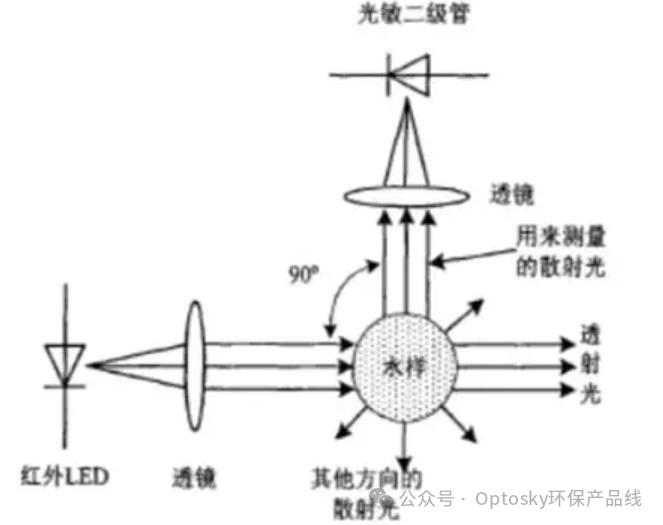
Firstly, it should be understood that turbidity sensors do not measure whether there are "impurities" in water, but rather measure the degree of light scattering by suspended particles in water.
It has a beam of light shining into the water inside, and the detector on the other side receives the scattered light from the particles. The stronger the scattered light, the higher the turbidity value. Therefore, turbidity is an optical indicator, measured in NTU.
Why is it not zero after emptying? The Four Truths
1. Air itself is a 'source of interference'
When the pipeline is emptied, it is filled with air. The air is not a vacuum, but floating with dust, microorganisms, and water vapor molecules that are invisible to the naked eye. These tiny particles also scatter light, causing the sensor to 'mistakenly believe' that it is still working. The reading is 0.1 NTU, which actually measures the 'cleanliness level' of the air background.
2. Sensors also have 'electronic tinnitus'
All electronic devices have background noise - just like when there is no sound in a speaker, there is also a faint electric current sound. Photodetectors and signal amplification circuits generate small signal fluctuations during operation, which are not faults but the 'background color' of the physical world.
It's like turning the volume of your phone to maximum, even if it's muted, you can still hear subtle background noise.
3. 'Zero point' is relative
The '0' of the turbidity meter, which is not an absolute turbidity meter, does not exist naturally. It was manually 'taught' to it by engineers using ultrapure water (below 0.02 NTU). Just like a weight scale that returns to zero after peeling, there is a floating range of ± 0.1kg for both standing and non standing individuals. The fluctuation of 0-0.3NTU is known as' zero drift 'in the industry and is a normal phenomenon for qualified equipment.
4. The 'memory effect' of pipe walls
Even if the water in the main pipeline is drained, the optical window surface of the sensor may still adhere to a very thin water film or have small water droplets. These residual water will still cause weak scattering in the optical path. Just like when a cup is emptied and there are still water droplets on the cup wall.
The 'zero' turbidity is actually an 'ideal state'
In the real world, there is almost no water that is completely pure and devoid of any particles. The ultra pure water used in the laboratory, after multiple filtration and purification processes, can have a turbidity close to zero, but the on-site environment of online sensors is much more complex than that of the laboratory.
Therefore, in engineering, the "zero point position" is usually agreed upon through "calibration". When the turbidity meter leaves the factory, it will use standard zero turbidity liquid (usually ultrapure water that has been specially filtered) for zero calibration. But on site, due to limited conditions, we usually only perform range calibration (such as using 20 NTU standard solution), and the zero point is taken as the "reference zero point" based on readings in air or dry pipe conditions.
That is to say, after emptying the water, 0.18 NTU can actually be considered as the "relative zero point" in the current environment. After the pipeline is filled with water, the actual turbidity value should be the compensation value obtained by subtracting the "environmental zero point" from the current reading (some advanced equipment can automatically reset to zero or offset correction).
How to determine if the device is functioning properly?
Don't stare at the air traffic control readings, look at these three golden standards:
Stable air traffic control reading: After emptying, the reading fluctuates between 0-0.3NTU and does not continue to rise, indicating that the equipment is normal.
Sensitive response after water supply: After restoring normal water supply, the reading jumps to 0.1-0.5NTU (drinking water standard).
Standard solution verification: Test with a known turbidity standard solution (such as 10 NTU), and if the error is within ± 5%, it is considered qualified.
Simply put, air traffic control checks for stability, water supply checks for inflexibility, and school checks for accuracy.
Small suggestions for homeowners and operators
If you also encounter similar questions:
1. Understanding that "zero" does not equal "absolute zero"
The small readings of online instruments in the air are a normal phenomenon and do not represent instrument malfunction or data distortion.
2. Pay attention to the stable readings after water supply
Once the pipeline is running normally and the sensor is covered by water flow, the reading will accurately reflect the water quality.
3. Regular maintenance and calibration
Cleaning (wiping the optical window) and calibrating the sensor according to the prescribed cycle can ensure long-term reliability of the data.
Aopu Tiancheng drinking water multi parameter water quality online analyzer