-
E-mail
ustc_sc@163.com
-
Phone
18020740586
-
Address
Room 1503, Building A04, Software Park Phase III, Jimei District, Xiamen City, Fujian Province
About Us
Opu Tiancheng (Xiamen) Optoelectronics Co., Ltd
Date: 2025-12-24Read: 1
Introduction: Accurately identifying the types and contents of pigments used in mural preservation and research is an important foundation for conducting scientific restoration and in-depth research.
Application keywords: pigment recognition, mural restoration, hyperspectral imaging
Application Overview
The pigments used in ancient murals were mostly derived from minerals and plant materials, with complex material systems. The same visual color is often formed by different substances or multiple pigments, and it is difficult to accurately determine its true composition with the naked eye or conventional imaging methods alone. With the deepening of research and protection of cultural relics, how to obtain more objective and quantifiable pigment information without touching or damaging the cultural relics themselves has become a key requirement.
Hyperspectral imaging captures the spectral reflection characteristics of mural surfaces within a continuous wavelength range, allowing for clear presentation of differences in the spectral levels of different pigments. Compared to traditional imaging methods that only record color information, hyperspectral data can more accurately reflect material properties and pigment combination states, providing a reliable data foundation for mural pigment analysis and distribution research.
Testing principles and methods
This article takes the Qing Dynasty murals in the collection of Yungang Research Institute as the research object, and uses hyperspectral remote sensing to explore the pigment distribution of murals, mainly using pigment abundance inversion method.
An important direction in the analysis of surface pigments on cultural relics is the spectral unmixing of pigments. Through spectral unmixing, the composition and proportion of surface pigments on painted cultural relics can be obtained. In the hyperspectral images of cultural relics, the spectrum of pure pigments can be regarded as endmembers, while each pixel can be described as a mixture of multiple spectra of pure pigments.
Fully Constrained Least Squares Method
(Fast Constrained Least Squares, FCLS)
It is one of the most classic linear unmixing methods, which can quickly obtain the abundance information of pigments. Assuming the mixing model of pigment spectra is linear mixing, the expression of the mixing model is:
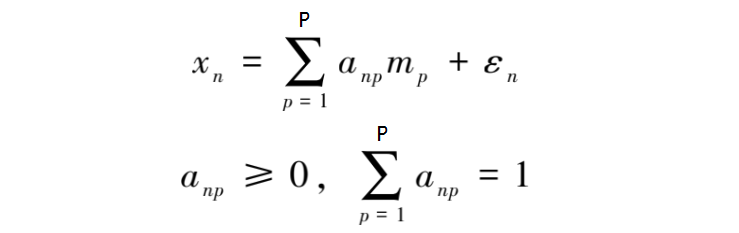
Among them, xn is the reflection spectrum of the nth pixel in the hyperspectral image; P is the number of end elements; Mp is the spectral vector of the p-th endmember; Anp is the abundance of the p-th endmember in the n-th pixel; ε n is noise.
After inverting the abundance of pigments on the surface of murals, pigment identification work is carried out using spectral matching technology. The first step is to establish a laboratory standard spectral library, and then compare and match the reflectance spectra of the tested pigments with the standard spectral library to select the pigment spectrum with the highest similarity to the tested spectrum, which is used as the final pigment identification result. The commonly used core methods for spectral matching include Spectral Angle Mapping (SAM) and Spectral Feature Fitting (SFF). Among them, the SAM method determines the similarity between the unknown spectrum and the reference spectrum by calculating the angle between their corresponding vectors. The smaller the angle value, the higher the similarity between the two spectra; SFF is a remote sensing classification technology based on spectral absorption features for matching. Before implementing matching, the target spectrum and reference spectrum need to be preprocessed by removing the envelope line, and then the least squares method is used to fit the curves of the target spectrum and reference spectrum after removing the envelope line.
Result Analysis
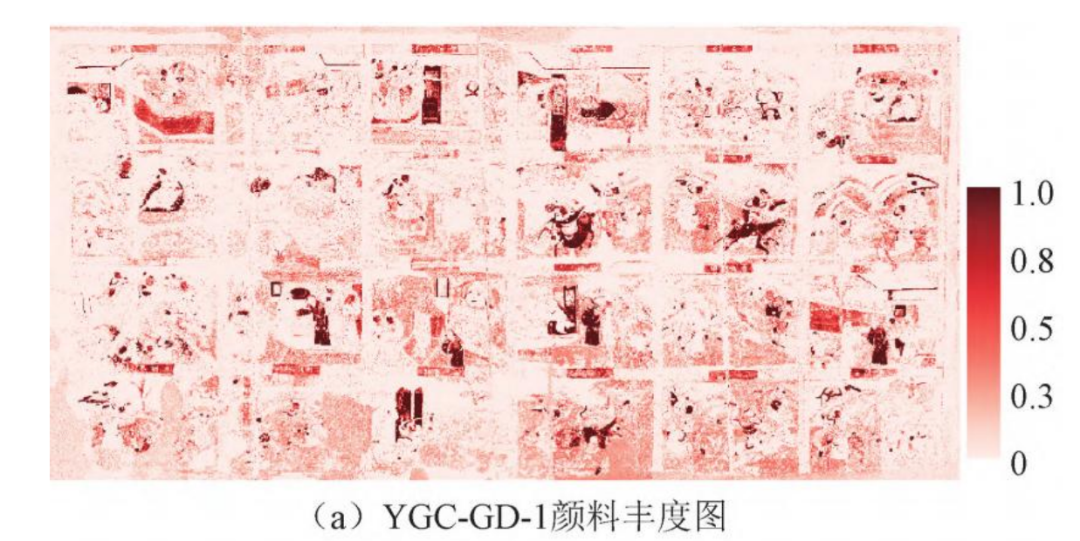
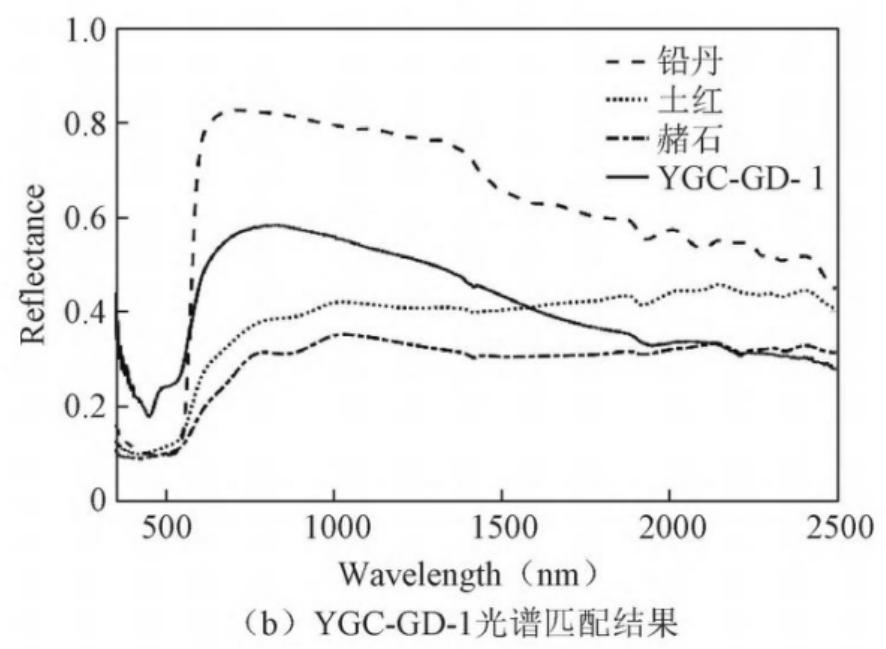
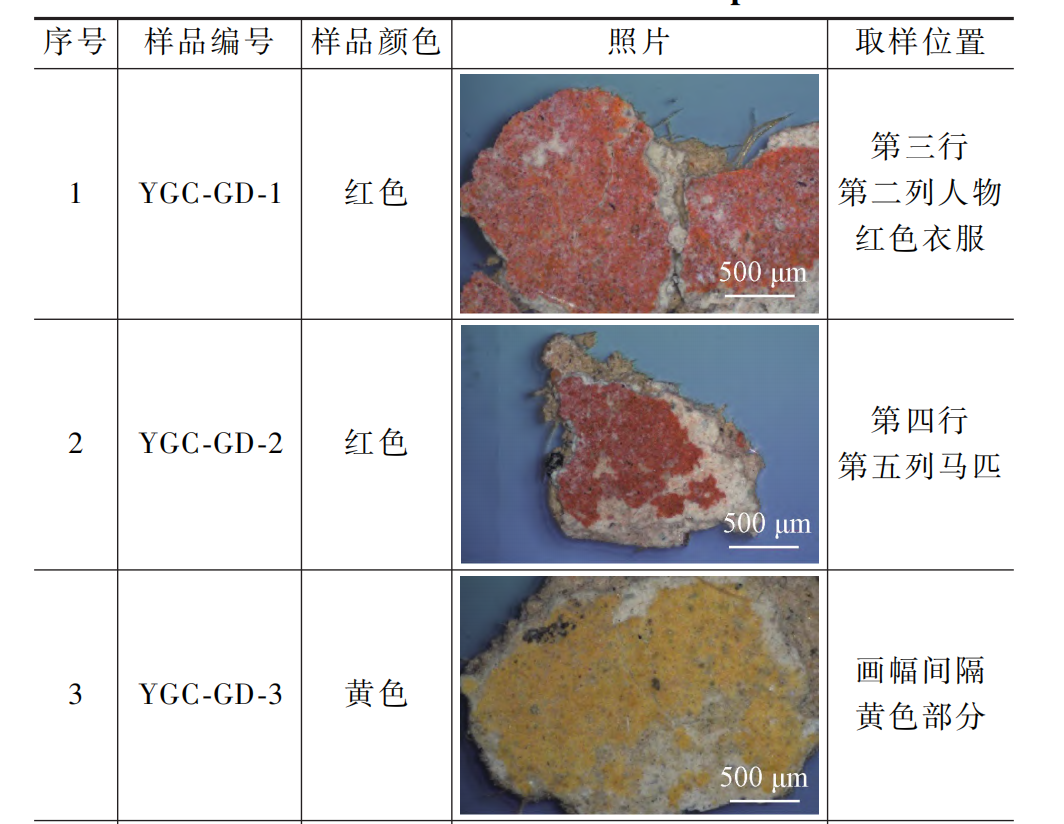
YGC-GD-1 is light red with some orange tones, and its spectral curve first increases and then decreases, reaching its highest value around 700nm. After spectral matching, the most similar pigment spectra to it are: lead lead, earth red, and ochre, with lead being the most similar.
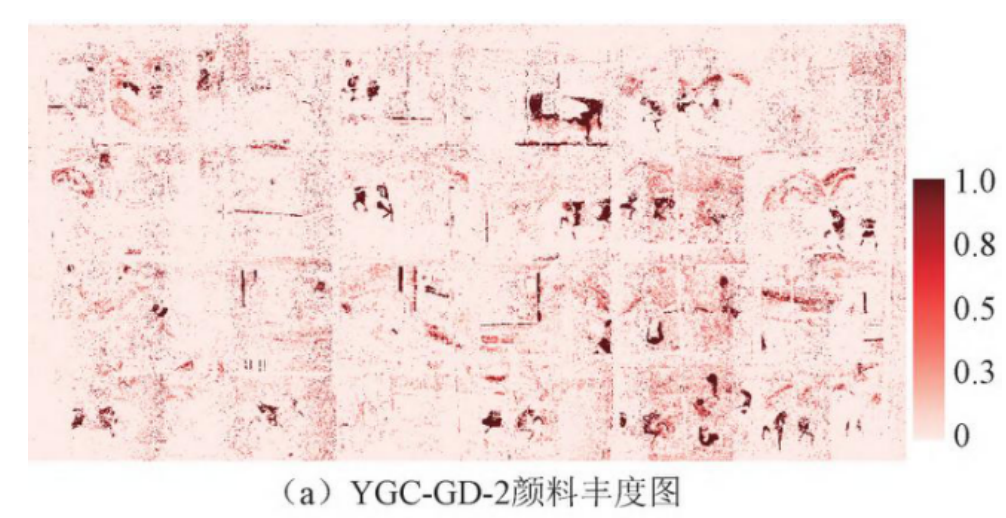
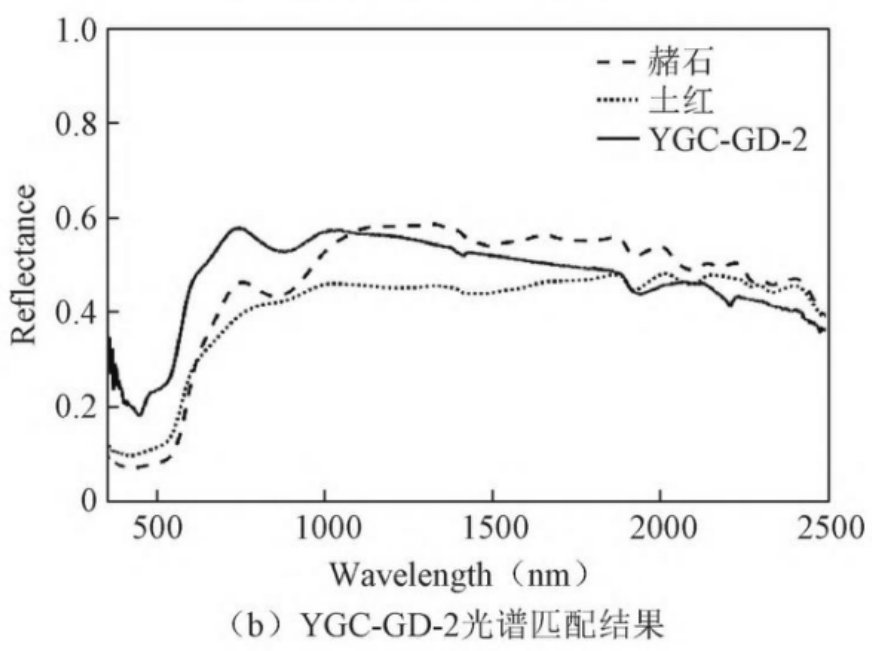
YGC-GD-2 is a deep red color with clear peaks and valleys in its spectral curve between 600 and 1000nm. After spectral matching, pigments with similar spectra to YGC-GD-2 include ochre and earth red, both of which are composed of Fe2O3.
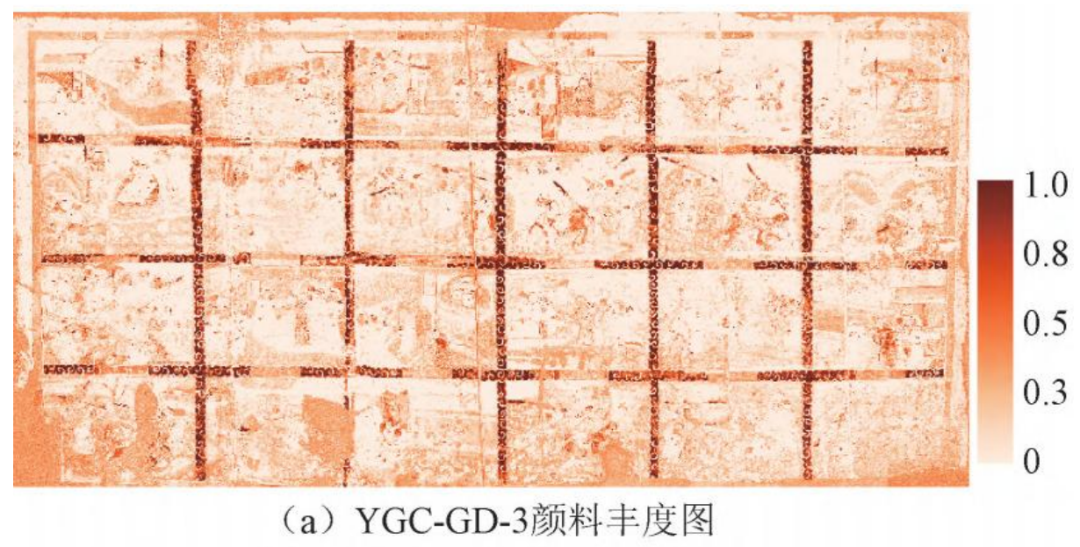
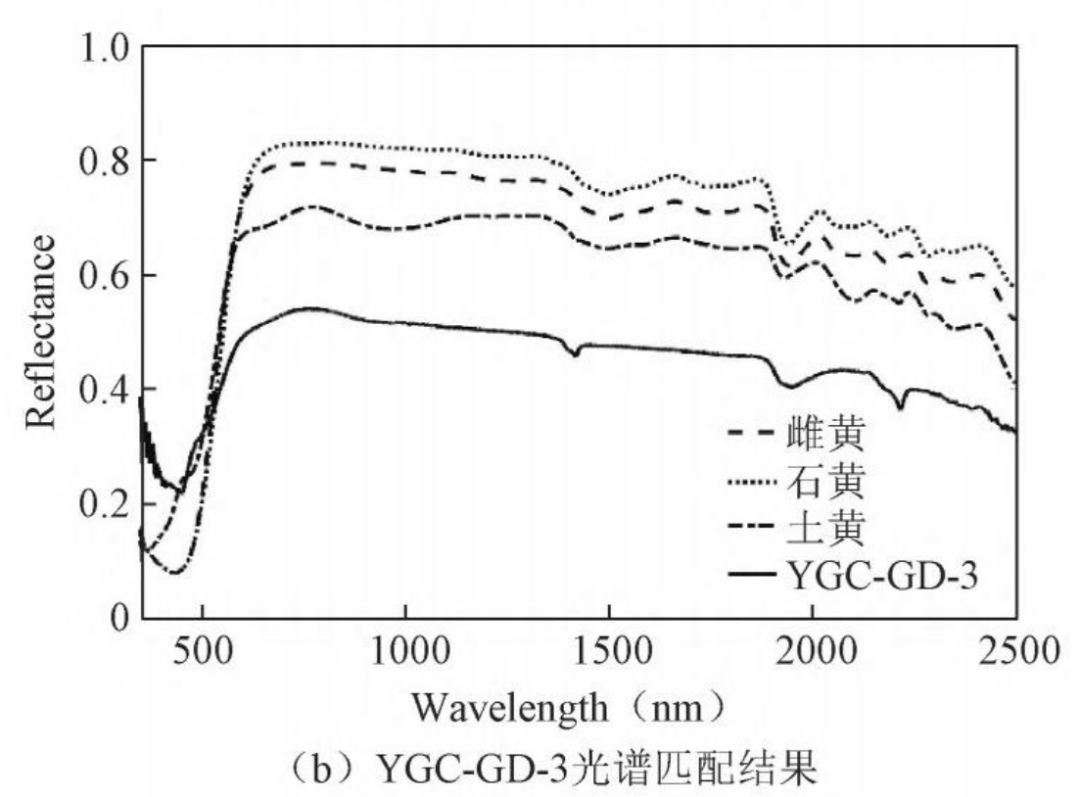
YGC-GD-3 has a light yellow color. There is a peak in the spectral curve around 750nm. After spectral matching, pigments with similar spectra are: orpiment, stone yellow, and earth yellow. Among them, soil yellow is the most similar, with a small peak around 750nm for both.
Conclusion
In pigment recognition, the use of hyperspectral technology can achieve non-destructive detection of pigment distribution. Combined with other detection and analysis methods, it can accurately identify pigment types and has great application value and potential.
References:
Analysis of Surface Pigments on Qing Dynasty Mural Paintings in the Collection Based on Hyperspectral Remote Sensing: A Case Study of the Comic Strip of the Holy Relics of Emperor Guan Yu
Guo Jing 1, Wang Yu 2, 3, Fan Xiao 1, Lv Shuqiang? 2,3
(1. Yungang Research Institute, Datong, Shanxi 037007; 2 School of Surveying and Urban Spatial Information, Beijing Jianzhu University, Beijing 102616, China;
3. Beijing Key Laboratory of Fine Reconstruction and Health Monitoring of Architectural Heritage, Beijing 102616, China
Product Recommendation