-
E-mail
ustc_sc@163.com
-
Phone
18020740586
-
Address
Room 1503, Building A04, Software Park Phase III, Jimei District, Xiamen City, Fujian Province
About Us
Opu Tiancheng (Xiamen) Optoelectronics Co., Ltd
Date: 2025-11-25Read: 2
What is drone hyperspectral imaging
Simply put, drone hyperspectral imaging refers to installing a hyperspectral imager on a drone and allowing it to fly into the air to collect spectral information of the ground or crops.
It combines two technologies:
Drone platform - provides low altitude maneuvering flight capability, can quickly cover large areas, and flexibly capture different angles and heights.
Hyperspectral imaging technology - divides continuous spectral information into dozens to hundreds of narrow bands (such as 400-1000nm visible light+near-infrared, and even extending to 2500nm short wave infrared), with each pixel having a complete spectral curve, like taking an "optical fingerprint" of the ground.
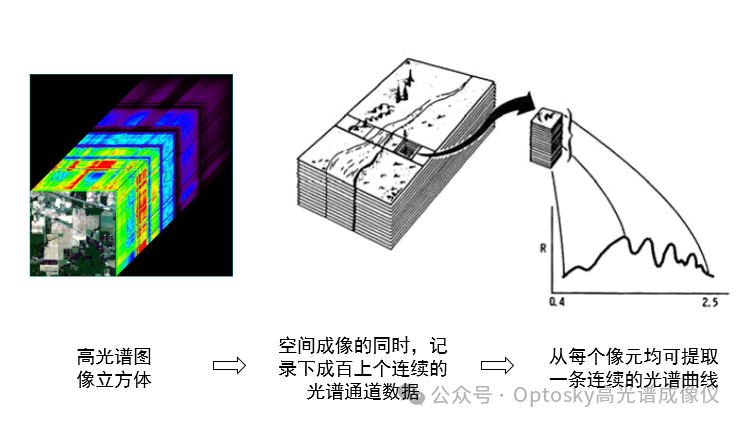
Hyperspectral schematic diagram
What is the difference between it and regular aerial photography?
A regular camera can only capture information in three colors: red, green, and blue.
Multispectral camera: can capture several specific bands (such as red light, near-infrared), suitable for vegetation indices such as NDVI.
Hyperspectral camera: It can capture tens to hundreds of consecutive bands, providing more comprehensive information and detecting subtle differences that are not visible to the naked eye.
For example, in the early stages of pests and diseases, the chlorophyll content, water content, and cell structure of crop leaves have already changed, but the color may not have changed yet. Hyperspectral imaging can detect these anomalies through changes in reflectivity in specific bands, achieving "early detection".
How to detect agricultural pests and diseases using hyperspectral imaging?
The leaves of plants reflect, absorb, or transmit different amounts of energy under different wavelengths of light, and these spectral characteristics depend on their chlorophyll content, water content, cell structure, and so on.

When crops are invaded by pests and diseases, these physiological indicators undergo subtle changes, such as:
Chlorophyll decreases → Reflectance in the red light region (around 680 nm) increases, and the position of the red edge shifts.
Decreased moisture content → Decreased reflectance in the near-infrared region (800-1000 nm).
Destruction of cellular structure → overall change in spectral curve morphology.
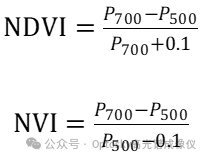
Hyperspectral imaging instruments can simultaneously capture these changing information in dozens to hundreds of narrow bands, forming a "spectral fingerprint" for each pixel. Even if the changes are not visible to the naked eye, hyperspectral imaging can recognize them and achieve early warning of pests and diseases.

Analysis of measured data
Data 1
Hyperspectral real shot data of Aopu Tiancheng in a certain location in Beijing
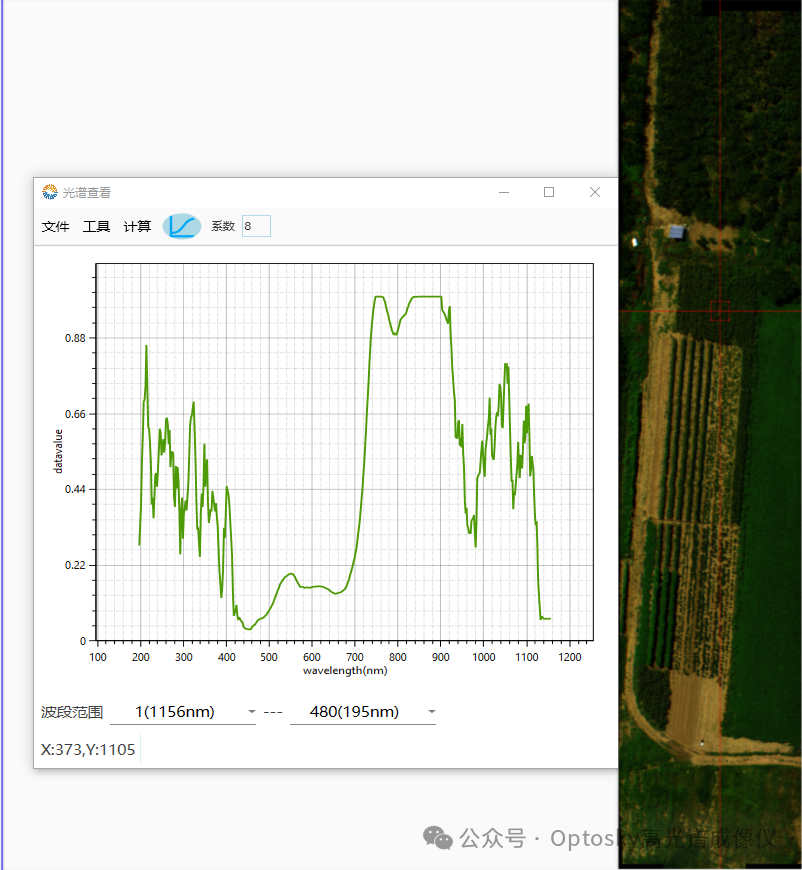
Hyperspectral analysis of pests and diseases (left)
The spectral curve of healthy leaves will have a clear chlorophyll absorption valley at 680nm (red light region), and a significant red edge reflection increase around 750nm.

Hyperspectral analysis of growth (right)
The growth status of crops is essentially a comprehensive reflection of their health status, growth rate, and biomass. It is related to chlorophyll content (reflecting photosynthetic capacity)
Other cases
Case 1
In a wheat planting area in northwest China, the changes in the red edge band were monitored by unmanned aerial vehicle hyperspectral imaging, which detected the initial infection area of stripe rust 6 days earlier than manual inspection, accurately guided spraying, and reduced pesticide use by about 30%.
Case 2
Identification of corn leaf spot disease
By combining NDVI and near-infrared reflectance, the drone accurately identified leaf spot disease areas in corn fields using hyperspectral imaging, with an accuracy rate of 92%.

In the field of agriculture, hyperspectral technology will be deeply integrated into precision agriculture, achieving a complete closed-loop process from crop growth monitoring, pest and disease warning to precision fertilization and spraying. In terms of ecological and environmental monitoring, hyperspectral imaging can be used for forest health assessment, wetland change monitoring, water quality analysis, etc., providing strong technical support for natural resource conservation and carbon monitoring.