-
E-mail
sales@nanjingkrs.com
-
Phone
15715193902
-
Address
A1015, No. 108 Keyuan Road, Jiangning District, Nanjing City
Nanjing Korisheng Equipment Technology Co., Ltd
Principle analysis of short-range distillation device and core technology for efficient separation
Date: 2025-07-28Read: 3
Short range distillation is a separation technology widely used in fields such as chemistry, pharmaceuticals, food processing, and petroleum refining. It achieves separation and purification by heating liquids and utilizing the boiling point differences of different components to evaporate and condense them at different temperatures. Compared with traditional distillation, short-range distillation has a smaller distillation path and higher separation efficiency, especially suitable for the separation of high boiling point substances or thermosensitive compounds. This article will provide a detailed introduction to the working principle and application of short-range distillation equipment.
1、 The basic principle of short-range distillation
The principle of short-range distillation is similar to that of ordinary distillation, which uses the difference in boiling points of various components in the liquid to achieve separation. The core step is to heat the liquid mixture so that its components evaporate successively according to their boiling points. The evaporated vapor is converted into liquid through a condensation device, thereby achieving the separation of different components.
However, a notable feature of short-range distillation is the "short-range" nature of its device, which means that the distance over which steam is transported in the system is very short. Due to the fact that the fractionation process occurs in relatively small equipment with a large gas-liquid contact area, the separation efficiency is significantly improved, making it particularly suitable for processing high boiling point or thermosensitive substances.
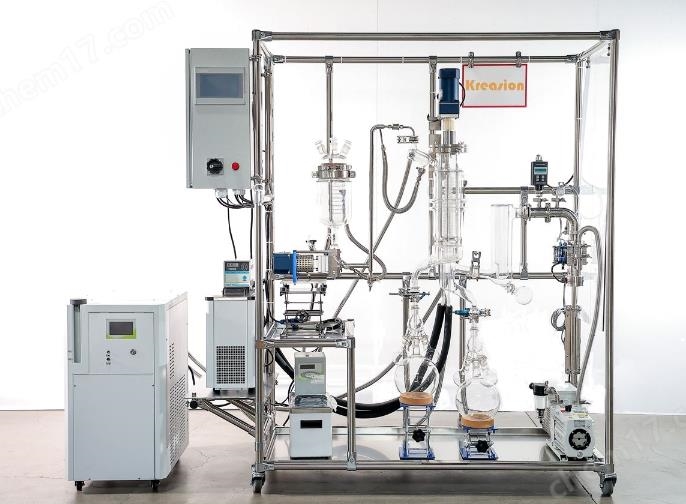
2、 Composition of Short Range Distillation Device
1. Heating furnace: used to heat the mixture and evaporate it. The heating method is usually carried out through a heating rod or an external heat source.
2. Evaporator: It is the first place where liquid mixtures enter during the distillation process, and the liquid components are evaporated into vapor by heating inside the evaporator.
3. Condenser: Used to cool the evaporated vapor into liquid. The condenser cools the vapor and condenses it into a liquid state by circulating a cooling liquid, such as water or coolant.
4. Collector: Collect the condensed liquid and separate different components.
Short range distillation is usually equipped with more sophisticated temperature control and vacuum systems to adjust operating conditions and optimize the separation process.
3、 The advantages of short-range distillation
Compared with conventional distillation, short-range distillation has the following advantages:
1. Efficiency: The evaporation path of this device is short, the gas-liquid contact time is long, and the separation efficiency is high. Suitable for handling heat sensitive and high boiling point substances.
2. Energy saving: Due to the shorter evaporation path and lower energy consumption, it is more energy-efficient compared to traditional long-distance distillation.
3. Accurate temperature control: The device is equipped with a precise temperature control system, which can finely adjust the temperature to ensure effective separation of different components, especially for substances with similar boiling points.
4. Wide applicability: Widely used in fields such as chemical synthesis, drug purification, and extraction of natural products.
4、 Application areas of short-range distillation
Short range distillation is particularly suitable for situations that require high-purity separation. For example, in the pharmaceutical industry, short-range distillation is commonly used for drug purification and solvent removal; In the food industry, it is used for the extraction of essential oil, essence, etc; In the petroleum industry, short-range distillation can be used to separate and purify different components in crude oil.
In addition, short-range distillation is also commonly used for solvent recovery in chemical reactions, reducing environmental pollution and resource waste.
V. Conclusion
As an efficient separation technology, short-range distillation devices have been widely used in multiple industries. With its advantages of high efficiency, energy saving, and precision, it provides an ideal solution for the separation of various complex substances. With the continuous advancement of technology, short-range distillation will be more widely applied in various fields. Mastering its principles and operating methods can enable experimenters to achieve better separation results when dealing with complex substances.