-
E-mail
3892196252@qq.com
-
Phone
13329186925
-
Address
Building 2, Shengfeng Software Park, Huashan District, Ma'anshan City, Anhui Province
Ma'anshan Maisite Intelligent Technology Co., Ltd
Introduction to Online Oxygen Content Analyzer
Date: 2025-11-05Read: 1
Introduction to Online Oxygen Content Analyzer
The online oxygen content analyzer is a semiconductor laser analyzer based on DLAS (Diode Laser Absorption Spectroscopy) gas analysis measurement technology, which can effectively solve many problems in traditional gas analysis technology.

DLAS technology is essentially a spectral absorption technique that obtains gas concentration by analyzing the selective absorption of laser by gas. The difference between it and traditional infrared spectroscopy absorption technology is that the spectral width of semiconductor laser sources is much smaller than the broadening of gas absorption spectral lines. Therefore, DLAS technology is a high-resolution spectral absorption technique. The attenuation of the light intensity of the laser passing through the measured gas can be expressed by Lambert Beer's law:

1. Spectral technology used in online oxygen content analyzer
1.1 Single line spectral measurement technology
Single line spectroscopy measurement technology utilizes the narrow and much smaller spectral characteristics of lasers compared to the absorption lines of the measured gas. It selects a specific wavelength of absorption spectral line, so that there are no absorption spectral lines of other gas components in the measurement environment near that wavelength, thereby avoiding cross absorption interference of these background gas components on the measured gas. Figure 1 shows the principle diagram of single line spectral measurement.
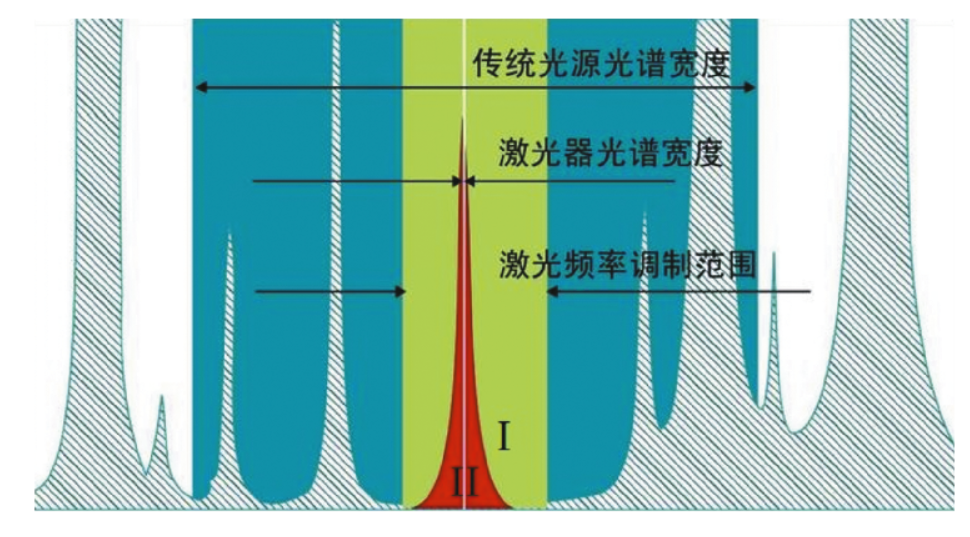
Figure 1 Schematic diagram of single line spectral measurement
1.2 Laser frequency scanning technology
The online oxygen content analyzer periodically scans the absorption spectral lines of the measured gas by modulating the laser frequency. The scanning range of the laser frequency is set to be greater than the width of the absorption spectral lines of the measured gas, so as to include the I region in Figure 1 that is not attenuated by the gas absorption spectral lines and the II region that is attenuated by the gas absorption spectral lines in one frequency scanning range. The measurement signal obtained from Zone I can obtain the transmittance T of dust and windowsdThe measurement signal obtained from Zone II can obtain the total transmittance T of dust, windows, and the measured gasgd=Td×TgTherefore, an online oxygen content analyzer can accurately obtain the transmittance T of the measured gas by simultaneously measuring Zone I and Zone II within one laser frequency scanning cycleg=Tgd/TdThereby automatically correcting the impact of light intensity attenuation caused by dust and window pollution on gas measurement concentration.
1.3 Automatic correction technology for spectral line broadening
When the gas temperature and pressure change, the broadening and height of the measured gas spectral lines will correspondingly change, thereby affecting the accuracy of the measurement results. By inputting 4-20mA temperature and pressure compensation signals, the online oxygen content analyzer can automatically correct the impact of temperature and pressure changes on gas concentration measurement results, thereby ensuring the accuracy of measurement data.
2. Composition of online oxygen content analyzer system
The online oxygen content analyzer consists of a transmitting unit, a receiving unit, a blowing unit, and a junction box, as shown in Figure 2.

Figure 2 Composition diagram of online oxygen content analyzer system
The detection laser emitted by the transmitting unit is received by the receiving unit through the measurement environment of the measured gas, and the signal is processed and the spectrum is calculated to obtain the concentration of the measured gas.
3.Online oxygen content analyzerUsage effect
An online oxygen content analyzer is installed on the exhaust pipeline from the vinyl chloride recovery process to the gas holder to detect the oxygen content in vinyl chloride online, achieving real-time monitoring of the oxygen content in the exhaust of the vinyl chloride removal gas holder. At the same time, the online oxygen content analyzer detection data is interlocked with the pneumatic cut-off valves on the gas holder pipelines of each system. Based on the trend changes of the monitoring data, timely measures can be taken to stop the discharge before exceeding the control standards, ensuring the safe operation of the system.
How to choose an online oxygen content analyzer?
In chemical production, hazardous processes, high-risk process reactors, and centrifuges generally require online detection of oxygen content, and oxygen content analyzers are used in this process. According to the working conditions, electrochemical oxygen content analyzer and laser oxygen content analyzer can be selected. The measurement principles, advantages and disadvantages, and applicability of both are as follows:
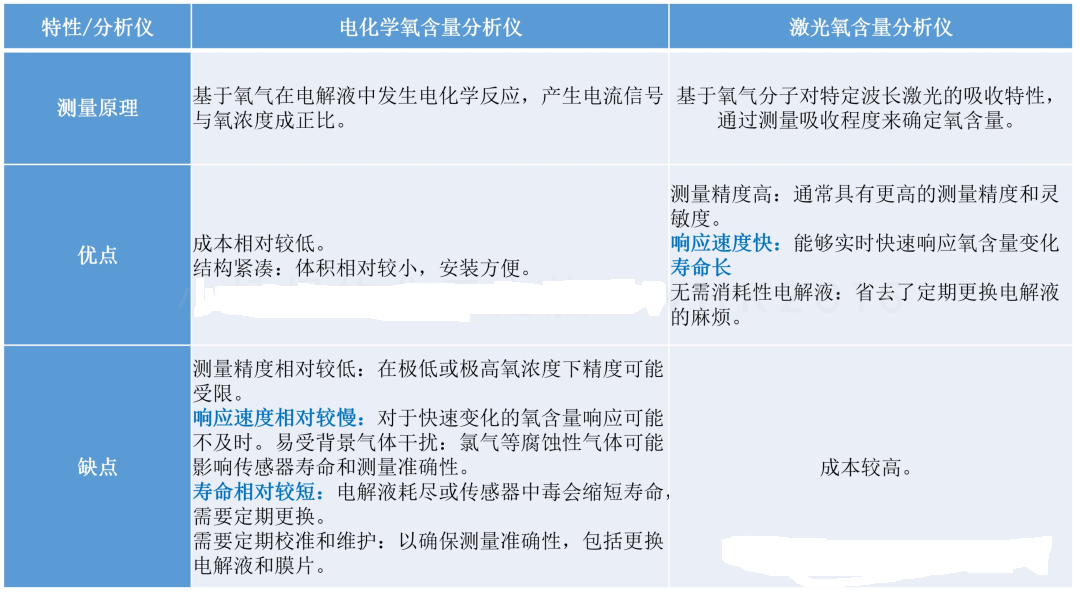
The general measurement process and components of an online oxygen content analyzer include three parts: preprocessing, sampling, and analysis. The process is as follows:

5. Conclusion
In response to the analysis and control status of the oxygen content index in the gas of the dechlorinated ethylene gas cabinet during the PVC production process, through the analysis of various links in the production system and fully drawing on the application examples of online oxygen content analyzers in production, the vinyl chloride recovery process was modified, and an online oxygen content analyzer was installed to effectively monitor the oxygen content in the exhaust of the dechlorinated ethylene gas cabinet, greatly improving the safety factor of the production system.
With the continuous development of technology, many online detection devices such as online impurity detection analyzers, online volatile matter detection analyzers, and online oxygen content analyzers have been successfully applied in actual chemical production, reducing the dependence on manual detection and becoming an important way to continuously strengthen process control and improve production safety.