-
E-mail
sales@care-mc.com
-
Phone
18702200545
-
Address
Taikang Zhida Industrial Park, Jinnan District, Tianjin
Kyle Measurement and Control Test System (Tianjin) Co., Ltd
Ratchet strain and cyclic softening of viscoelastic soft adhesives under uniaxial and biaxial cyclic loading
Date: 2025-12-23Read: 0
With the increasing demand for structural lightweighting in industrial manufacturing, the application of soft adhesives is becoming increasingly widespread in fields such as automotive, aerospace, and electronic equipment. The fatigue failure of soft adhesives under cyclic loading conditions will significantly affect the safe use of adhesive structures. Considering that soft adhesives often exhibit significant viscoelasticity, studying the deformation of viscoelastic soft adhesives under complex path multiaxial cyclic loading is of great significance for the anti fatigue design and safety evaluation of adhesive structures. Recently,Professor Zhang Jun's team from Zhengzhou UniversityAn experimental study was conducted on the deformation behavior of modified polyurethane soft adhesive HP-172B with viscoelasticity under uniaxial tension and biaxial multi-path stress controlled cyclic loading conditions (Figure 1), and a cyclic constitutive model was established to describe the complex deformation mentioned above.

Figure 1 Schematic diagram of biaxial loading path: (a) Proportional path; (b) Diamond shaped path; (c) Circular path; (d) Elliptical path.
This study first prepared dumbbell shaped modified polyurethane soft adhesive samples and conducted uniaxial tensile cycling experiments. As shown in Figure 2, the soft adhesive with viscoelastic properties undergoes continuous cyclic creep and ratchet strain accumulation under cyclic loading. As the number of cycles increases, the soft adhesive undergoes cyclic softening accompanied by a gradual decrease in dissipated energy. To describe this evolutionary law, this study proposes a nonlinear viscoelastic constitutive model that considers the viscoelastic properties of materials. Based on the phenomenological Kelvin model and Maxwell model, mathematical expressions containing strain accumulation function and slope function are constructed to predict the ratchet strain accumulation and cyclic softening behavior of materials under cyclic loading.
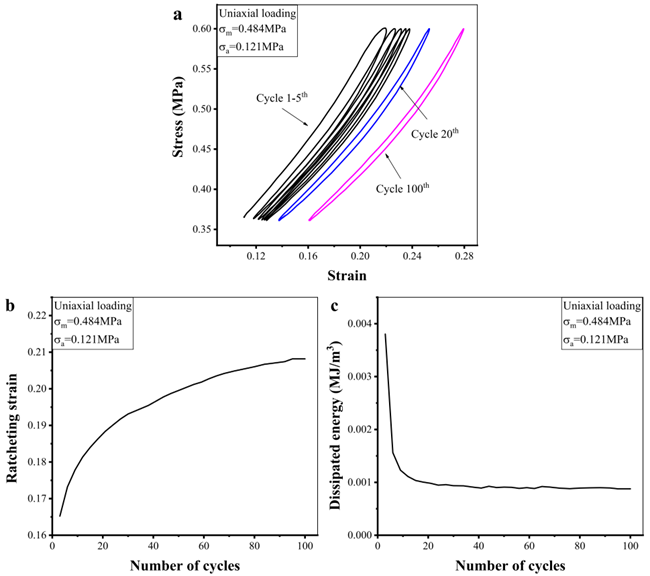
Figure 2 Results of uniaxial loading cycle test
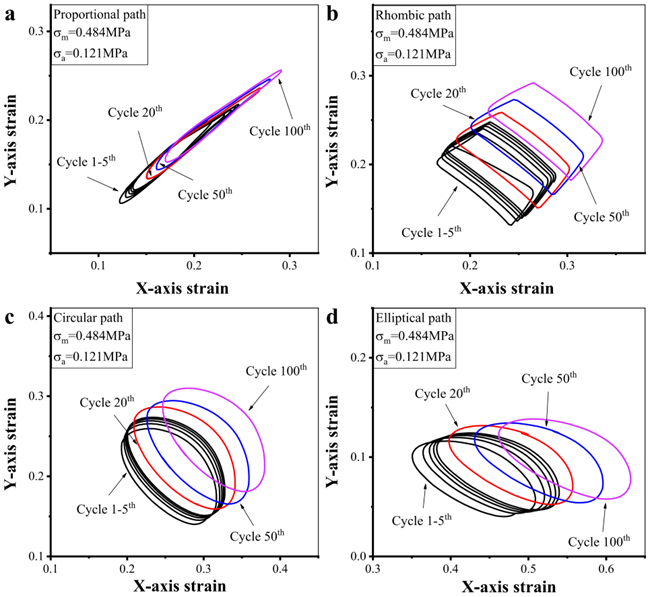
Figure 3 Strain response curves of soft adhesive under different loading paths
Considering that soft adhesives may still need to withstand biaxial cyclic loading in actual service, this study further conducted biaxial tensile cyclic loading tests considering complex loading paths. Compared to uniaxial cyclic loading, non proportional loading path leads to more significant accumulation of ratchet strain, and the evolution law of ratchet strain is strongly correlated with the loading path (Figure 3). Under non proportional cyclic loading conditions, tensile deformation in different directions leads to changes in the intermolecular interactions, making it more difficult to restore the viscosity of the molecular chains compared to proportional loading, ultimately resulting in different ratchet strain accumulation patterns. In addition, soft adhesives exhibit different dissipation energy evolution laws under different loading paths. The initial dissipation energy and total dissipation energy corresponding to non proportional loading paths are higher than those of proportional loading paths, indicating that non proportional loading paths may cause greater damage to materials. To describe material deformation under complex loading paths, this study developed a biaxial multi-path cyclic constitutive model by introducing loading path coefficients. This model accurately predicts the mechanical response under biaxial cyclic loading conditions by adjusting the loading path coefficients to describe the additional effects of different loading paths on the material's ratchet strain (Figure 5).

Figure 4 Evolution of Ratchet Strain and Dissipation Energy with Cycle Times under Different Loading Paths

Figure 5 Comparison of model calculation and experimental results under biaxial multi-path cyclic loading conditions
In summary, this study focuses on the relationship between ratchet strain, cyclic softening, and material damage under different loading path conditions during the cyclic deformation process of soft adhesives. The research results are helpful for the anti fatigue design and development of soft adhesive structures. It is worth mentioning that this study considers the loading path coefficient as a parameter that is only related to the loading path, while in reality, this parameter may be related to the number of cycles. By considering the dependence of the number of cycles on the loading path coefficient and making corresponding adjustments, the accuracy of theoretical predictions can be further improved.
The related research paper titled "Investigation on the Ratcheting Strain and Cyclic Softening of Viscoelastic Soft Adhesive under Uniaxial and Biasal Cyclic Loading" was published in the International Journal of Fatigue.