-
E-mail
sales@care-mc.com
-
Phone
18702200545
-
Address
Taikang Zhida Industrial Park, Jinnan District, Tianjin
Kyle Measurement and Control Test System (Tianjin) Co., Ltd
Large strain mechanical behavior of OCA in flexible electronic devices under different temperatures, humidity, and strain rates
Date: 2025-12-22Read: 0
Optical Transparent Adhesive (OCA) is the core material of flexible electronic devices, and studying its mechanical behavior under high strain, temperature, and humidity environments is crucial for the reliability design of foldable screens. Existing research is mostly limited to small strains (<100%) and conventional environmental conditions. In practical applications, OCA may withstand temperature environments and large strains up to 1000%. Traditional linear viscoelastic models are difficult to describe the complex mechanical response of OCA. Therefore,Associate Professor Yuan Hongyan's team from Southern University of Science and TechnologyWe studied the large strain mechanical behavior of OCA under different temperature ranges, humidity levels, and strain rates, and established its nonlinear viscoelastic constitutive model.
This article conducted uniaxial tensile, simple shear (strain 1000%), and 10 hour creep tests at different temperatures (-40 ° C to 80 ° C) and strain rates (0.01-5 s ⁻¹) in a humidity environment of 95% RH (Figure 1). Using digital image correlation technology (DIC), the Poisson's ratio of OCA was measured to be approximately 0.46, verifying the almost incompressible nature of the material (Figure 5).
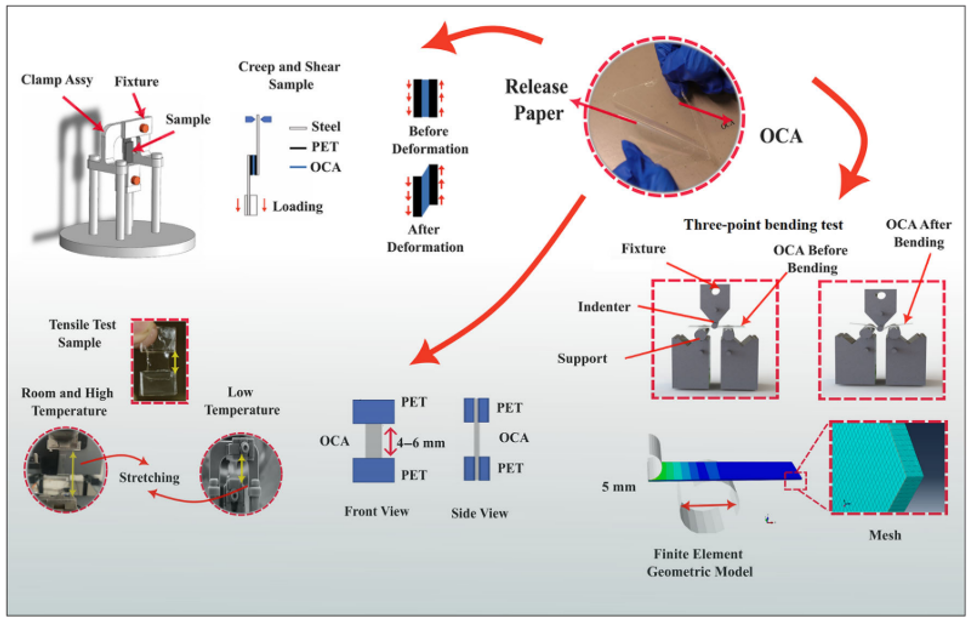
Figure 1 Schematic diagram of loading for mechanical tests (tension, shear, creep, bending)
The experimental results showed that the modulus of OCA exhibited significant temperature dependence: the modulus decreased by 84% from -40 ° C to 25 ° C, and then decreased by 41% from 25 ° C to 80 ° C. The shear modulus reached as high as 262.3 kPa at low temperatures (-40 ° C), and sharply decreased to 20 kPa at high temperatures (80 ° C) (Figure 2). In creep tests, OCA materials undergo rapid failure due to water vapor erosion caused by high temperature and high humidity (80 ° C, 95% RH) environment, with a fracture strain close to 1500% (Figure 3). However, the effect of humidity changes at room temperature on modulus is weak. The strain rate effect is manifested as a 2-fold increase in stress values at 5 s ⁻¹ compared to 0.01 s ⁻¹, and a significant weakening of OCA viscoelastic response at high temperatures.

Figure 2 (a) Tensile tests at different strain rates at 25 ℃, (b) Shear tests at different strain rates at 25 ℃, (c) 65 ℃, and (d) 80 ℃

Figure 3 (a) Simple shear results at different temperatures, (b) Low temperature tensile results, and (c) Creep tests under 50 kPa stress at different temperatures
This article uses a third-order Yeoh hyperelastic model to describe the nonlinear elastic response of materials, combined with a generalized Maxwell model (Prony series) to characterize their viscoelasticity, breaking through the limitations of traditional linear viscoelasticity assumptions. In the process of parameter determination, the Yeoh model and Prony series model parameters were innovatively determined independently for each temperature point, avoiding the failure problem of traditional time temperature equivalence theory (WLF equation) under large strain and significantly improving the model accuracy. The rationality of the constitutive model and parameters was verified through three-point bending simulation. The simulation results showed that the force displacement curves of the experiment and simulation were consistent, and the viscoelastic hysteresis and stress relaxation phenomena were successfully reproduced.

Figure 4 Schematic diagram and stress cloud map of FEM three-point bending loading

Figure 5 (a) Comparison of three-point bending test (loading unloading), (b) Comparison of loading holding unloading test results with FEM, (c) Comparison of loading unloading test results with FEM at different holding times of 10, (d) 60, (e) 300, (f) 600 s, (g) Distribution of DIC speckle and Poisson's ratio
In summary, this study systematically investigated the high strain mechanical behavior of OCA in flexible electronic devices under different temperature, strain rate, and humidity conditions through experimental and numerical methods. A general method for analyzing the mechanical properties of soft materials such as OCA has been proposed, including material testing, constitutive parameter calibration, verification, and applying the model and parameters to finite element simulations of complex large strain mechanical behavior. The constitutive model mainly focuses on the stress-strain relationship of OCA. During the process of large strain, the OCA molecular network may be disrupted, leading to phenomena such as necking, which have not been considered in existing models.
The related paper titled "Large strain mechanical behaviors of optical clear adhesives for flexible electronic devices under different temperature, humidity, and strain rates" was published in the Journal of Applied Polymer Science.