-
E-mail
sales@care-mc.com
-
Phone
18702200545
-
Address
Taikang Zhida Industrial Park, Jinnan District, Tianjin
Kyle Measurement and Control Test System (Tianjin) Co., Ltd
Determination of axial and shear mechanical responses and Poisson's ratio of PDMS elastomers using digital image correlation method
Date: 2025-12-18Read: 0
Polydimethylsiloxane (PDMS) elastomers have been widely used in flexible sensors, electronic component optical systems, and biomechanics due to their excellent properties such as flexibility, optical transparency, non flammability, chemical stability, non toxicity, biocompatibility, and low cost. In these applications, PDMS components are often subjected to complex multiaxial stress states and accompanied by large deformation behavior. It is of great significance to accurately characterize and predict the stress-strain response of PDMS under different deformation modes in order to achieve reasonable selection of soft materials under actual working conditions. To this end, Satya Pal and Abir Bhattacharyya from the Indian Institute of Technology used non-contact digital image correlation (DIC) technology to accurately measure the strain field on the surface of the specimen under finite strain, discussed the influence of deformation modes on its stress-strain response, and based on this, determined the evolution law of Poisson's ratio of PDMS with strain.
This article first conducted mechanical tests under uniaxial compression, uniaxial tension, and simple shear deformation modes. The specimen model is shown in Figure 1, and the strain field evolution of PDMS during this process was obtained through DIC, as shown in Figures 2 to 4. The results indicate that DIC technology can effectively describe the evolution of strain field of PDMS under different deformation modes with loading time.
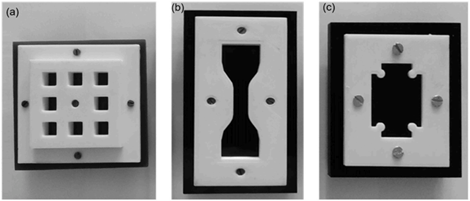
Figure 1 Sample Model
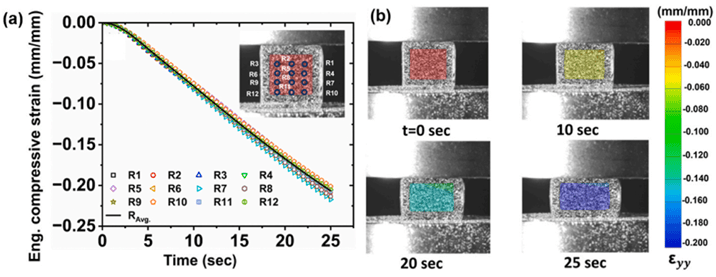
Figure 2 Evolution of axial strain over time under uniaxial compression conditions
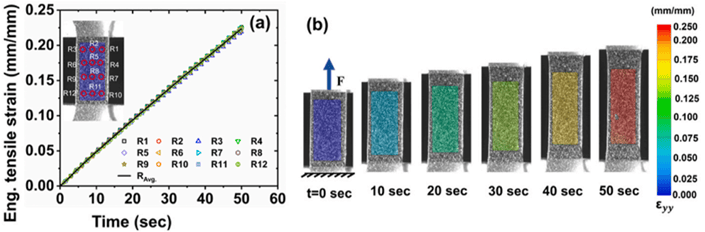
Figure 3 Evolution of elongation strain over time under uniaxial tension conditions
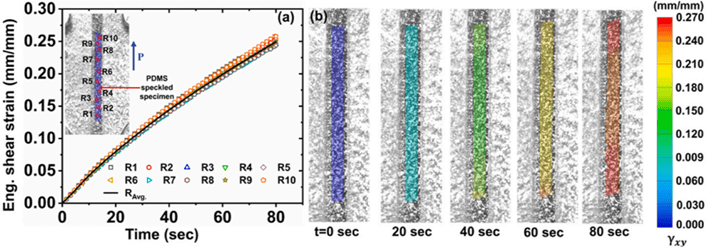
Figure 4 Shear strain evolution over time under simple shear conditions
Based on the above strain field measurement results, this study further obtained the stress-strain relationship curves of PDMS with different curing agent ratios under uniaxial compression, uniaxial tension, and simple shear conditions, as shown in Figure 5. The results indicate that the higher the proportion of curing agent, the greater the apparent modulus of PDMS. There are significant differences in the mechanical behavior of PDMS under different deformation modes, with significant nonlinear behavior under uniaxial compression conditions and strain hardening behavior dominating; PDMS exhibits an approximate linear elastic stress-strain relationship under simple shear conditions; Under uniaxial tension, when the proportion of curing agent is high (10:1), PDMS exhibits a nonlinear response of softening first and then hardening, while when the proportion of curing agent is low, it only shows strain softening. This phenomenon may be related to the moderate strain range studied in this article.
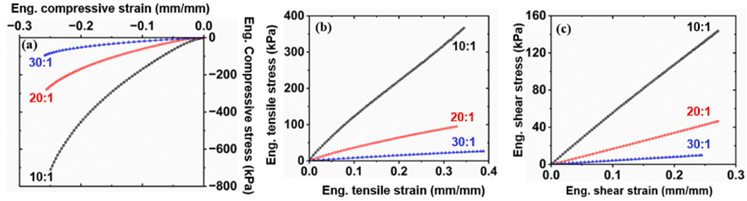
Figure 5 Stress strain relationship of PDMS under different deformation modes
Finally, this article directly obtained the evolution law of Poisson's ratio of PDMS with strain through strain field data from uniaxial tensile tests, as shown in Figure 6. The results indicate that Poisson's ratio is independent of strain rate and curing agent proportion, with an average value of around 0.44. This article obtains the Young's modulus and elastic modulus of PDMS based on the assumption of linear elasticity, and derives the Poisson's ratio value, which is similar to the Poisson's ratio result obtained directly through strain field. PDMS behaves as an incompressible solid under small strain and its mechanical behavior can be described by a linear elastic model.
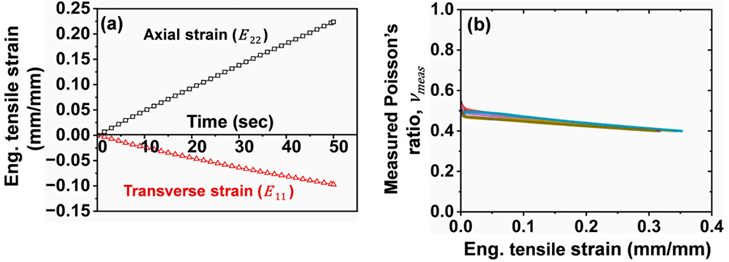
Figure 6: Evolution of PDMS Poisson's ratio with tensile strain
In summary, this article used DIC to measure the surface strain field of PDMS under three typical deformation modes, and determined the magnitude of Poisson's ratio based on the assumption of linear elasticity and direct strain measurement, respectively. The results indicate that there are significant differences in the mechanical behavior of PDMS under different deformation modes, and it can be regarded as a linear elastic solid under small deformation conditions. It should be pointed out that due to the fact that the strain research scope of this article does not exceed 40%, the strain hardening behavior of PDMS has not been fully manifested. Therefore, when establishing a nonlinear constitutive model under large deformation conditions, experimental research at larger strain levels is still needed, and the applicability of the DIC method may be limited under such large strain conditions.
The related paper was published in Polymer Testing under the title "Measurement of axial and shear mechanical response of PDMS elastomers and determination of Poisson's ratio using digital image correlation".