-
E-mail
info@campbellsci.com.cn
- Phone
-
Address
1201, Building 60, Tianji Zhigu, No. 109 Jinghai 3rd Road, Yizhuang Economic Development Zone, Beijing
Kangbao Zhixin Measurement Technology (Beijing) Co., Ltd
Promoting automatic identification of airborne fungal spores: spore culture guidelines and dataset creation
Date: 2025-09-23Read: 1
Background Introduction
In recent years, bioaerosols (including fungal spores, etc.) have posed an increasingly serious threat to human and plant health, and there is an urgent need for precise monitoring and research on them. At present, Europe has established relevant standards based on Hirst artificial observation. However, due to time-consuming and labor-intensive characteristics, high dependence on professionals, significant individual influence, and long data release cycles, it is no longer able to meet the needs of researchers from fields such as medicine, atmospheric physics, plant protection, etc; Automated biological aerosol monitoring equipment is highly anticipated.
The automated monitoring of bioaerosols largely relies on machine learning. However, due to the diversity of particle size, sources, chemical composition, and limited training data, this work is quite challenging. To fill this scientific gap, scientists from 10 research institutions, including the University of Applied Sciences North Western Switzerland, the University of Athens (National and Kapodistrian University of Athens), and Swiss company Swisens, conducted scientific and detailed research to comprehensively introduce practical methods for cultivating and collecting fungal spore material samples, creating machine learning training datasets, and providing methodological references for further real-time airborne fungal monitoring and classification using airflow particle counting instruments such as SwisensPoleno Jupiter.
Materials and Methods
This study utilized 17 fungi from the Belgian fungal sample library BCCM/IHEM for related research, exploring key processes such as preparation of in vitro culture, dry spore harvesting, aerosol atomization, machine learning, and automatic instrument measurement classification, effectively promoting the progress of automatic monitoring and identification of airborne fungal spores.
The research involves fungi, culture media, and the difficulty of obtaining spores through collectors (0 represents the least easy, 3 represents the easiest)
And the microscopic significance of the presence of obvious small mycelium and/or other particles in the sample species (Y represents the presence, N represents the absence).
PAD: Potato Glucose Agar; S10: Diluted sand preservation medium.

Schematic diagram of laboratory setup for nebulization of fungal spores and measurement using SwisensPolemo Jupiter

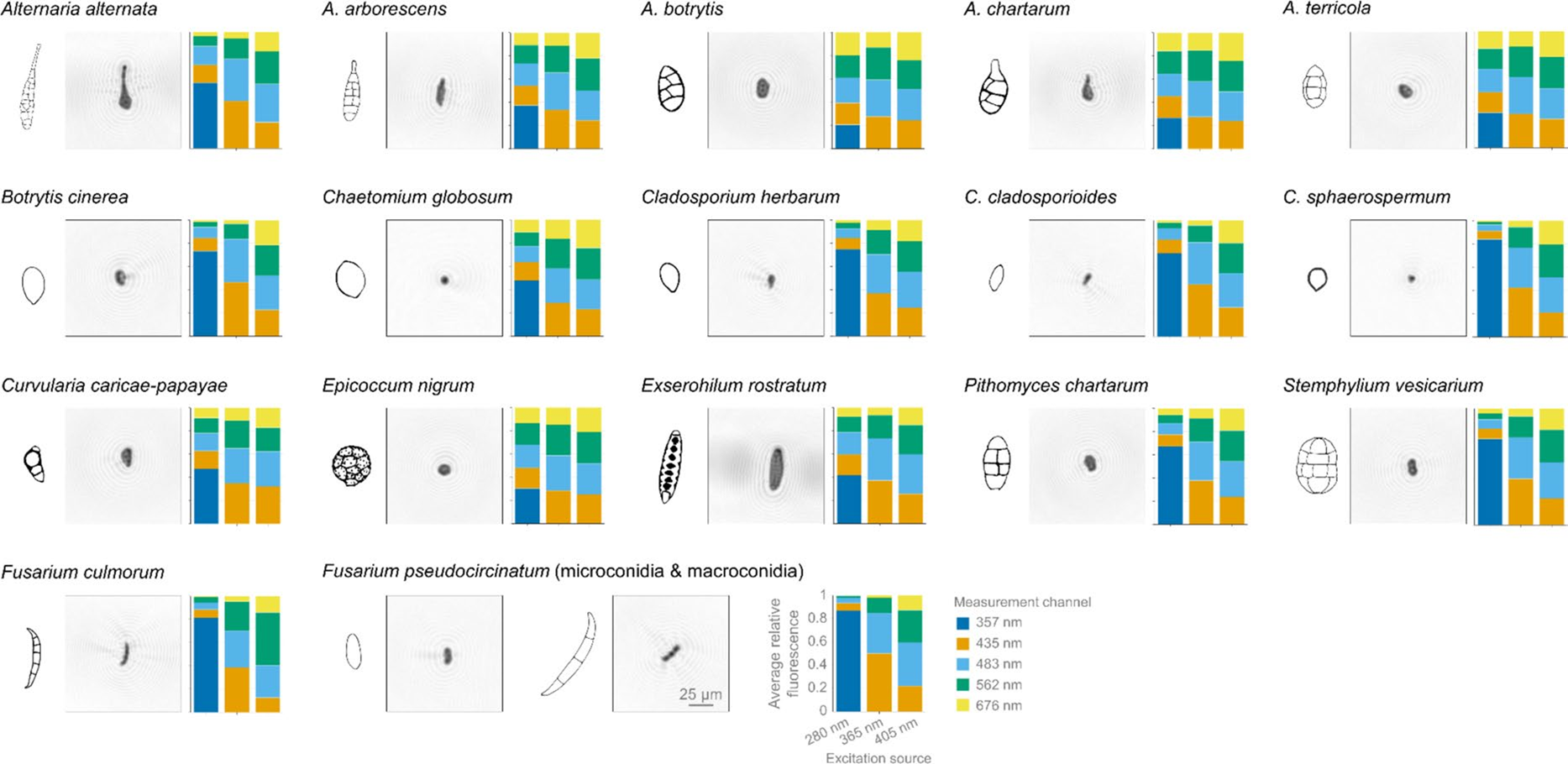
Holographic images (120x120 μ m) of 17 fungi involved in the study, as well as average corresponding data measured by SwisensPoleno Jupiter for each fungus.
17 fungal spores monitored by SwisensPoleno Jupiter:
(A) Convolutional neural networks trained solely on holographic image data recognize performance confusion matrices;
(B) Convolutional neural networks trained on holographic images combined with fluorescence data recognize performance confusion matrices.

Conclusions and Discussion
Through thorough experimentation,
1) This study elucidates that the cultivation and controllable, effective atomization of fungal spores are key steps in obtaining sample datasets for machine learning;
2) Proving that fungal cultivation on agar medium and maturation of fungal spores on air atomized medium are the best ways to maintain spore integrity and reduce hyphal contamination.
Finally, this study hopes that the focus of future work will be on expanding the reference dataset to cover a wider range of fungi, in order to more accurately and comprehensively automatically identify fungal spores, providing a good technological implementation for the dynamic development of bioaerosols and their impact on human and plant health research.
Original source
Aerobiologia Journal, June 2, 2025
Volume 41, pages 505-525 (2025)