-
E-mail
sumcso@sumspring.com
-
Phone
15665715386
-
Address
16th Floor, Greenland Quanjing Yayuan Business Building, Yangguang New Road, Shizhong District, Jinan City, Shandong Province
Jinan Sanquan Zhongshi Experimental Instrument Co., Ltd
Pre filled syringe (pre filled needle) sealing inspection Pharmacopoeia 4041 latest requirements and testing methods
Date: 2025-12-10Read: 0
Pre filled syringe (pre filled needle) sealing inspection Pharmacopoeia 4041 latest requirements and testing methods
As a direct contact injection drug delivery system, the sealing performance of pre filled syringes (pre filled needles) directly affects drug stability, sterility assurance, and clinical safety. In order to ensure reliable sealing of components such as protective caps, needle interfaces, pistons, etc. during storage, transportation, and use, the 2025 edition of the Chinese Pharmacopoeia provides clearer and stricter testing requirements for the sealing of pre filled syringes (pre filled needles) in General Rule 4041 "Sealing Inspection Method for Pre filled Syringe Components".
The newly added and improved standards mainly include two parts:
Sealing inspection of protective cap and sleeve
Sealing inspection of piston and sleeve
And it is highly compatible with the Sanquan Zhongshi technology scheme, including:
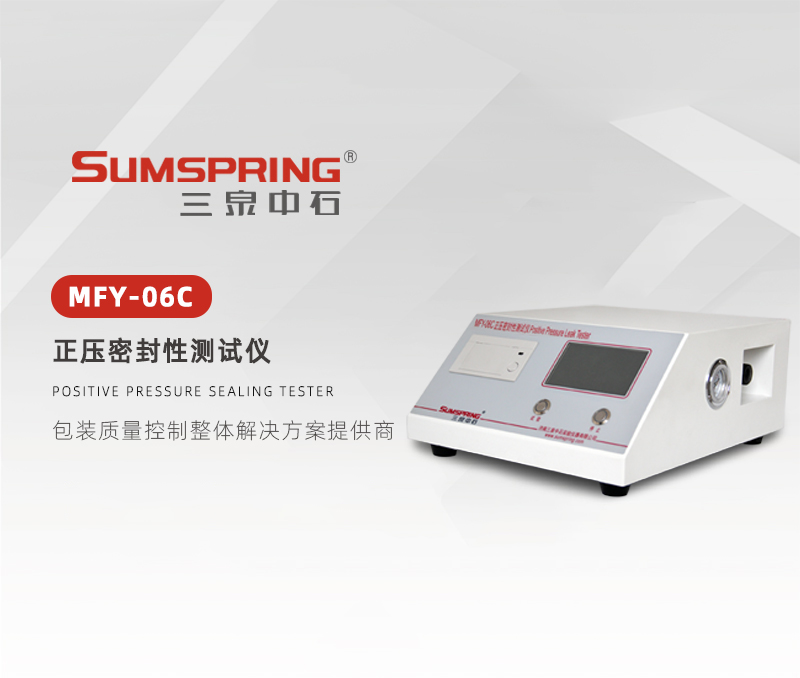
One method corresponds to the Three Springs Stone MFY-06C Positive Pressure Sealing Tester
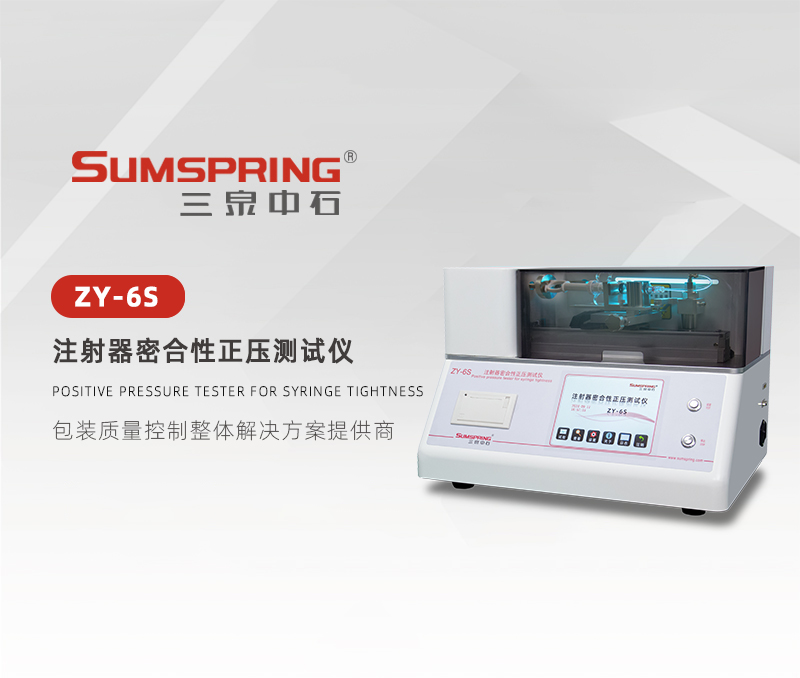
The second method corresponds to the Sanquan Zhongshi ZY-6S syringe positive pressure tightness tester (newly added item "Sealing between Piston and Sleeve" in the 2025 Pharmacopoeia, also known as body tightness in drug packaging materials)
The following will elaborate on two inspection methods based on standard terms, combined with the functions and applications of the Sanquan Zhongshi instrument.
1、 Sealing inspection of protective cap and sleeve (can use Sanquan Zhongshi MFY-06C positive pressure sealing tester)
The tight fit between the protective cap and the sleeve is related to the sealing reliability of the needle or Luer cone joint, and is the key to avoiding drug leakage and contamination.
1. Purpose of testing
Used to verify whether the connection between the protective cap and the sleeve can maintain liquid leakage resistance under pressure.
2. Detection device
According to the pharmacopoeia requirements, two methods can be used:
Material testing machine applies load (applicable when wall friction can be ignored)
Compressed air pressurization method (priority method)
The Sanquan Zhongshi MFY-06C positive pressure sealing tester adopts compressed air pressure method, which allows the test sample to be leak judged under controlled pressure and fully meets the second priority requirement.
3. Sample preparation
The protective cap should be tested at least 12 hours after assembly to ensure assembly stability.
4. Inspection method
(1) One method (material testing machine applies load)
The steps are as follows:
Fix the sample in the fixture and fill it with 1/3 to 2/3 of the indicated amount of water.
Install the piston and push rod.
Apply a load according to the following formula to achieve an internal pressure of 110 kPa and maintain it for 5 seconds:
Check if the protective cap falls off and if there is any leakage during and after the experiment.
(2) The second method (positive pressure pressurization) - MFY-06C corresponding method
This method is consistent with the testing format of the MFY-06C positive pressure sealing tester for Sanquan Zhongshi, and it is recommended to use it first.
Fix the sample and fill it with the specified volume of water.
Close the end and reserve an airway.
Apply 110 kPa pressure to the syringe using the positive pressure sealing tester MFY-06C and maintain it for 5 seconds.
Check if the protective cap has come off or if there is any liquid leakage.
2、 Piston and sleeve sealing inspection (corresponding to the ZY-6S syringe positive pressure sealing tester of Sanquan Zhongshi)
This section is a key requirement added to the Pharmacopoeia in 2025, also known as "syringe body sealing" in drug packaging materials, to test whether the piston has sufficient resistance to liquid leakage after the push rod is applied with force.
1. Purpose of testing
Simulate the actual use of push rod displacement and piston compression to verify whether there is liquid leakage.
2. Testing equipment and requirements
Standard requirements may apply:
Lateral force 0.25-3N
Axial pressure of 200 kPa or 300 kPa
The ZY-6S syringe positive pressure tightness tester from Sanquan Zhongshi can accurately output the lateral and axial forces mentioned above, making it an ideal device that meets the requirements of the new standard.
3. Inspection method
Add more water than the marked amount into the syringe, exhaust and adjust it to the marked amount.
Connect the pressure gauge and seal it.
Apply a specified lateral force to the push rod to place the piston in a biased position.
Apply the specified axial force to the syringe to achieve the required internal pressure in the gauge (200 or 300 kPa).
Maintain for 30 ± 5 seconds
Check if there is any liquid leakage at the piston (liquid is allowed between the sealing rings, which is not considered as unqualified).

3、 The overall solution of Sanquan Zhongshi in the sealing testing of pre filled syringes
Faced with the new requirements for the sealing of pre filled syringes in the 2025 edition of the Pharmacopoeia, Sanquan Zhongshi, based on years of technical accumulation in the field of drug packaging material testing, provides a full process testing plan from cap sealing, needle interface sealing to piston sealing:
MFY-06C Positive Pressure Sealing Tester: Suitable for positive pressure sealing inspection of protective caps and sleeves, meeting the requirements of pharmacopoeia law.
ZY-6S syringe positive pressure sealing tester: adapted to the new version of the "syringe body sealing" project, it can control lateral and axial forces to ensure that the piston sealing performance meets the pharmacopoeia requirements.
As a professional manufacturer with independent intellectual property rights, Sanquan Zhongshi has been deeply involved in the field of drug packaging material testing equipment for nearly 20 years, with rich technical reserves that meet multiple domestic and international standards, and continue to provide stable and reliable testing equipment for drug quality and safety.