-
E-mail
sumcso@sumspring.com
-
Phone
15665715386
-
Address
16th Floor, Greenland Quanjing Yayuan Business Building, Yangguang New Road, Shizhong District, Jinan City, Shandong Province
Jinan Sanquan Zhongshi Experimental Instrument Co., Ltd
How to measure residual oxygen in ampoules? Application analysis based on headspace gas (residual oxygen) analyzer
Date: 2025-12-15Read: 0
How to measure residual oxygen in ampoules? Application analysis based on headspace gas (residual oxygen) analyzer
In oxygen sensitive products such as injections and freeze-dried preparations, the residual oxygen level (O ₂) inside ampoules is an important indicator for determining packaging sealing, product stability, and process control level. Excessive residual oxygen in the headspace can accelerate the oxidation of the drug solution, causing color changes, decreased potency, and even affecting drug safety. Therefore, how to accurately and quickly determine residual oxygen in ampoules is a key link in the quality control of pharmaceutical companies.
This article focuses on "How to measure residual oxygen in ampoules", introduces the basic principle of headspace gas detection, and combines with the Sanquan Zhongshi DKY-03S ampoule headspace gas (residual oxygen) analyzer to illustrate an efficient, on-site, and reproducible testing scheme.
1、 The core principle of residual oxygen detection in ampoules: headspace gas analysis method
The "residual oxygen" in ampoules mainly refers to the oxygen content in the headspace area inside the packaging.
The detection steps usually include the following three key actions:
1. Headspace sampling
Use a dedicated sampling needle or sampler to penetrate the sealed part of the ampoule and extract a certain volume of sample gas from the headspace area inside the bottle.
The stability of sampling determines the accuracy of testing.
2. Sensor detection
Transport the extracted gas to the sensor. According to the voltage signal output by the sensor, the concentration of oxygen in the sample gas can be converted.
3. Read data after the concentration stabilizes
After the gas enters the sensor, the instrument will monitor the changes in values in a short period of time and automatically record stable data to obtain the final residual oxygen result.
In addition, if nitrogen needs to be measured, it can be calculated by subtracting oxygen, carbon dioxide, and other known components from the total gas content.
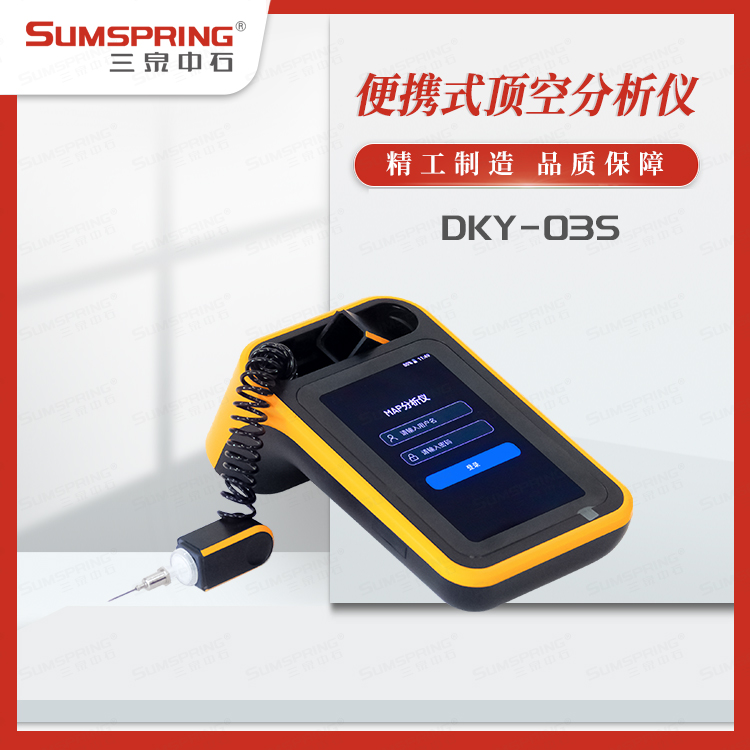
2、 Why choose the handheld headspace gas analyzer DKY-03S from Sanquan Zhongshi? ——Significant improvement in detection efficiency and on-site adaptability
In pharmaceutical quality control laboratories, sterile workshops, or production lines, it is sometimes necessary to randomly inspect a large number of ampoules.
Traditional residual oxygen meters have a large volume and are inconvenient to use on site. The DKY-03S ampoule headspace gas (residual oxygen) analyzer of Sanquan Zhongshi has been optimized for these pain points.
1. Complete all tests on a single machine without the need for auxiliary equipment
The entire process of sampling, pumping, and testing is completed by instruments in one go, greatly reducing equipment dependence.
2. Handheld structure, suitable for laboratories and production sites
Small in size and light in weight, it can be easily carried for sampling and is also suitable for on-site verification of packaging processes.
3. Android system+5-inch high-definition display screen
The operation interface is clear and intuitive, and data viewing and retrieval are very convenient.
4. Powered by lithium batteries, with strong endurance and fast charging
5. One click calibration, fully automatic testing
6. Wireless data transmission, easy to operate
7. Short measurement time and small sample size
This is particularly crucial for smaller packaging such as ampoules, reducing the impact on samples and improving detection efficiency.
3、 Example of testing process: How to conduct residual oxygen testing on ampoules?
Prepare samples and wipe the bottle body to ensure no external contamination.
Insert the sampler into the headspace of the ampoule
Start the instrument and extract the headspace sample gas to the sensor.
The instrument automatically monitors the stable signal output of the sensor.
After the value stabilizes, the instrument automatically records the residual oxygen content and stores the data.
The data can be viewed on-site.
Using the DKY-03S ampoule headspace gas (residual oxygen) analyzer from Sanquan Zhongshi, the entire testing process is fast and efficient.

4、 Why is residual oxygen detection particularly important for ampoules?
Evaluate packaging sealing: High residual oxygen indicates the possibility of slight leakage in the seal.
Verify process stability: The effectiveness of filling, sealing, and nitrogen extraction processes needs to be validated through residual oxygen levels.
Ensure drug stability: Oxygen exposure must be strictly controlled for oxidative sensitive injections.
Ampoule residual oxygen detection is not only an indicator of quality management, but also a core manifestation of the safety of the entire packaging system.
5、 Sanquan Zhongshi provides a more comprehensive packaging and testing solution
As a research and manufacturing enterprise specializing in packaging material testing instruments, Sanquan Zhongshi provides integrated solutions from sealing, mechanical properties to integrity verification for the pharmaceutical packaging field with independent technology and rich industry experience.
The DKY-03S ampoule headspace gas (residual oxygen) analyzer for Sanquan Zhongshi is just one of them.
For enterprises involved in various systems such as glass packaging, pre sealing, and soft ampoules, Sanquan Zhongshi can provide professional and highly stable testing equipment and standardized support.